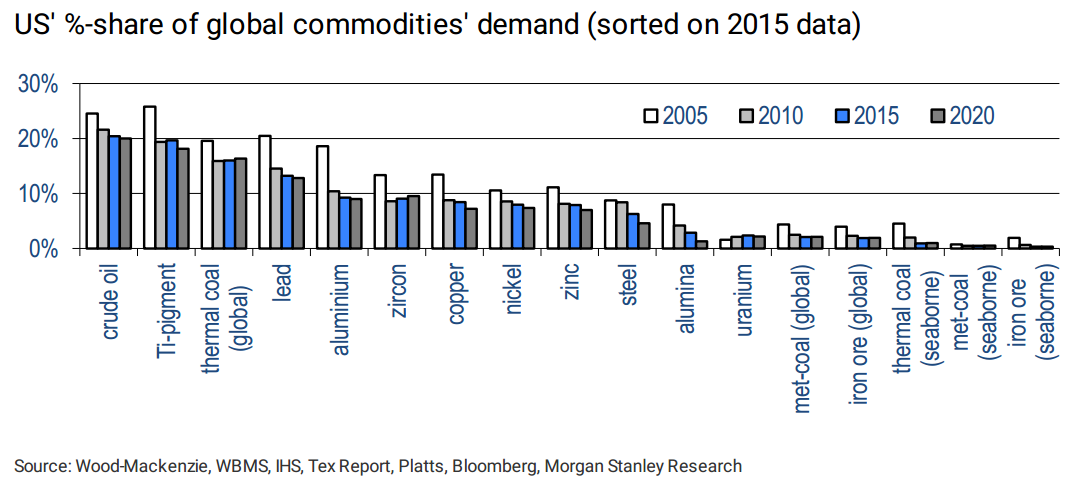
The next US president proposes to rebuild the nation’s infrastructure. It’s a big economy, so this is probably bullish for metal/rock trades. But what’s the likely demand upside? Election shock passing: Commodity prices are normalising now, mainly via currency adjustments – after a week-or-so of an inflation risk-prompted, USD-led,general re-rate – since Mr. Trump won the election (metal&ROCK: Election whipsaw, 14- Nov-16). But what of this new-found US commodities demand growth story? No one really knows the nature, scale or time frame of Mr. Trump’s proposed rebuild event. Still, at least we’ve got a base line for US consumption…
US vs. the World: The US economy currently consumes up to 20% of the world’s total metal and ore supply. Ithas long-been a major broad-based commodity consumer:energy, metals & bulks. Indeed, before China fully engaged global trades a decade ago, the US was the biggest buyer. As a carbon-fired, automobile-dependent, mature economy – possessing the world’s largest coal reserves – the US remains heavily dependent on oil, lead (auto-batteries) and coal. Note though,any large lift in demand growth for these particular commodities can probably be met by domestic supply (Making Steel Investable Again; Upgrading X, AKS,and CLF, 14-Nov-16). Good for US-centric exposure, but again: where’s the ‘Trump-based’upside for commodities worldwide?
The full text of this article is available to MacroBusiness subscribers
David Llewellyn-Smith is Chief Strategist at the MB Fund and MB Super. David is the founding publisher and editor of MacroBusiness and was the founding publisher and global economy editor of The Diplomat, the Asia Pacific's leading geo-politics and economics portal.
He is also a former gold trader and economic commentator at The Sydney Morning Herald, The Age, the ABC and Business Spectator. He is the co-author of The Great Crash of 2008 with Ross Garnaut and was the editor of the second Garnaut Climate Change Review.