It has been an interesting few weeks for the coal markets. Thermal coal has finally sold off, with the forward curve dropping $15–20/t since 7 November, while coking coal has remained strong, with spot HCC prices up $10–15/t over the same period. These moves were in line with our thoughts published at the start of the month, predicated on evidence that, unlike coking coal, thermal coal supply was increasing materially.
Last week saw the announcement of new production-loosening measures in China. There is uncertainty on the quantitative impact, but this relaxation is certainly more ‘coking coal heavy’ than the previous ones, and we should expect more production to come to market. On top of this, Chinese coking coal producers are now signing term deals with steel mills that should ease buyer panic, while supply disruptions at Anglo’s Grasstree and South32’s Appin HCC operations have been resolved. As a result, we expect spot HCC prices to start easing, although the process might be more gradual than the recent thermal coal fall, and one should expect a large QoQ increase to the 1Q17 HCC contract.
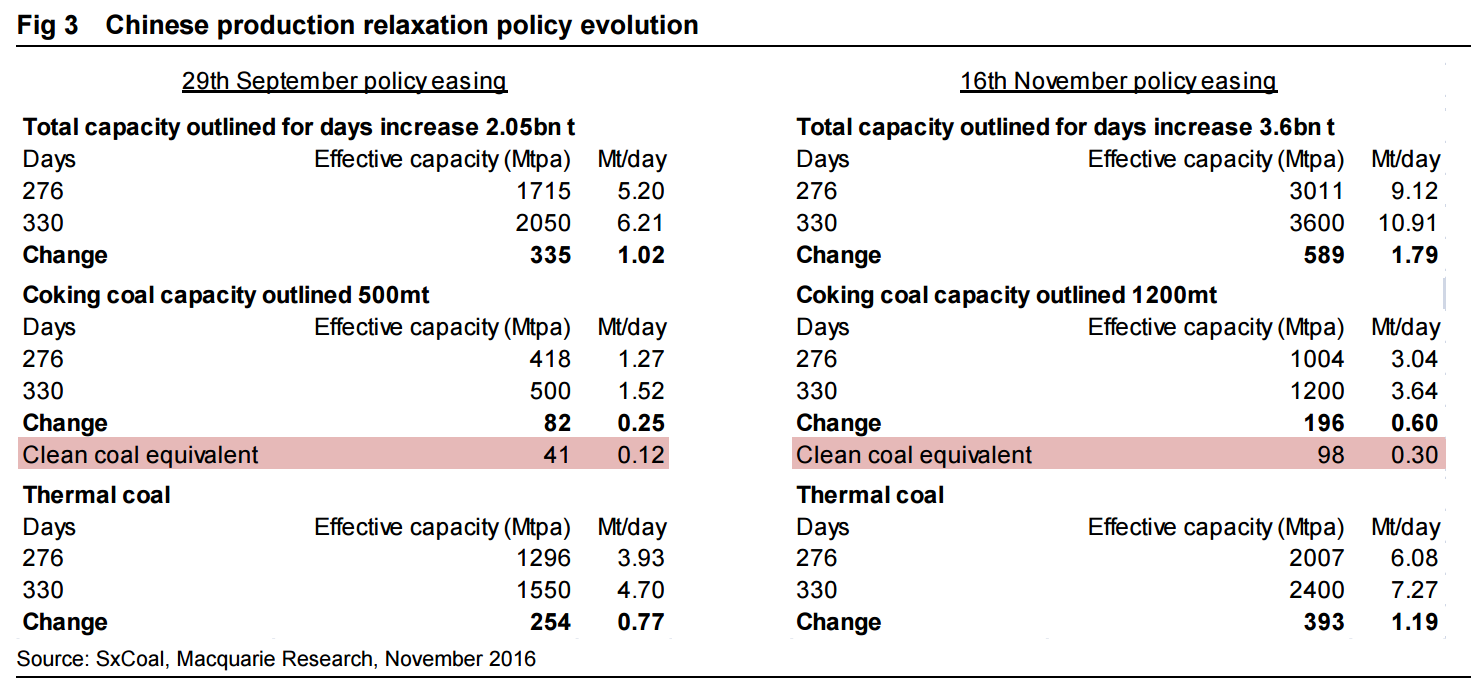
The relaxation of Chinese coal production controls is critical to normalising both the thermal and coking coal markets. There have been three key meetings held by the NDRC since September at which policy decisions were made to boost domestic production.
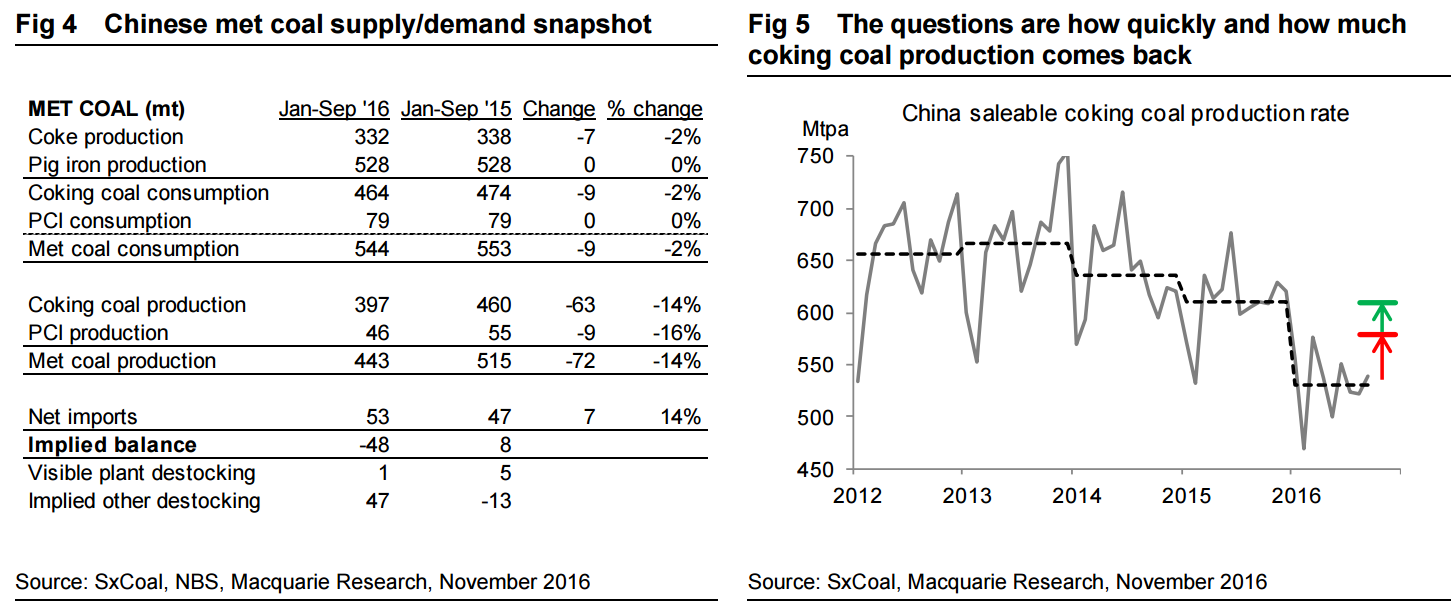
The implication is that we will see a large amount of coking coal production come back to market – in a best case, everything that was lost could come back. Fig 5 shows the implied production return based on the 29 September policy (red line) from September’s production level and then the extra amount of production required to get back to last year’s average run rate (green line). This is less than the 16 November incremental increase outlined in Fig 3, since September clean coal output was already ~30mt higher than that suggested by strict implementation of the 276-day policy.
The judgement then becomes – how much of this released capacity will actually produce and how quickly? On our China commodities tour held last week, our takeaway was that a coking coal production increase would be slower than thermal coal due to the complexity of its mining and greater safety issues, and also the fact that the share of SOE mines in the coking coal industry is lower than in thermal coal, with private miners more reluctant to bring back production on a lack of confidence in government policy and coal prices for next year.
But even if we only get a proportion of the lost production back, there are other factors that suggest coking coal tightness should start to ease.
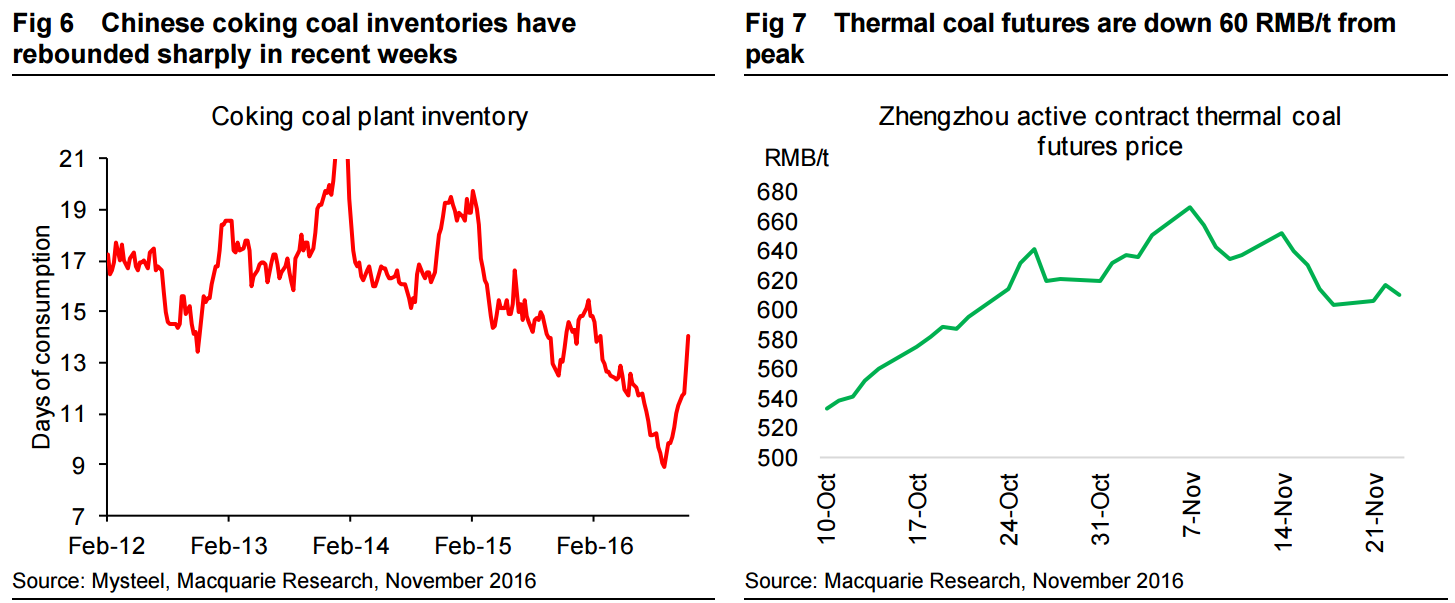
Low stocks and, hence, panicked buying activity were clearly a major driver of both the thermal and coking coal rallies. Coking coal inventories have rebounded sharply over the past few weeks and are now only just shy of long run average levels. In addition, major Chinese coking coal producers are in the process of signing term deals with steel mills. When similar deals were signed in thermal coal a couple of weeks ago, the sense of buyer panic eased.
Secondly, HCC has been much tighter than the SSCC/PCI markets following Australian supply disruptions. These have now been resolved at both Anglo’s Grasstree and South32’s Appin, which are major suppliers of premium material. Unlike thermal coal, coking coal demand is seasonally weakest through the northern hemisphere winter.
So we think spot seaborne coking coal prices will start to soften but do not expect the adjustment to be as fast as that seen in thermal coal. And a modest softening of coking coal spot prices still suggests a large QoQ increase to the 1Q17 contract price.
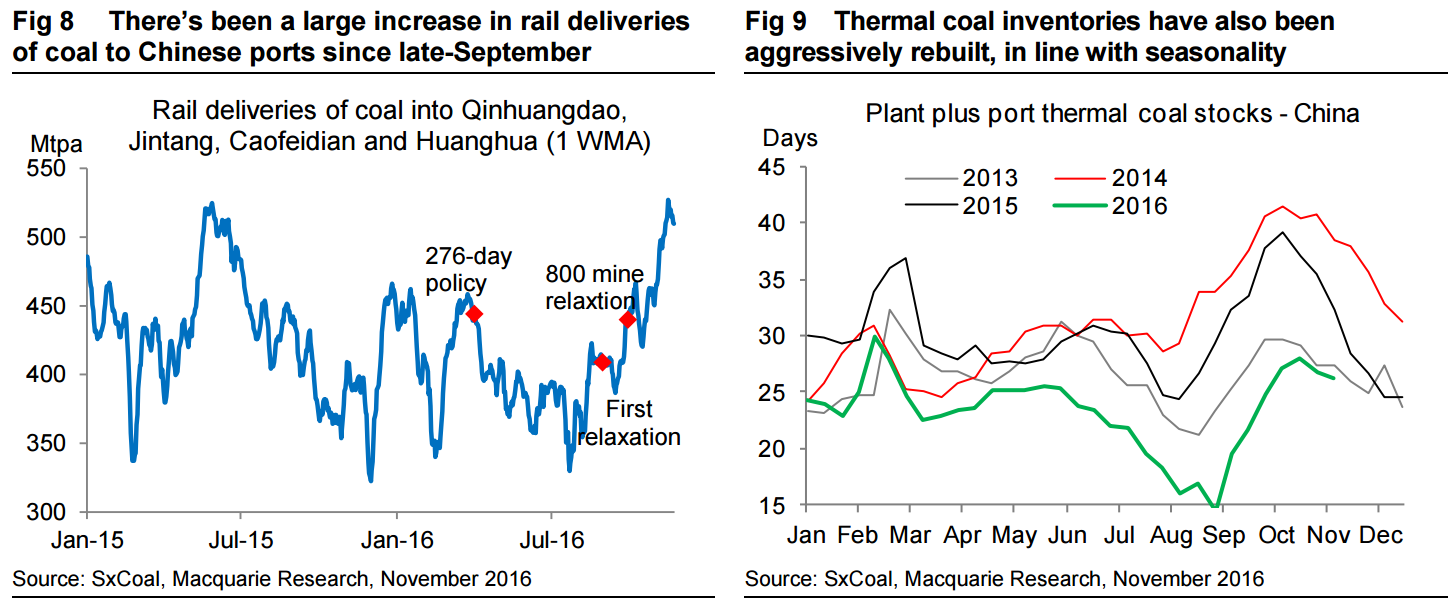
Turning to thermal coal, we have seen a $15–20/t fall in spot seaborne prices over the past two and a half weeks. This has been a function of greater domestic supply availability, as illustrated in very strong railings of coal into China’s northern transhipment ports. Inventories have been rebuilt in line with usual seasonality, and although they remain below 2014/15 levels, they are comfortable.
It has been reported that Chinese power plants are closing import books following the signing of annual contract terms with major producers, and we would expect thermal coal supplies to continue to get rail priority over other cargoes through the winter. Not only was production relaxation, until last week, much more focused on thermal, but increasing production back up to 330 days was more feasible for these mines. We look for further downside to thermal coal pricing from here and look at 535 RMB/t (~$70/t FOB Newcastle) as guidance for a pricing level that the government is happy with. This is the price at which annual terms were settled, albeit with an index linkage component.
I still expect full normalisation of bulk prices by mid next year.
David Llewellyn-Smith is Chief Strategist at the MB Fund and MB Super. David is the founding publisher and editor of MacroBusiness and was the founding publisher and global economy editor of The Diplomat, the Asia Pacific's leading geo-politics and economics portal.
He is also a former gold trader and economic commentator at The Sydney Morning Herald, The Age, the ABC and Business Spectator. He is the co-author of The Great Crash of 2008 with Ross Garnaut and was the editor of the second Garnaut Climate Change Review.