
The National Party of Western Australia’s proposed new tax on iron-ore could cost Australia about 13 500 jobs and will shrink the economy by about A$2.9-billion a year.
Commissioned by the Minerals Council of Australia (MCA), a research study by Deloitte Access Economic has found that the proposed tax will cost 2 900 jobs in the Pilbara, 3 400 in the broader West Australian economy and 7 200 jobs nationally.
Western Australian Nationals leader Brendon Grylls has proposed the tax, which will impose a A$5/t levy on iron-oreproduction from the Pilbara, with the aim of raising A$7.2-billion in state funds. Currently, iron-ore miners pay 25c/t.
Mining majors Rio Tinto and BHP Billiton, which rejected the proposed tax, have also warned that it will place jobs and competitiveness at risk.
The Deloitte report found that the A$2.3-billion-a-year tax will shrink the size of the economy by more than the revenue it will raise, and found that the proposed tax would lift the production costs of some Australian iron-ore producers without affecting their domestic and foreign competitors.
The impact will see the Australian economy eventually shrink by A$2.9-billion a year.
MCA CEO Brendan Pearson pointed out on Monday that the Western Australian economy would be the worst affected, with the report saying that over the longer term, the state would ultimately suffer the majority of the economic cost, while only receiving a small share of the benefit from additional government revenues.
“The tax will raise little revenue for Western Australia. After allowing for resultant losses in goods and services tax grants under the financial arrangements between the commonwealth and the states, the revenue for Western Australia will be less than A$300-million a year,” Pearson said.
“This report shows that any revenue gain will be swamped by the loss of jobs and growth and the damage to Western Australia’s reputation as a place to invest.”
The report noted that the Pilbara economy would be 4.8% smaller than it would otherwise be, with a 4.3% reduction in employment, while the national economy would also contract, with Deloitte estimating national gross domestic product falling by 0.17% with the loss of 7 200 jobs.
Furthermore, the report has denounced claims that iron-ore miners were not paying their fair share of tax, pointing out that the tax ratio in the minerals sector is currently close to 50%.
Obviously we need a code of conduct for economists in this ‘gun for hire’ business.
Nonetheless, it’s possible that over the long term that this study will prove right. As I’ve argued all along, $5 is too high given it would place the majors alongside Vale:
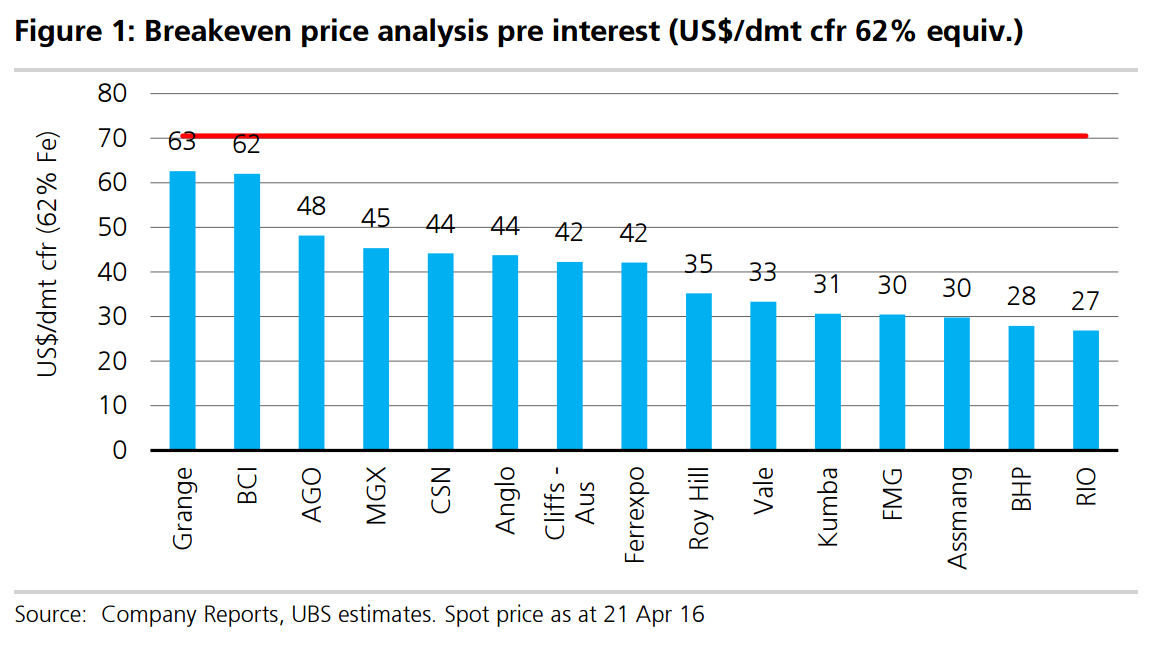
So investment could be at risk. $2.50 per tonne is more reasonable.
As for paying 50% tax why is that enough? The majors are now making above 200% margins:
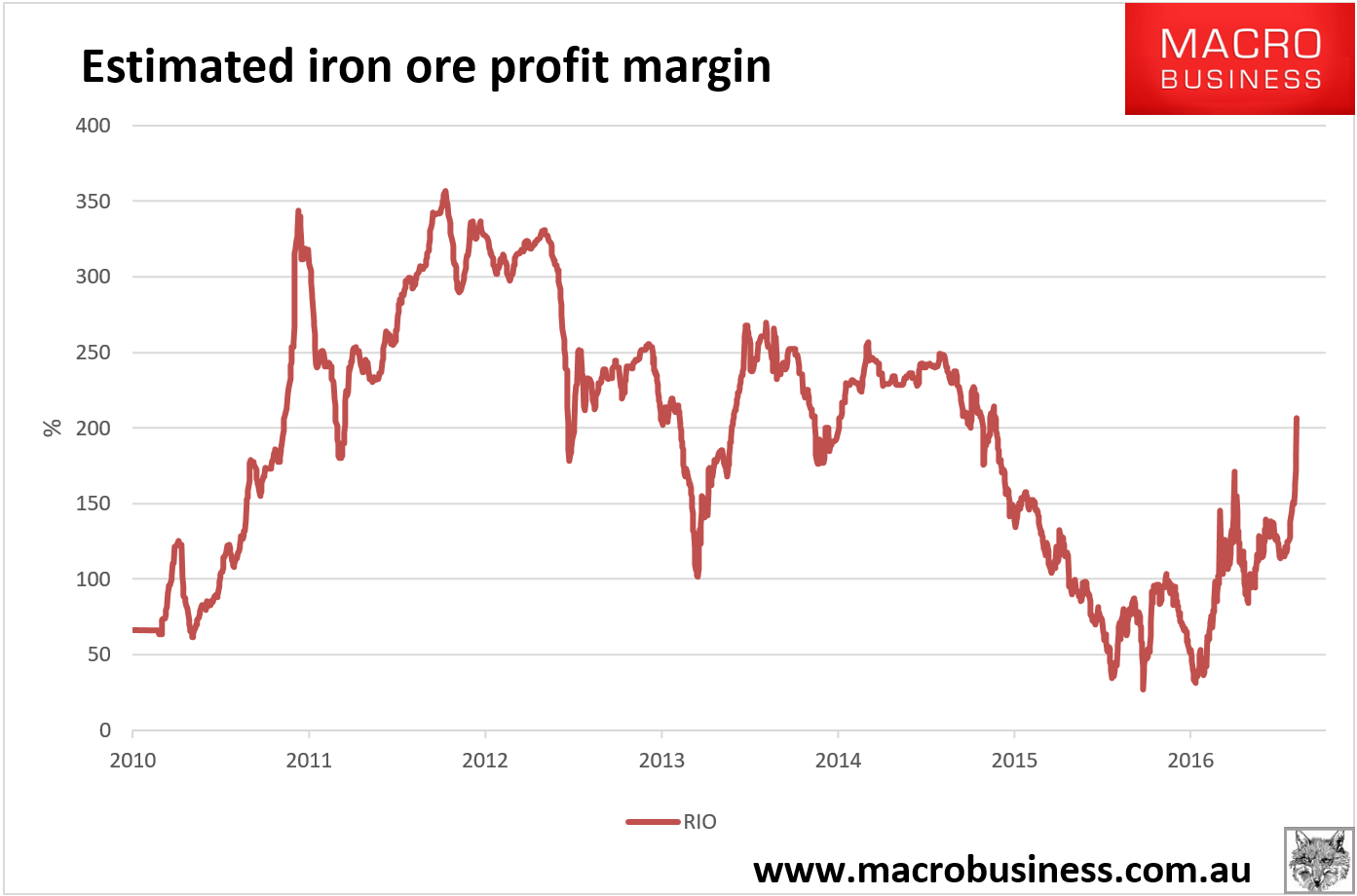
These are super profits and the people of Australia are being reamed for the privilege of developing their dirt. Remember that this is a non-renewing natural resource owned by the people of WA and Australia. It’s depleting nature needs to be reflected in the revenue being received by them and us. The tax take should be more like 80% (not kidding) such as it is in Norwegian oil.
By the same token, Mr Grylls should also commit to paying down debt with the windfall (or invest it strictly in infrastructure or an SWF). If the debate is about equity over generations then the revenue should be accordingly distributed over time.
Needless to say, the MCA and the big miners must be wondering at their bad luck with the iron ore bubble making their arguments about mine closures look ridiculous. They find themselves in the peculiarly Australian situation of cyclical bounty threatening structural damage. The irony!
