Straya is not the only place under pressure from Chinese economic imperialism via the FT:
A Congressional panel has urged the US’s next president to put curbs on Chinese investment in American entertainment, internet and media assets in response to trade barriers in the world’s second-largest economy.
In its annual report, the bipartisan Congressional-Executive Commission on China said the US needed to “address potential trade barriers in China, including ongoing and persistent restrictions on the free flow of news and information which affect foreign media companies attempting to access the Chinese market”.
Chinese censors block access to US internet companies such as Facebook and Twitter. The websites of media organisations such as Bloomberg, the New York Times and Wall Street Journal have also been blocked in recent years, forcing them to scale back investment in Chinese-language sites aimed at the country’s more than 700m internet users.
Chinese companies, meanwhile, are on track to spend more on outbound mergers and acquisitions than their US counterparts and have been snapping up assets in entertainment and other sectors barred to foreign investors in China.
As a result, the commission said the US government needed to consider whether “market access for Chinese investors in news, online media, and the entertainment sectors [should be] conditioned on a reciprocal basis in order to provide a level playing field for US investors”.
The commission, whose recommendations are not mandatory, was established after China formally entered the World Trade Organisation in December 2001, guaranteeing it access to the US market on the same terms as other members. Before China’s accession, Congress voted each year on whether or not to apply WTO-standard tariffs to Chinese imports.
Most of the commission’s annual findings and recommendations focus on the Chinese government’s human rights record, of which it is extremely critical. The commission accused President Xi Jinping of overseeing a “deterioration in human rights and rule of law conditions marked by greater consolidation of his own power … through forced ideological conformity and the systematic persecution of human rights lawyers and defenders”.
China’s foreign ministry was not immediately available for comment. It routinely rejects such criticism and issues an annual report of its own listing the US government’s alleged human rights failings.
Shame we don’t do the same instead of selling our souls. Let’s recall some recent examples. Canada is agonising, from New York Times:
TORONTO — Canada’s prime minister, Justin Trudeau, is due in China on Tuesday for a much anticipated visit, hoping to reset what had been an up-and-down relationship under the previous government. Closer ties, Mr. Trudeau says, would release untapped prosperity at home and promote Canadian values like good governance and the rule of law in China.
But many Chinese-Canadians say the opposite is happening. They say the growing economic clout wielded in Canada by China, Canada’s largest trading partner after the United States, is leading to an erosion of their own freedom — specifically their freedom to speak openly about China’s authoritarian state. Journalists who write for the many Chinese-language publications in Canada, along with activists and others, say they are under increasing pressure to promote the interests of the Chinese government.
“It’s gotten worse and worse,” said Jonathan Fon, 67, a Toronto paralegal, freelance writer and critic of China’s Communist rulers. Mr. Fon, who emigrated from China in 1992, said publications that had once printed his opinion articles now routinely rejected them because of worries about political and financial fallout. “They will not take my contributions, even though we’re friends,” he said.
In the past decade, China has embarked on an ambitious effort to promote its image abroad, including a multibillion-dollar overseas expansion by Chinese state media and a network of Confucius Institutes, which teach Chinese language and culture while disseminating the Communist Party’s viewpoints. In Western countries, analysts say, the party exerts influence over Chinese immigrants and students through embassies, consulates and community organizations, as well as business interests with the financial leverage to shape local Chinese-language media coverage.
“China is not shy about using overseas Chinese communities to advance its interests abroad,” said Minxin Pei, an expert on Chinese politics at Claremont McKenna College in California. “What’s brilliant about the Chinese government’s interest strategy is that it exploits the freedoms of Western democracies against Western democracies.”
A Chinese writer said he had lost his column in the Global Chinese Press, based in British Columbia, after the newspaper was pressured over his criticism of Mr. Wang and Mr. Chan, according to a report in The Globe and Mail. A Chinese-Canadian freelancer in Toronto who uses the pen name Xin Feng received death threats online for chastising Mr. Wang in a column.
A year ago, the editor in chief of a Chinese-language newspaper in Ontario said she had been fired for publishing a commentary critical of Mr. Chan. She blamed that, in part, on complaints from the Chinese consulate in Toronto.
In Ontario, which includes Toronto and its suburbs, Chinese-language journalists and media executives say self-censorship has become widespread because of the economic pressures on their outlets. They fear boycotts by pro-Beijing advertisers and the loss of distribution deals with Chinese state media publications.
Ontario has more than 30 Chinese-language news outlets, mostly free newspapers, and the majority of them appear to avoid reporting that would anger China’s leaders.
Jack Jia, 54, the publisher of the Toronto-based Chinese News Group newspaper and website, said China’s influence had “grown stronger and stronger” in recent years. “They want to control everything,” Mr. Jia said.
Today, he said, as immigration from China has soared, Chinese officials have gained more leverage. “They can threaten, because most media employees have family back in China,” Mr. Jia said.
A Chinese-language reporter in Toronto, who asked not to be identified in order to protect her job and her relatives in China, said her editors now regularly deleted quotations that were critical of Beijing, and reviewed article ideas specifically to head off coverage that might reflect poorly on the Chinese government.
Activists in Canada critical of Beijing have found themselves targets for intimidation. Not long after Zang Xihong, 54, a prominent Chinese human-rights activist, emigrated to Canada 27 years ago, she said, she began receiving menacing phone calls from Chinese state security agents at her home in the Toronto suburbs.
Ms. Zang said the Canadian authorities had told her that they could take no action because most of those activities were protected free speech, leaving her powerless, she said, to escape the long arm of the Chinese government or its supporters.
“When I fled from China, I suddenly realized they are here already,” she said. “Where else can I go?”
Good question.
Advertisement
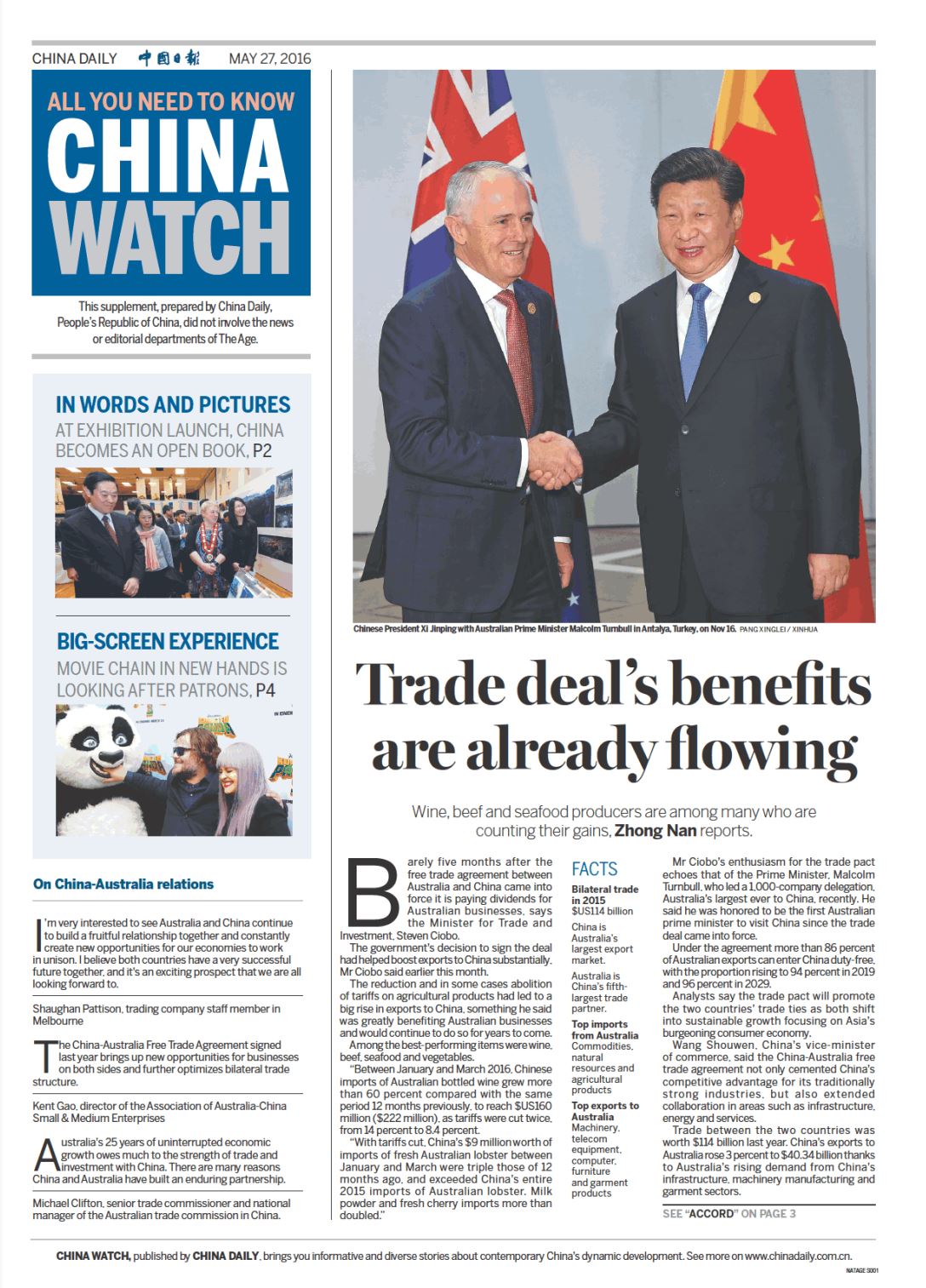
Of course it will be as bad in Australia as it is in Canada the only difference being that our media is already so horribly corrupted that it wouldn’t care, so we don’t know. The recent deal to directly print Chinese propaganda at Sinofax being a case in point, from the ABC:
Times are tough, especially for newspapers and we can only assume that’s why Fairfax Media has recently agreed to take money from the Chinese for spreading their propaganda.
It also reflects, of course, how hard it is to make money in the media nowadays.
Ten days ago readers of The Age, Sydney Morning Herald and Financial Review received this lift-out in their print editions.
Which came with the tell-tale admission that it was … prepared by China Daily, People’s Republic of China…And that its production: … did not involve the news or editorial departments…of the respective mastheads.
But then if you already sold your principles to a real estate agent, what matter if it is Aussie or Chinese?
David Llewellyn-Smith is Chief Strategist at the MB Fund and MB Super. David is the founding publisher and editor of MacroBusiness and was the founding publisher and global economy editor of The Diplomat, the Asia Pacific's leading geo-politics and economics portal.
He is also a former gold trader and economic commentator at The Sydney Morning Herald, The Age, the ABC and Business Spectator. He is the co-author of The Great Crash of 2008 with Ross Garnaut and was the editor of the second Garnaut Climate Change Review.