
From The West Australian:
Rio Tinto’s iron ore boss has warned WA Nationals leader Brendon Grylls’ mining tax plan would “severely undermine” the giant’s business and wipe out recent efforts to cut costs.
In an update sent to senior Rio managers, the miner’s iron ore chief executive, Chris Salisbury, said the proposal to increase the so-called production rental fee from 25¢ per tonne — the price struck when original State Agreements were signed in the 1960s and 1970s — to $5 a tonne would add $1.5 billion a year to the company’s costs.
“Through all your hard work in driving improvements we have taken three years to remove $1.2 billion of cash cost from our business,” Mr Salisbury wrote.
“The WA Nationals tax would undo all that effort in one hit and require us to find this amount, and more, each and every year.
“I am seeing some great team initiatives in our cost reduction and productivity pipelines, more than 1000 identified to date. I’m impressed by the decisions you are making and the ambitious improvement plans you are taking on, with each contributing to our required plan for 2016 and beyond.
“However all these initiatives come nowhere near combating the impact of the WA Nationals tax proposal; it is difficult to imagine what further cost and productivity improvements would be required to deal with an extra $1.5 billion in annual costs.”
Mr Salisbury said the suggestion miners could pay more ignored the fact that earnings, after providing a return to shareholders, were invested back into the Pilbara to sustain operations.
He cited the announcement in August of a $US338 million commitment to expand the Silvergrass mine, a project the company says will sustain 500 jobs during construction, that could be threatened if the tax plan goes ahead.
Would the Silvergrass mine still be profitable? Why, yes, yes it would. Immensely so. In fact, even if RIO paid the full $5 at today’s prices the Silvergrass mine would contribute to iron ore margins that would remain at 96%:
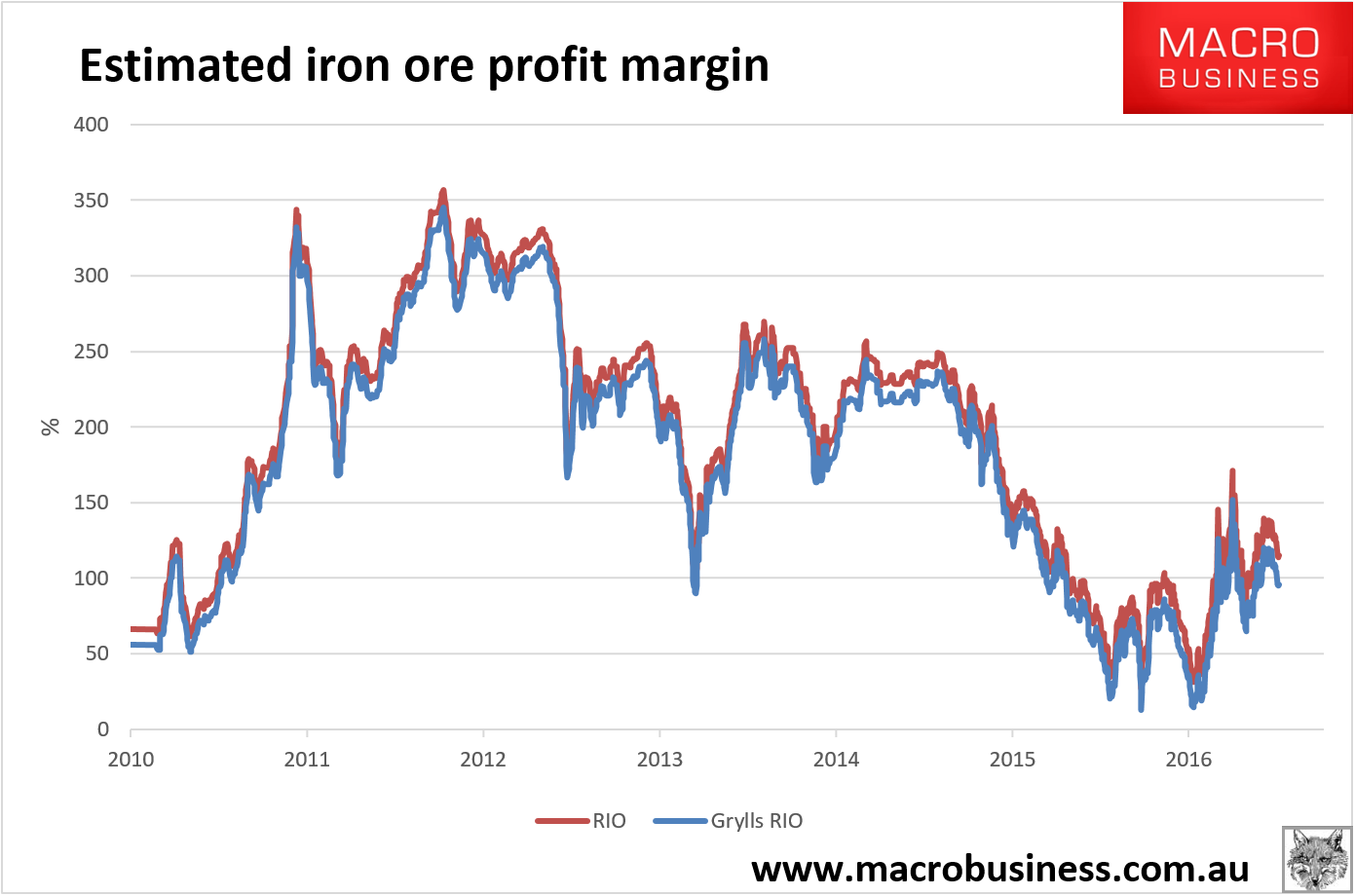
Yes, 96%. Even at its absolute worst price in recent times, RIO’s margin would not have sunk below 13% even with the increased Grylls levy. These are super returns in today’s low interest rate world. There’ll be no more job losses than there would be otherwise.
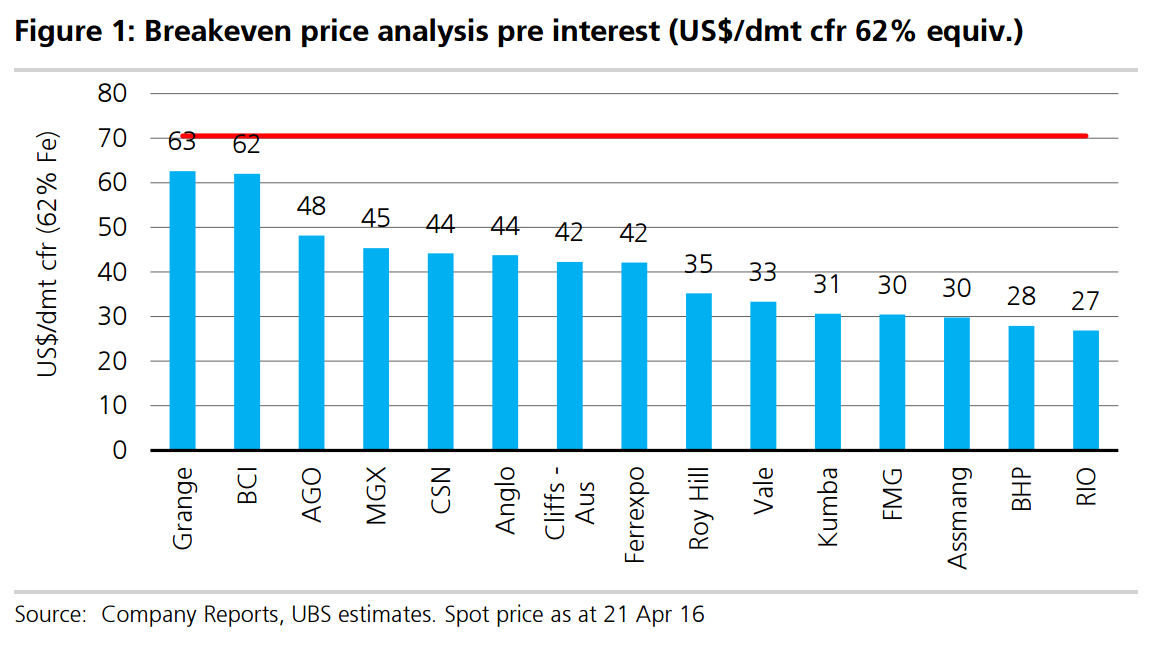
I acknowledge that we are in a market share war so there is a high risk that prices will fall again and much more volume will need to come out of the seaborne market. Some of it will eventually be from the majors too. That’s why I argue that the Grylls charge is too high. $2.50 would better. The amount should be calibrated so that BHP’s and RIO’s competitiveness is not adversely impacted causing them to lose volumes (and therefore investment). That level is more like $2.50 per tonne than the proposed $5 which would put them on par with Vale, from UBS:
However, margins as they are “economic rents” and the people of Australia are being reamed for the privilege of developing their dirt. Remember that this is a non-renewing natural resource owned by the people of WA and Australia. It’s depleting nature needs to be reflected in the revenue being received for their development.
I would like to see WA Nats also commit to paying down debt with the windfall (or to invest it strictly in infrastructure or an SWF). If the debate is about equity over generations then the revenue should be accordingly distributed over time.
The RIO whinge is, as usual, pure rent-seeking.
