
Earlier this week, Fortescue mounted a public relations blitz at the FT:
Fortescue Metals Group has dismissed concerns about oversupply in the iron ore market, taking the view that a prolonged commodity crash is finally giving way to a cyclical upturn.
“We think there is stability in demand in China, and most of the new large volume supply has already come on to the market,” said Nev Power, Fortescue chief executive. “The commodity market is cyclical and there is no reason to expect we won’t see a continuation of that.”
…Mr Power said some forecasters were overestimating the speed at which new supply would materialise.
“The iron ore market over the last while has been in supply-demand balance and for every new tonne of low-cost supply that comes on to the market, we have seen high-cost supply exit,” he said.
He said long-term iron ore demand and therefore the price of the commodity would be determined by Chinese economic policy and the rate of growth in emerging economies across Asia: “The demand side will be much more important than new supply.”
Rubbish. There are 200mt of new supply coming in the next four years. Moreover, 50mt tonnes of it is going to arrive in H1 2017 from Vale and Roy Hill.
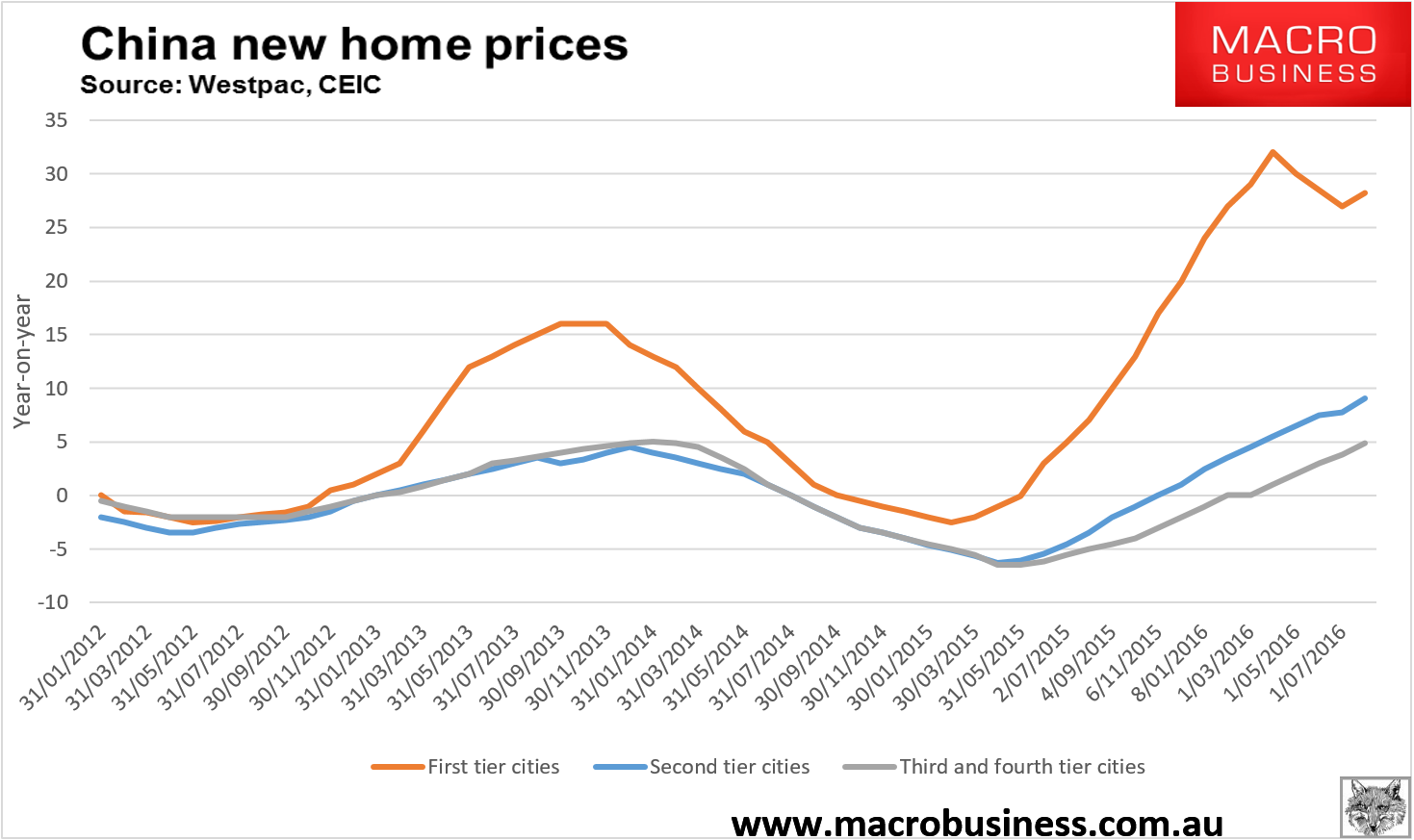
Chinese policy is also swinging against FMG as authorities use macroprudential to tighten on runaway top tier city house prices. The history of such prudential measures in China suggest limited efficacy versus interest rate tightening but they do work to slow prices rises significantly, as we are already seeing in place like Shenzhen which have seen growth tumble from 65% per annum to 12% recently and still falling:
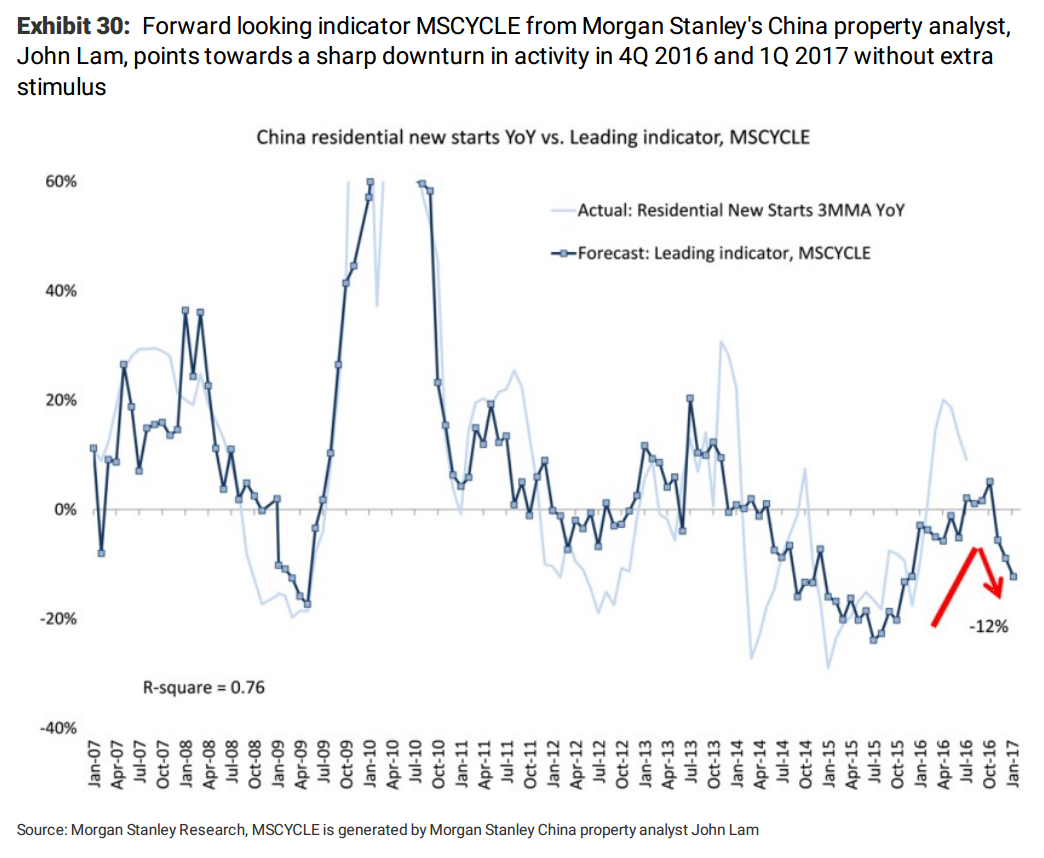
More to the point, such price slowing will derail the the construction boomlet which has also predominated in top tier cities. The Morgan Stanley dwelling construction leading index is already capturing this:
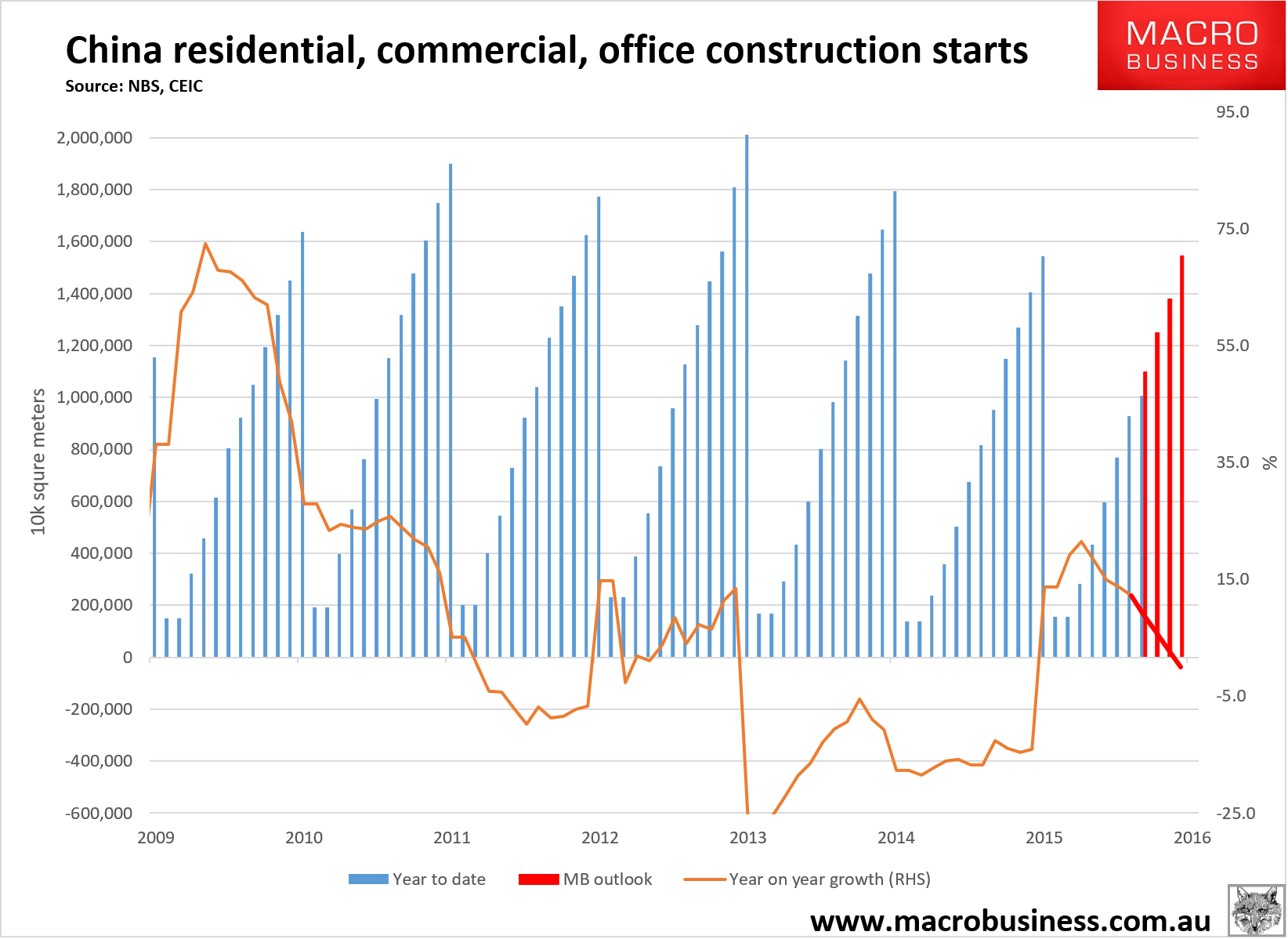
By year end I expect housing starts will be flat to falling:
It is my view that the Chinese plan, such as it is, is to allow house prices to run in lower tier cities (to the extent that that will aid in destocking the enormous inventory overhang) while containing the blowoff in higher tiers. They’ll also be looking to promote a consumption wealth effect by extending the cycle at lower rates of growth in aid of “rebalancing”.
That means the construction cycle in the top tiers is going to wind down and it will not be picked up in lower tiers. There will be more infrastructure spending to support growth but it will not be enough to offset the housing pullback in terms of net construction. Most importantly, the entire balancing act looks likely to sustain enough momentum that another big credit pulse will not be necessary.
As Goldman shows, the sensitivity of iron ore to Chinese property is very high:
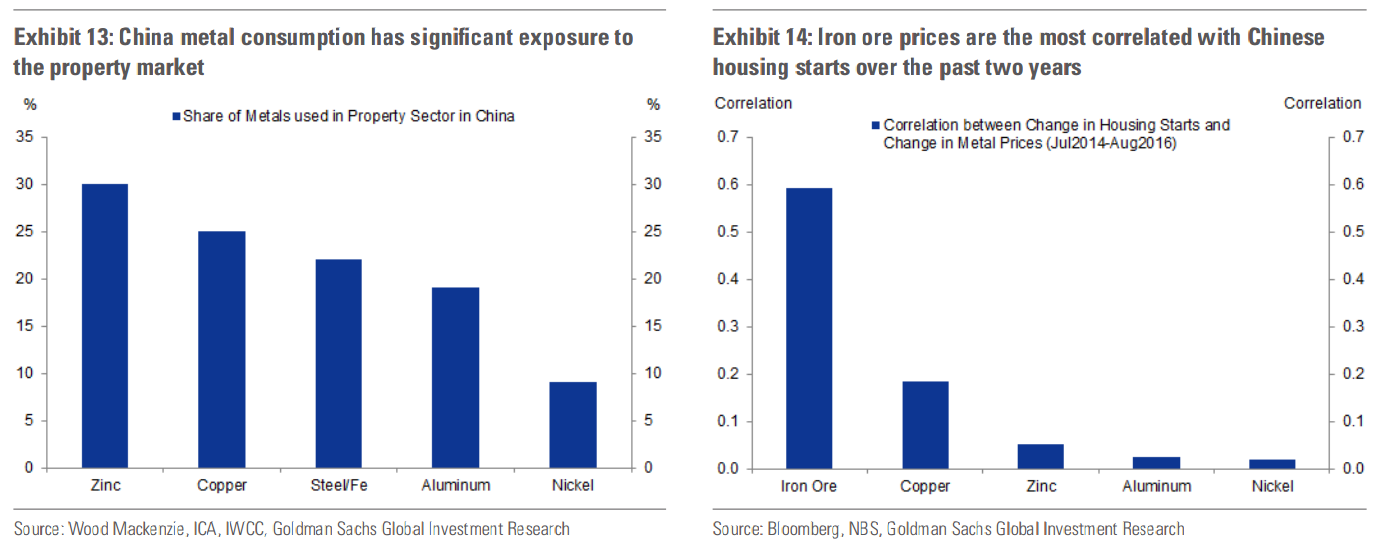
So, demand is going to come off just as supply ramps up.
Then there is Chinese steel mill margins which are under pressure from cooking coal even before we get to any demand hit:
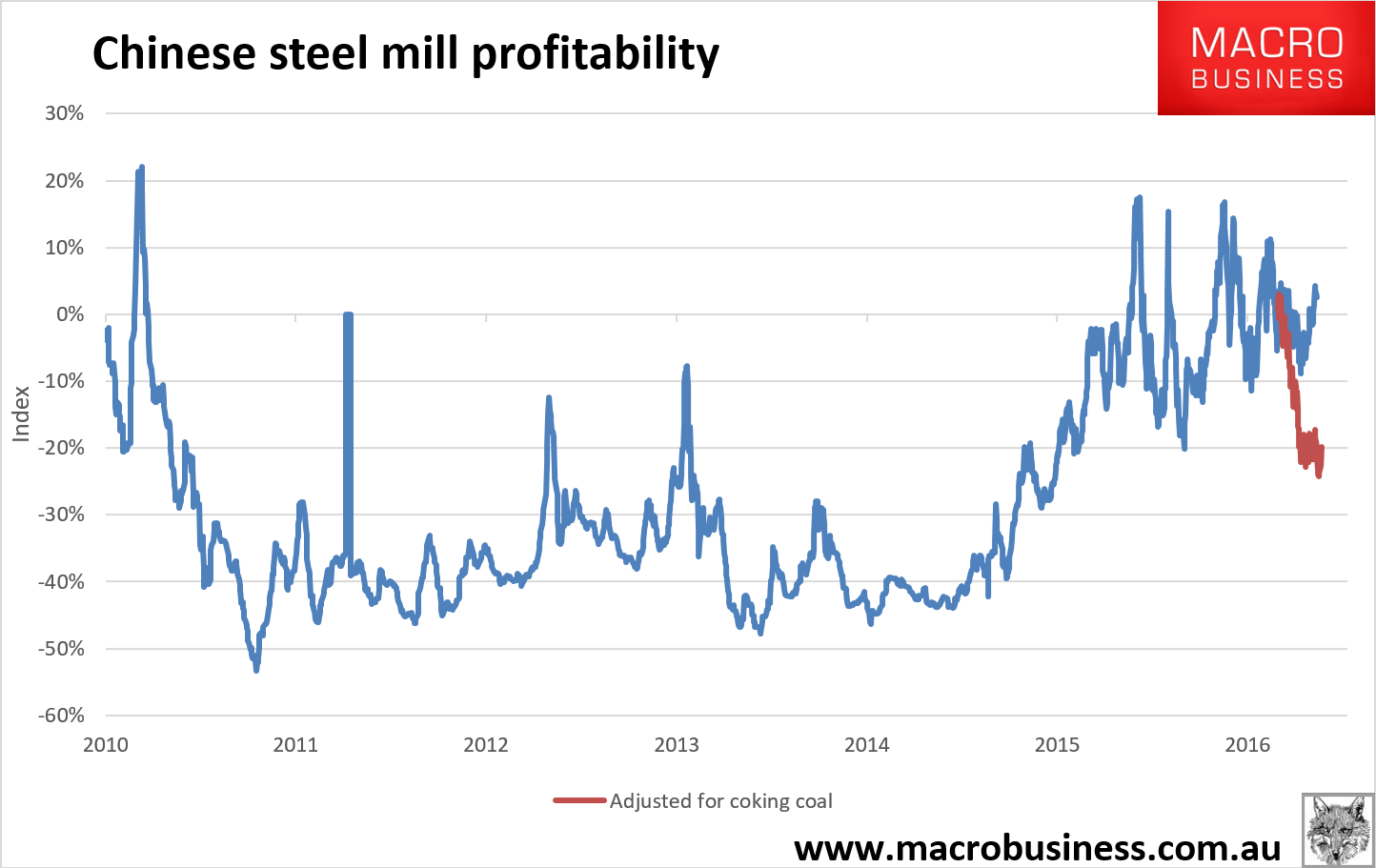
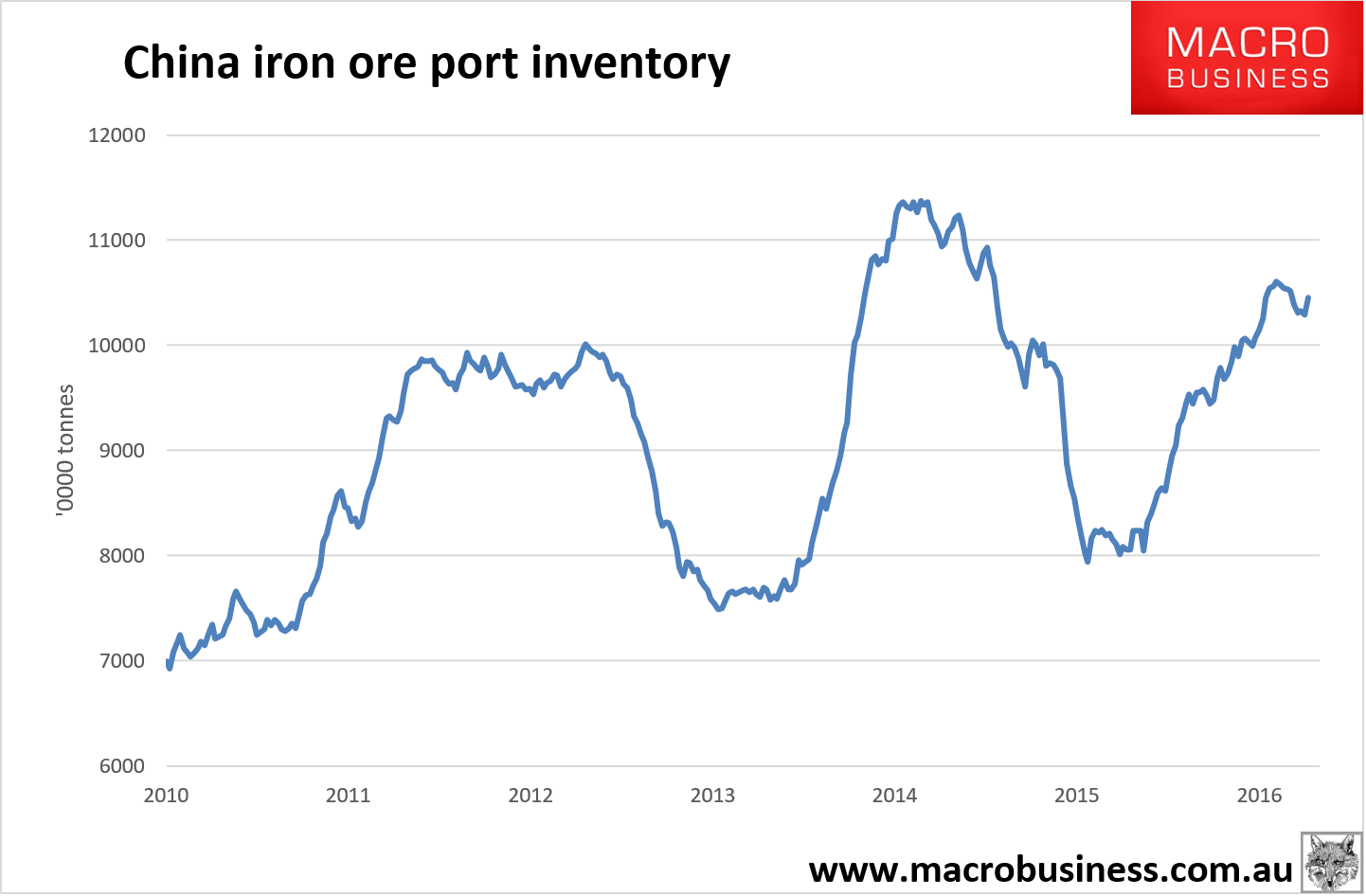
I do not expect the coking coal squeeze to fully diminish for six months so mills are going to have to destock iron ore of which there is plenty sitting at ports:
We are already seeing the leading edge of this in India, from Goa.com:
Panaji: The lackluster demand for low-grade ore is going to be a dampener for iron ore mining in the new season, said mining companies on Tuesday. The companies said that demand for low-grade ore has been poor in the international market and that global prices have been weak. It is going to be difficult to achieve volumes in exports with the outlook on demand continuing to remain weak, said sources. Most companies are on the verge of reopening their mines in the new mining season, which commenced on October 1. The recent rainfall has also slowed down resumption of mining activities.However, major mining leaseholders said that they would commence operations soon.The mining companies said that global prices of low-grade ore have fallen because of poor demand from the steel industry, which is facing recession.
The steel industry prefers to use high-grade ore of which there is ample supply in the market. Iron ore-producing nations, such as Australia and Brazil, have upped production and increased the output of high-grade ore. A steep increase in the price of coke is another reason as to why demand for low-grade ore is weak, the companies said. Goa’s mining industry is primarily export driven. Ore that is produced locally is of low-grade and finds no takers from the domestic steel industry. The government expects 70 per cent of leases to be working in the current season of 2016-17. Total production capacity of the leases is 20 million tonne.
This is the ore that competes with Fortescue’s 58% low grade dirt and the discounts to benchmark have leaped to around 21% in recent weeks. There is also the oil rally to hurt FMG’s costs though that will likely be offset by a falling AUD if iron ore does turn down. This year’s exceptional deleveraging will also support it. Sell side analysts are still plumping FMG on the basis of above consensus earnings based upon this year’s iron ore rally. But to me that is ancient history and if the equity market is a discounting mechanism then it is going to have begin pricing worse for 2017 before too long. FMG is still the great iron ore pure play and it ought to track the underlying commodity price over time.
I’m not going to change my iron ore outlook at this stage. I still see a sell down to the low-to-mid $40s before year end then a rebound in Q1. What has changed is my confidence in this outlook has firmed and the likelihood of any renewed Chinese credit surge next year has materially diminished (that said, an incremental pulse is ongoing) so iron ore in 2017 is much less likely to be disrupted to the upside even in the lead up to the leadership change mid-year.
