
How Flufferfax killed the property market (and itself)
From Credit Suisse today:
■ Upgrade to OUTPERFORM (from Neutral): We upgrade REA to OUTPERFORM (from Neutral) following the recent pull back in the share price. We believe that the share price weakness has been driven by lower property market listing volumes, which we see as only a temporary issue that has minimal impact on our longer term REA valuation. This has created a buying opportunity in our view and we expect the share price to re-rate as listings volumes recover.
■ New listings down 7.5% in 1Q17: Data from CoreLogic RPdata shows that new listings volumes were down 7.5% nationally in the 3m to September (vs pcp). We forecast REA revenue growth to have slowed to 16% in 1Q17 (9- 10% ex iProperty), down from 22% in 4Q16. The decline in new listings volumes has eased recently (roughly flat vs pcp in last 3 weeks), although the important Sydney market remains weak. There is no obvious driver of the listings slowdown as property prices remain strong, interest rates are low and unemployment is stable. It appears to just be part of the natural ebb and flow of the property market and we expect volumes will therefore recover.
■ Reduce FY17F EBITDA: We reduce our FY17F EBITDA by 3% to A$407m (vs A$419m previously) to reflect the low listings volumes outlined above. We reduce FY17F ‘core’ NPAT by 3.3% to A$250.5m (vs A$259m previously). We expect the listings volume shortfall to be made up next year and our FY18 forecasts are unchanged.
■ A$61 valuation and target price unchanged: We remain positive on the medium to long term online property growth opportunity driven by price rises and higher depth penetration. REA operates in a large market and we see plenty of opportunity for it to continue to increase its share of the property spend wallet. When REA’s revenue growth has slowed down previously it has signaled a buying opportunity. Our A$61.00 target price is unchanged. Property market volatility is the key risk factor.
Here are the tumbling volumes:
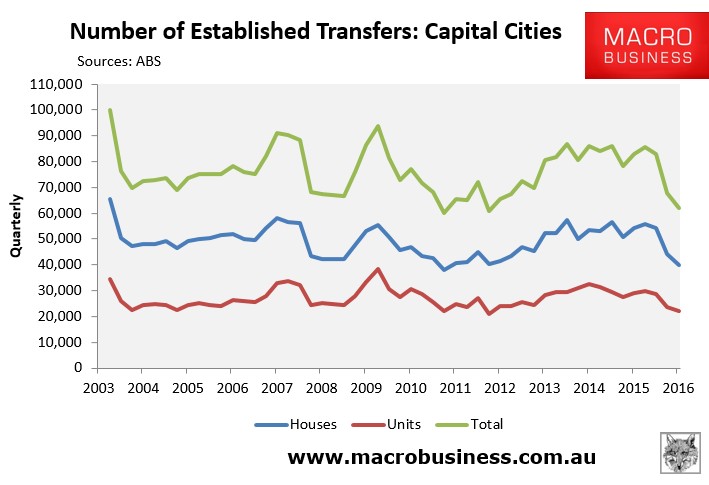
Why have they fallen and will they rebound? CoreLogic explains it:
CoreLogic estimates show settled transaction numbers have levelled over the most recent three months, however, at just under 110,000 settled transactions, sale numbers are down 5.3% compared with the June quarter and are 15.0% lower than the September quarter last year.
In markets such as Sydney and Melbourne where dwelling values are still showing strong growth despite lower volumes, lower transaction numbers are partially due to low advertised stock levels. There are fewer than 20,000 dwellings currently being advertised for sale across Sydney, which is less than half the number of homes that were listed for sale five years ago. Mr Lawless said, “Reduced stock levels create urgency in the market, adding to the upwards pressure on dwelling values”…
“Interestingly, real estate agent activity across CoreLogic platforms, as measured by the CoreLogic listings index, has been tracking higher than a year ago, despite the lower amount of fresh stock being added to the market. Increased levels of agent activity translating into fewer new listings indicates a heighted level of competition amongst real estate agents for listings. Sellers may also be nervous about selling in a strong market, especially with the consequential challenges of buying well in that same market.” …
“Despite the low mortgage rate environment, high transaction costs may also be a disincentive for transacting in the housing market. Due to bracket creep and higher dwelling values, we’ve also seen stamp duty dollar value payments rise substantially. In addition, percentage-based expenses such as agency commission fees for vendors have moved higher as the value of housing rises. It is likely that an increasing number of home owners are weighing up the pros and cons of the costs associated with selling and buying, or, staying where they are. It seems an increasing number, particularly in Sydney, are choosing the latter.”
Contrast this with the ceaseless Flufferfax line that lower listings are driving demand and prices wild. This giant spruik has been pushed relentlessly across the group and we now see the self-destructive fruits of such an editorial policy. If there is a pervasive fear over affordability, and folks are scared they won’t be able to buy back in if they sell, then that is what is preventing people from transacting their properties. Accordingly, Flufferfax is busy killing both the property market and its own volumes-driven Domain listings business.
Well done, you creepy bastards!
