Westpac has released its China Resources Quarterly, which tips that the recent commodity price surge will reverse on the back of weaker demand, rising supply, and a reversal of speculation. Below are some key extracts.
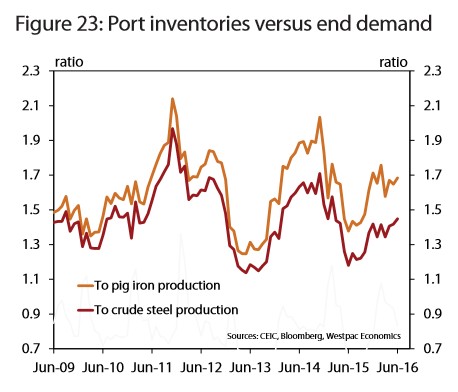
Following the declines of 2014–2015, commodity prices have experienced a sharp rally which has been sustained since the last CRQ. The real demand backdrop; inventory levels; and anecdotes all indicate that speculation has provided considerable support to prices during this period. If this is true, and weak end-demand persists, these gains will reverse.
Australian bulk commodity producers have taken great strides in lowering their production costs and increasing capacity, putting them in a strong position to weather adverse conditons. Those further up the cost curve are in a much more precarious position…
Steel:
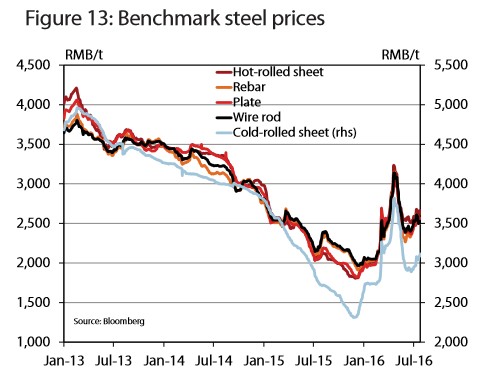
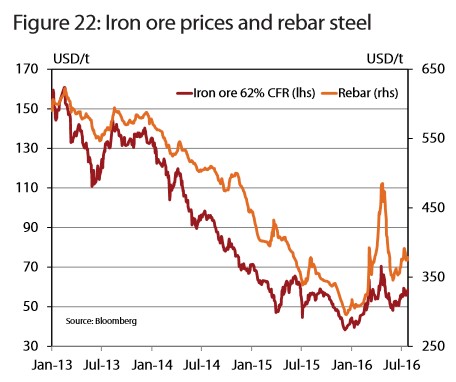
Steel prices continued to increase at the start of Q2 as a result of the Chinese government’s stimulus measures implemented at the start of the year and efforts to reduce excess capacity. The rebar price peaked on 26 April at RMB3150, the highest it has been since November 2014.
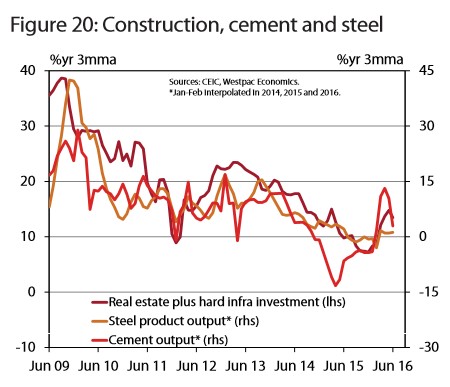
Despite ongoing issues of domestic overcapacity, a modest recovery in prices has been supported by sustained demand from the property sector, reflected in very low inventories (down 32%yr in Q2).
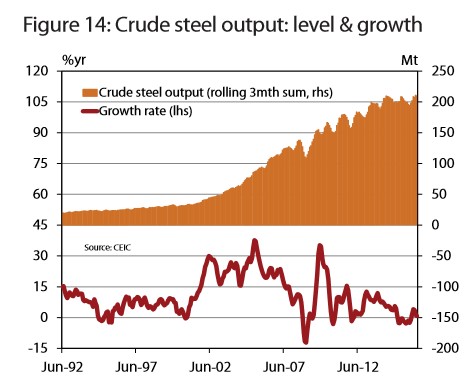
China’s steel production increased 1.3%yr in Q2 to 209 Mt—the highest level in two years. Despite higher production, China’s steel consumption fell marginally by 0.1%yr in Q2.
Production in Hebei, accounting for a quarter of steel production in China, increased 7%yr in Q2. At the end of Q2, Baosteel and Wuhan Iron & Steel, two of China’s top steel producers, announced the start of ‘strategic restructuring’ talks. The possible merger could make significant inroads to consolidating the domestic steel industry.
Despite ongoing concerns from global competitors in regard to unfair competition, China’s steel exports continued to grow 11%yr to 29 Mt in Q2…
Iron Ore:
Iron ore prices averaged US$55 a tonne (CFR) in Q2, up 12%qtr but down 5%yr, because of higher demand from China’s steel sector.
Price volatility remained high in Q2 and into early Q3, with iron ore trading between a peak of US$70/t on 21 April and a low of $US48/t on 2 June. Speculative activity on the Dalian Commodities exchange, which may have contributed to the volatility, has since slowed because of measures implemented by exchanges to address overheating markets, including trading restrictions and increased commission fees and margin requirements.
Prices steadily increased in early Q3 and while prices have been somewhat volatile, in responce to weakening sentiment towards China’s property market due to an absence of any further government stimulus, they were around US60/t on August 5.
Import demand from the domestic steel industry has grown, supported by a fall in China’s iron ore production (run of mine), which was down 5%yr in Q2.
Iron ore production from Rio Tinto increased 8%yr in Q2, while production from Vale and BHP Billiton fell 2.8%yr and 7%yr, respectively.
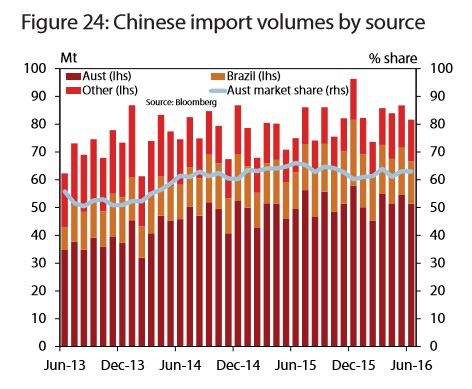
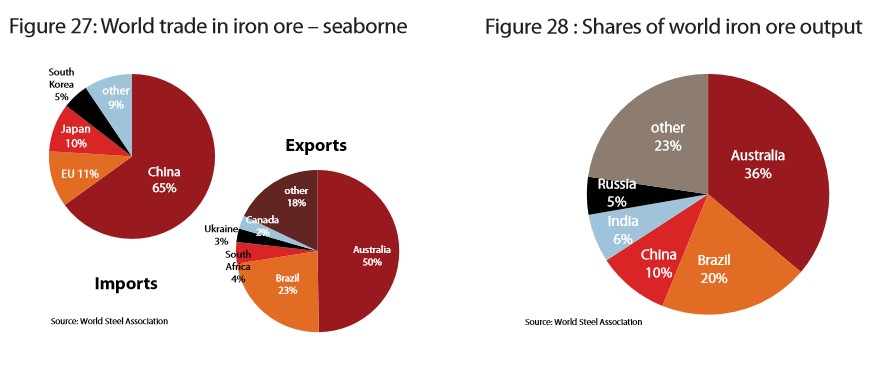
China’s imports of iron ore increased by 12%yr in Q2, due to growth in imports from Australia (up 7%yr), Brazil (up 14%yr), and the rest of the world (up 27%yr). Australia’s share of the seaborne market was 62% in Q2, compared with 19% for Brazil and 18% for the rest of the world.
Iron ore port stocks increased 6%qtr and 28%yr to 95 Mt in Q2.
Australia’s iron ore export volumes into China increased 8%qtr and 7%yr to 165 Mt. Export earnings increased by 26%qtr and by 14%yr to A$10.8 billion.
Coking Coal:
After declining over the previous few quarters, spot prices for metallurgical coal increased over Q2, driven by increased activity in China’s construction and steel making sectors. Australian premium hard coking coal (FOB) averaged US$91 a tonne, up 15%qtr and 1%yr.
Australian benchmark prices for high-quality metallurgical coal delivered in Q3 2016 settled higher than expected at US$92.50 a tonne, up from around US$84 a tonne in Q2.
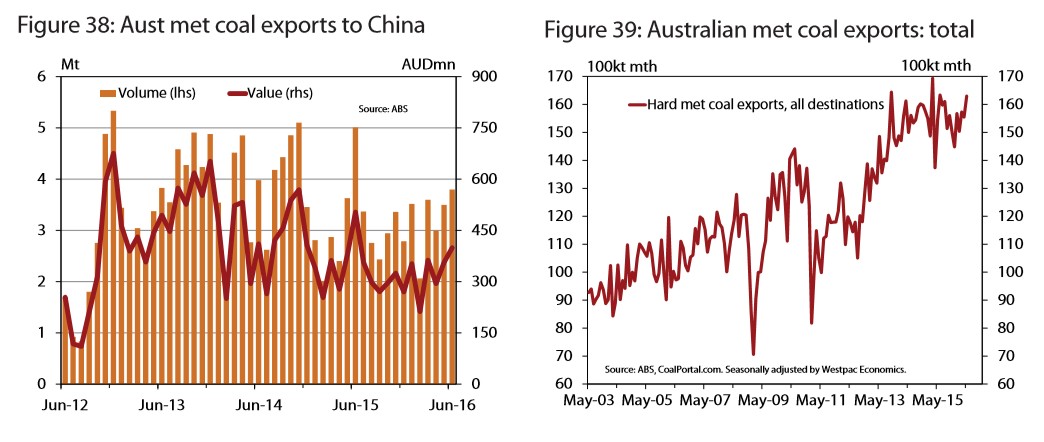
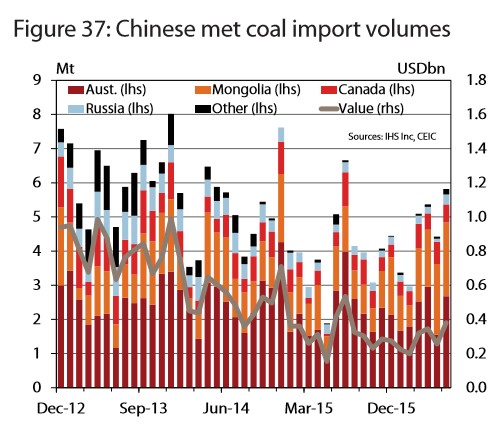
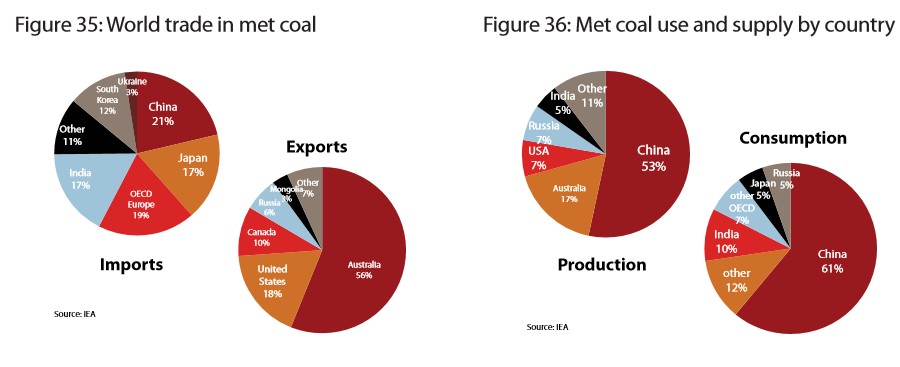
China imported 15.6 Mt of metallurgical coal in Q2, up 46%yr. Australia remained the primary source of China’s metallurgical coal imports, accounting for 46%. China’s imports from Mongolia, China’s second largest source of imported metallurgical coal, increased 89%yr to 5.9 Mt.
Australia exported 10.4 Mt of metallurgical coal to China in Q2, an increase of 12%qtr but a decline of 6%yr. Export values declined 9%yr to $A1.1 billion, however increased 10%qtr due to higher prices.
Leith van Onselen is Chief Economist at the MB Fund and MB Super. He is also a co-founder of MacroBusiness.
Leith has previously worked at the Australian Treasury, Victorian Treasury and Goldman Sachs.