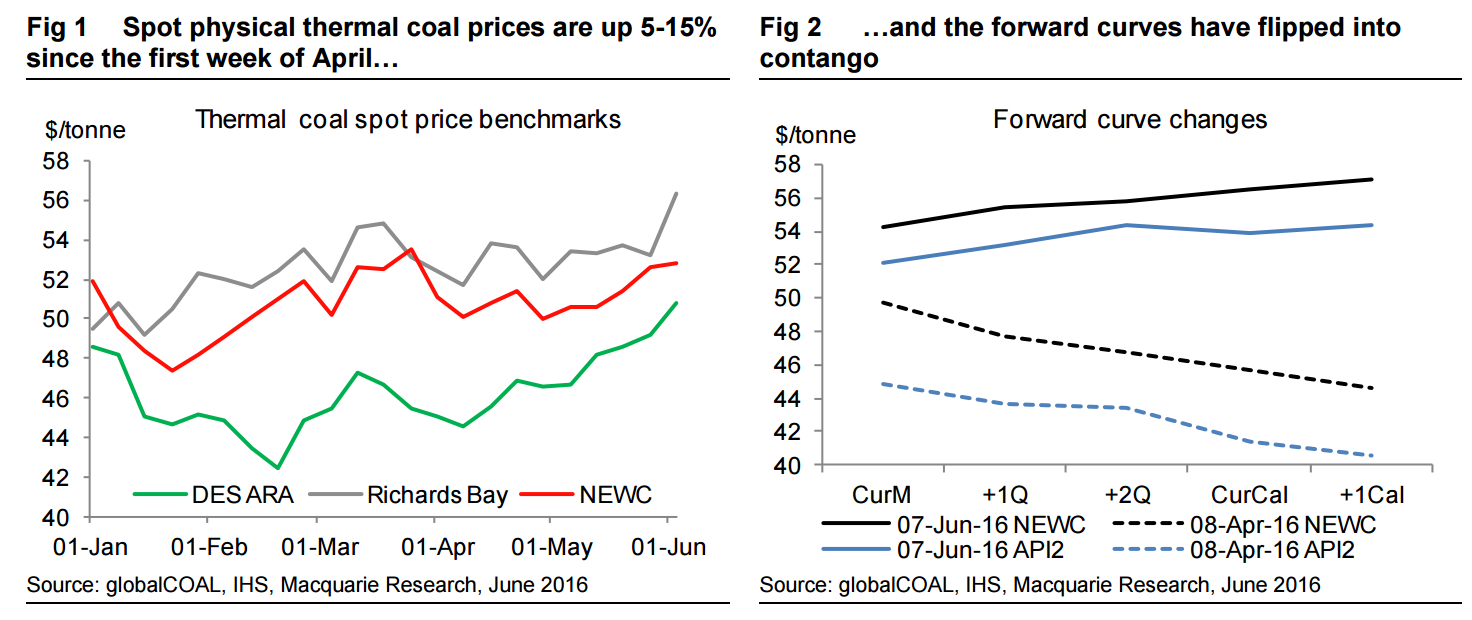
Thermal coal, our least preferred commodity exposure and a consensus short, has rallied between 5 and 15% over the past two months. The main driver has been a significant fall in Chinese domestic supply, which has driven up seaborne prices via the import arbitrage. Macro forces and recent Indonesian supply disruptions have also contributed to the gains and the forward curves have flipped into contango.
This was accompanied by a significant fall in Chinese supply. An accident at major producer Datong Coal in late-March led to the shutdown of consolidated mines in Shanxi, for safety checks, and then even more significantly the first major capacity closures under the ‘supply-side reforms’ banner were implemented. Central government policy reduced statutory working days for coal miners to 276 days from 330 days per year, and despite initial skepticism, the policy has had an impact. SOEs and listed companies in particular are reported to be enforcing it strictly, under supervision from officials from both central and local governments. Provincially Shanxi, China’s third-largest thermal coal producing province (after Inner Mongolia and Shaanxi), has seen the largest production impact.
So what happens next? Current sentiment in China and thus the seaborne market is that government efforts to keep cutting production are going to continue, and that short-term the market will remain tight. Market participants have been wary of taking the other side of this trade so far. However we reaffirm our view that structurally the market remains weak and highlight the following reasons:
Supply discipline gets harder to enforce in a rising price environment. Both Chinese domestic output and Indonesian seaborne supply is known to be price-reactive.
In the absence of further protectionism, as prices rise Chinese imports are also likely to head higher, since seaborne producers will be more aggressive in pushing volume there. Longer term, this is generally incompatible (or at least illogical) with China’s aim of creating a more financially stable domestic coal industry (the overarching aim of supply-side reforms). In our view, bias will be towards further reducing import competition, so even if Chinese prices continue to head higher over the long term, we don’t think seaborne producers will be able to fully take advantage of them.
Global thermal coal demand is past peak and YTD conditions have been dire. Chinese domestic consumption is down ~1% YoY in 4M16, better than trend following the Chinese stimulus over the past couple of months, but still declining. And sequentially demand is getting worse again according to high frequency data points for coal-fired power plants, while we are also approaching peak hydro season in the summer. In terms of ex-China demand, Fig 9 illustrates that across major importers there has basically been no growth whatsoever so far this year.
Finally, one shouldn’t forget about the wave of LNG that is coming. Recent oil and gas price rises have had a positive impact on thermal coal prices, but from late this year to early next year, once significant LNG volumes enter the market, we are likely to see an aggressive market-share battle between fossil fuels with negative price implications.
David Llewellyn-Smith is Chief Strategist at the MB Fund and MB Super. David is the founding publisher and editor of MacroBusiness and was the founding publisher and global economy editor of The Diplomat, the Asia Pacific's leading geo-politics and economics portal.
He is also a former gold trader and economic commentator at The Sydney Morning Herald, The Age, the ABC and Business Spectator. He is the co-author of The Great Crash of 2008 with Ross Garnaut and was the editor of the second Garnaut Climate Change Review.