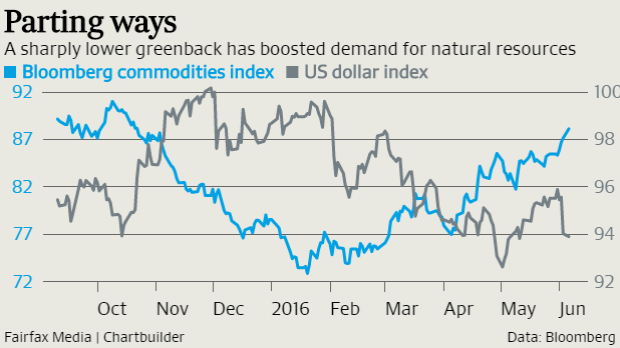
Commodities have entered a bull market, ending a five-year rout, as the greenback weakened and supply constraints drive up prices in everything from soybeans to zinc and help the asset class outperform bonds, currencies and equities so far in 2016.
The Bloomberg Commodity Index, which tracks returns from 22 raw materials, closed up 1.1 per cent at 88.1137 on Monday, 21 per cent above its low on January 20, meeting the common definition of a bull market. The gauge was helped higher by gains across energy, metals and agriculture. The index is still down about 50 per cent from the high reached in 2011.
The US dollar held near three-week lows versus a basket of currencies on Monday after falling 1.6 per cent on Friday, when data revealed the smallest US monthly employment increase since September 2010.
A weaker dollar makes dollar-priced commodities such as gold and oil cheaper for holders of other currencies.
“The implied probability for a rate hike in June is zero and the probability for a July rate hike has been lowered significantly,” said Barnabas Gan, economist at OCBC Bank in Singapore.
Commodity prices have also gained on speculation that supply disruptions and production cuts are whittling away the surpluses that caused the biggest price collapse in a generation, while global demand improves steadily, if undramatically. Citigroup Inc. said last month that commodities had turned a corner, increasing its forecasts for metals to grains amid an oil-led recovery.
Raw materials “appear to finally be entering their renaissance”, Citi analysts said in a report. “Supportive drivers are emerging both on the investment side and the fundamental side.”
In the last two weeks, Brent crude has traded at more than $US50 a barrel for the first time since November. Oil rebounded from its 12-year low in January amid disruptions from Nigeria to Venezuela and as US output declined, pressured by OPEC’s policy of sustaining production.
The global oil market has flipped to a deficit sooner than expected, Goldman Sachs said in May. US natural gas prices are gaining as warmer-than-usual weather eats away at a glut of domestic stockpiles and drilling for the fuel subsides.
Metals have also seen an encouraging start to 2016. Gold is on course to snap three straight annual declines and silver is also higher as concern over the health of the global economy and the dollar’s retreat boost demand for precious metals as stores of value.
Any euphoria may be premature. China’s economy will have to stabilise and US industrial production recover for there to be a sustained recovery in commodity prices, according to Dominic Schnider, head of commodities and Asia-Pacific foreign exchange of the wealth-management unit at UBS. Until that happens, they may retreat again, he said.
“I still think prices can fall in the short run, they should find a bottom during summer,” Schnider said. “I think prices of commodities in general, not so much base metals but predominantly energy, will come off again.”
You bet they will. This is bunkum:
China is going to keep slowing and shifting away from commodity-intensive growth;
nearly every industrial commodity remains hugely oversupplied, and
moreover, any price rises will be greeted with an avalanche of only recently idled extra supply.
Much more commodity consolidation lies ahead. Huge amounts. For a decade. This rally is financialised balderdash as markets adjust to a more dovish Fed. By all means trade it but, heavens, don’t believe in it!
David Llewellyn-Smith is Chief Strategist at the MB Fund and MB Super. David is the founding publisher and editor of MacroBusiness and was the founding publisher and global economy editor of The Diplomat, the Asia Pacific's leading geo-politics and economics portal.
He is also a former gold trader and economic commentator at The Sydney Morning Herald, The Age, the ABC and Business Spectator. He is the co-author of The Great Crash of 2008 with Ross Garnaut and was the editor of the second Garnaut Climate Change Review.