Analysts are calling a “renaissance” in commodities after oil climbed to a 10-month high overnight and as iron ore prices jumped further above the US$50-a-tonne threshold.
On Tuesday night iron ore climbed a further 2.8 per cent to $US52.54, and is now up 9 per cent since after slumping to $US48.18/tonne last Thursday. Brent crude oil jumped 1.9 per cent overnight to $US51.49/barrel, as the US dollar continued to ease.
The recent boost to natural resources prices may not just be short-lived phenomenon. Commodities – the worst-performing global asset class over the past few years – finally appear to be “entering their renaissance”, according to research from Citi.
Citi’s assessment comes as commodities officially enter a bull market, ending a five-year rout, as a weak US dollar and supply constraints drive up prices and help the asset class outperform bonds, currencies and equities so far in 2016.
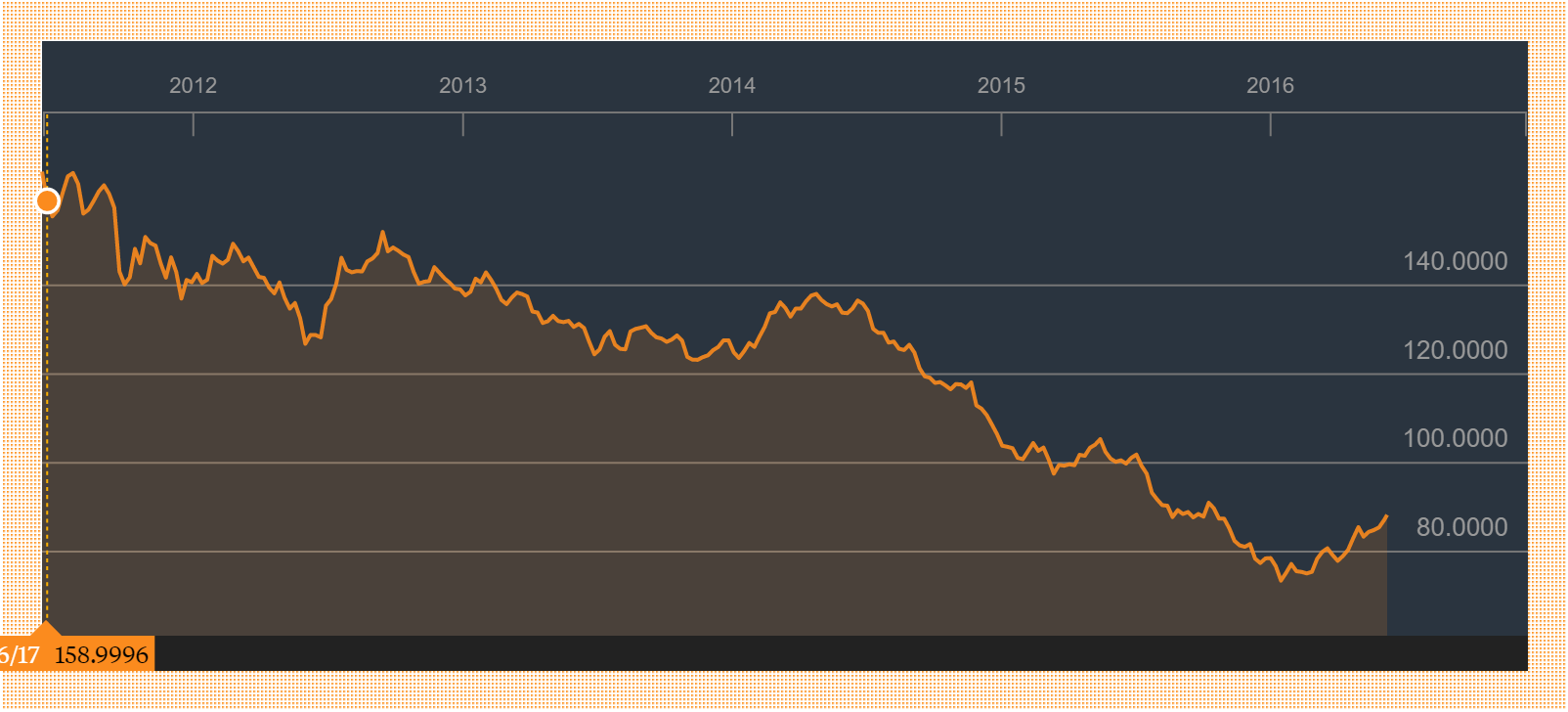
The Bloomberg Commodity Index, which tracks returns from 22 raw materials, closed up 1.1 per cent at 88.1137 on Monday, 21 per cent above its low on January 20, meeting the common definition of a bull market.
Here’s what the index looks like if you pan back a bit:
A little less impressive, no? The rest is drawn from quotes by Citi which is bullish on iron ore and coal short term on Chinese stimulus, gold longer term on inflation, copper just because, and oil is supposed to cause everything to rise.
That is poor analysis from top to bottom. The outlook is more like:
horrible for iron ore short term and disastrous long;
same for both coals as steel output slips and energy transforms;
gold is bullish on deflation not inflation, and
oil is the one exception with rebalancing underway but with a lot of wood still to chop as current short term supply outages ease. Even this will not boost wider commodity prices because there is no pricing for power for producers to pass on costs as China keeps using less and less stuff far into the future. There’ll simply be more cost out.
It’s possible that oil has bottomed-out aggregated indexes for commodities given its heavy weighting but the bear market marches on for pretty much everything else industrial and the future for Australia’s bulks in particular remains bleak.
David Llewellyn-Smith is Chief Strategist at the MB Fund and MB Super. David is the founding publisher and editor of MacroBusiness and was the founding publisher and global economy editor of The Diplomat, the Asia Pacific's leading geo-politics and economics portal.
He is also a former gold trader and economic commentator at The Sydney Morning Herald, The Age, the ABC and Business Spectator. He is the co-author of The Great Crash of 2008 with Ross Garnaut and was the editor of the second Garnaut Climate Change Review.