We have updated our economic, currency and interest rate outlook for Australia following the recent CPI outcome, federal budget, RBA rate cut and updated Statement on Monetary Policy outlook revision.
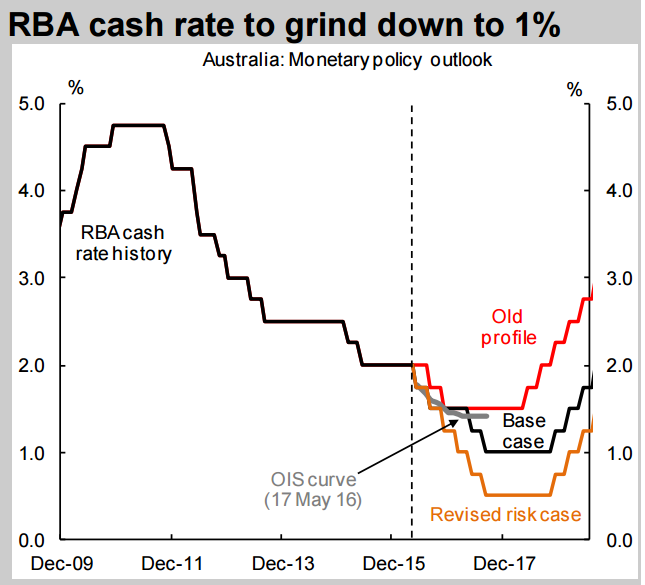
A 1% RBA cash rate – We think that the RBA will have to cut the cash rate further, to at least 1%, and have further delayed the timing of expected policy normalisation. Recent weakness in inflation has surprised to the downside of our already subdued outlook. Our former risk case is now our base case. With little to differentiate Australia from other advanced economies, the risk lies with a slow and persistent grind to even lower rates.
Demand weakness to persist – With fiscal policy still on a consolidation path, and weak domestic income growth, the domestic demand outlook remains weak. Population growth continues to underpin demand growth, although the pace of net migrant inflows has moderated. Additional policy support is needed to sustain the current dissaving-driven pace of household spending growth as the support from wealth effects wanes. Further A$ depreciation is needed to provide an additional demand boost.
Lower inflation – Over coming years the persistence of space capacity domestically, and globally, suggests it is going to be harder than previously anticipated to generate, and sustain, inflation near the RBA’s target band. With domestic inflation pressures muted, imported inflation – which is not yet being passed through as expected – is key to sustaining price pressures.
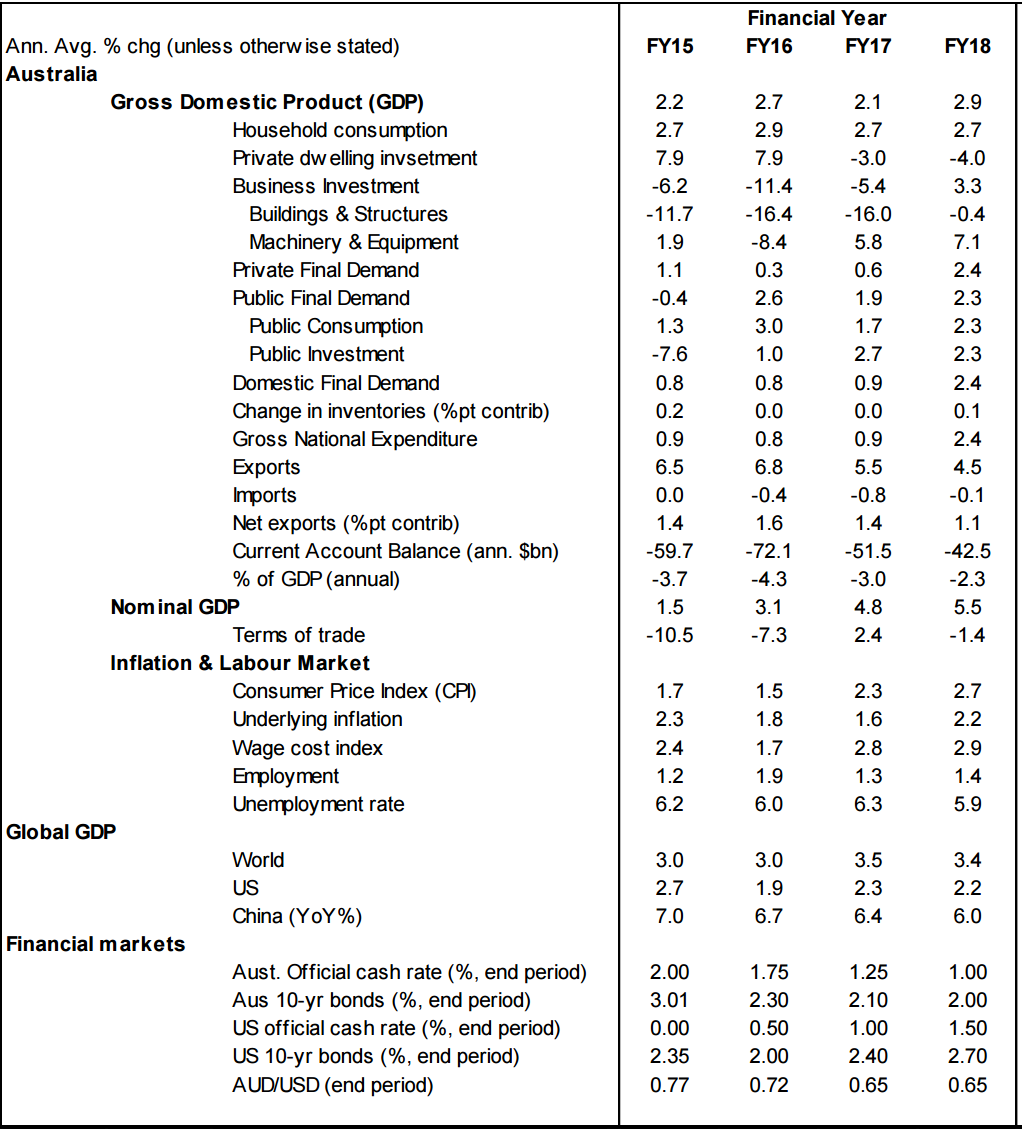
A sub-2% 10-year yield – The trajectory for bonds will be impacted by a lower for longer RBA cash rate. We have revised our 10-year bond forecast to reflect the new record low in the domestic cash rate, as well as taking a view that further policy support elsewhere will continue to drive a search for yield. We see the 10-year bond grinding down to just below 2% in FY17/18.
But the economy to still grow – Whilst we have adjusted our rates outlook, we have not made significant further downward adjustments in our growth trajectory for the Australian economy. Growth is very narrowly based. Resource exports are a key driver, whilst domestic demand remains muted and the fiscal trajectory points to further consolidation. There is little per capita growth outside of the production and export payoff from the investment boom.
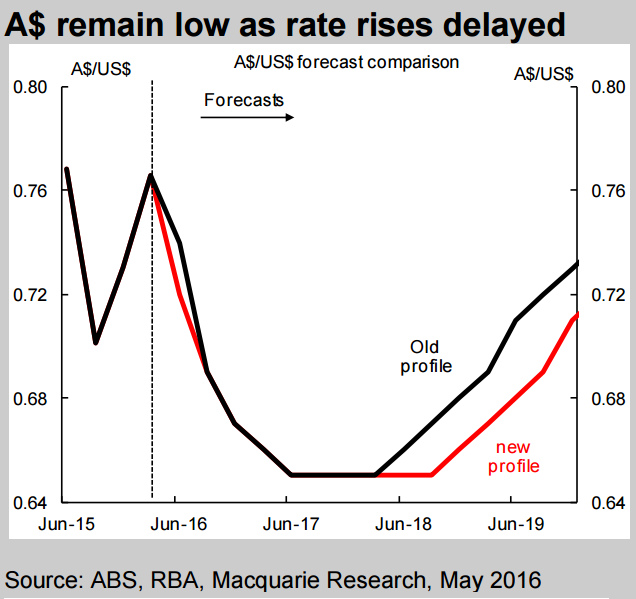
A$ longer at the lows – The recent strength in the A$ is likely to have a dampening impact on the economy’s transition through 1H16. We remain of the view that further A$ depreciation is required to secure the economy’s transition. With the delay in RBA normalisation, we have extended the period through with the A$ at its lows relative to the US$.
Lower long run – In addition to shifts and changes in the near term profile for rates, and the currency, we have also adjusted our long-run RBA, bond, GDP and inflation assumptions. We have adjusted our long-run inflation target from 2.5% down to 2.0%. Our long-run nominal 10-year bond assumption has also been cut from 3.75% to 3.25% (real rate unchanged). And we have trimmed our long-run neutral RBA cash rate assumption to 3% to reflect lower inflation and further mortgage repricing.
Good job, chaps, streets ahead of other IBs. I’ve called the risk case of 50bps ZIRP (zero interest rate policy) because we are unsure Australia can cut any lower.
The amusing part about it, though, is Macquarie is far too bullish:
Advertisement
Check out business investment, terms of trade and wages growth. Nope, nope and nope. The dollar is not going to bottom at 65 cents I’m afraid!
David Llewellyn-Smith is Chief Strategist at the MB Fund and MB Super. David is the founding publisher and editor of MacroBusiness and was the founding publisher and global economy editor of The Diplomat, the Asia Pacific's leading geo-politics and economics portal.
He is also a former gold trader and economic commentator at The Sydney Morning Herald, The Age, the ABC and Business Spectator. He is the co-author of The Great Crash of 2008 with Ross Garnaut and was the editor of the second Garnaut Climate Change Review.