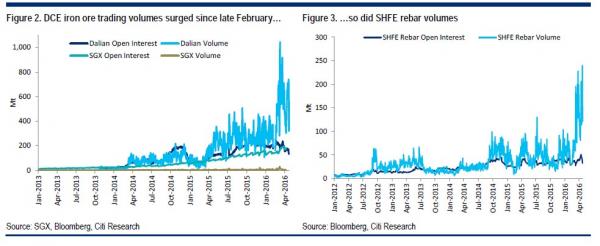
The fact that iron ore, responsible for a small fraction of daily trade in oil and far less important for the global economy than oil, has attracted massive fund inflows in China is an indication of the excesses of Chinese futures exchanges and the dangers that wanton trading on Chinese exchanges may destabilize global markets. Trading in Chinese futures on some irrelevant commodities including bitumen, polypropylene, and PVC have also soared during the past weeks.
Short positions on iron ore, steel and base metals began to accumulate at the end of last year, accelerating in January as equity investors were prevented from shorting equities during the big China sell-off, partly due to a government crackdown on short-selling equities, and moved to short commodities as a way to profit from a slowing Chinese economy. Roughly after Chinese New Year, they went suddenly long, apparently showing more confidence in the Chinese economy but it was designed as well to lock in lower prices under the assumption that the RMB was weakening over the course of 2016, with higher-priced dollars implying significantly higher RMB prices for commodities in China.
The full text of this article is available to MacroBusiness subscribers
David Llewellyn-Smith is Chief Strategist at the MB Fund and MB Super. David is the founding publisher and editor of MacroBusiness and was the founding publisher and global economy editor of The Diplomat, the Asia Pacific’s leading geo-politics and economics portal.
He is also a former gold trader and economic commentator at The Sydney Morning Herald, The Age, the ABC and Business Spectator. He is the co-author of The Great Crash of 2008 with Ross Garnaut and was the editor of the second Garnaut Climate Change Review.