
Treasurer Scott Morrison has flagged that the Coalition will cut the company tax rate in the Federal Budget. From The AFR:
Salary earners will have to wait some years for an income tax cut after Treasurer Scott Morrison confirmed on Thursday that company tax cuts will be his priority in the federal budget…
The Australian Financial Review has previously reported that, because of the lack of revenue options to fund a corporate tax cut, the government wants to lower the 30 per cent rate to 25 per cent or lower over a period of years. This so-called glide path would be legislated so as to provide investor confidence.
There is some merit to cutting the company tax rate.
In 2014, we witnessed biotechnology manufacturer, CSL’s, decision to build its new $500 million factory in Switzerland rather than Australia, citing Australia’s high company tax rate as a factor. Switzerland’s company tax rate is 18% versus Australia’s 30%.
International capital is inherently flighty, making high rates of company tax a big disincentive for international firms looking to locate here.
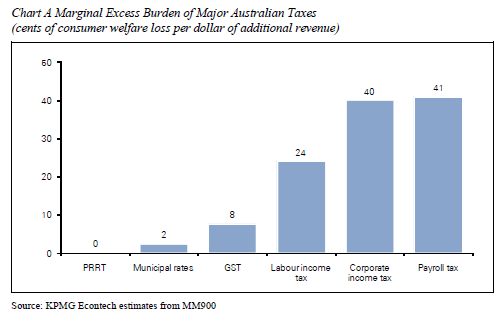
Indeed, the Henry Tax Review showed that company tax has “a high marginal excess burden” (i.e. a big loss in consumer welfare relative to the net gain in government revenue), because “it is applied to capital, which is highly mobile” (see next chart).
Moreover, as by The Guardian’s Greg Jericho a few years back, Australia has the third highest reliance on company taxes when compared against other OECD nations (see next chart).

Jericho also showed that company tax receipts are inherently volatile, which makes Budget planning uncertain (see next chart).

That said, the Henry Tax Review argued to cut the company tax rate to 25% provided there were “improved arrangements for charging for the use of [non-renewable] resources should be introduced at the same time” through “a broad-based resource rent tax”.
The Review also noted that “current charging arrangements [for resources] distort investment and production decisions….. they fail to collect a sufficient return for the community because they are unresponsive to changes in profits” (see next chart).

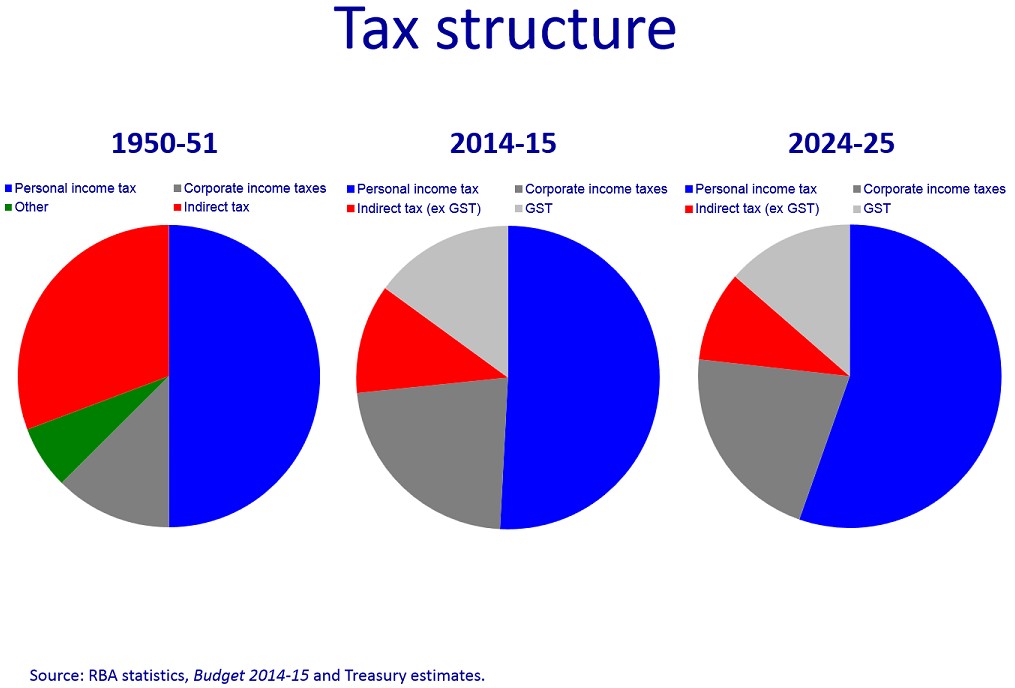
While company taxes are no doubt inefficient, a bigger concern in my view is the growing reliance on personal income taxes, whose share of total federal budget revenue is forecast by the Treasury to rise inexorably over the coming decade, whilst the take from company taxes, indirect taxes, and the GST will shrink (see next chart).
As shown in the first chart above from the Henry Tax Review, personal income taxes also are highly inefficient – albeit less so than company taxes – with a marginal excess burden of 24% due to their discouraging effect on labour force participation. And worryingly, bracket creep is set to impose an increasing burden on Australian workers.
The key with tax reform, therefore, is not just to lower company taxes, but to shift the entire tax base away from productive effort and onto more efficient sources, such as land and resources, along with the closure of generous taxation concessions favouring the old and the asset rich.
Reform of this nature would both broaden the tax base – since virtually everyone would be captured – and be far more equitable than making the diminishing pool of workers shoulder the lion’s share of the tax burden.
It is also why all sides should place fundamental tax reform on the table and look to wind-back Australia’s world-beating and poorly targeted tax expenditures.
Unfortunately, such a broad-ranging discussion is missing from the political debate.
