
Remember this chart from the International Monetary Fund (IMF), which estimated that Australia has the highest tax expenditures in the OECD when measured against GDP (see next chart).
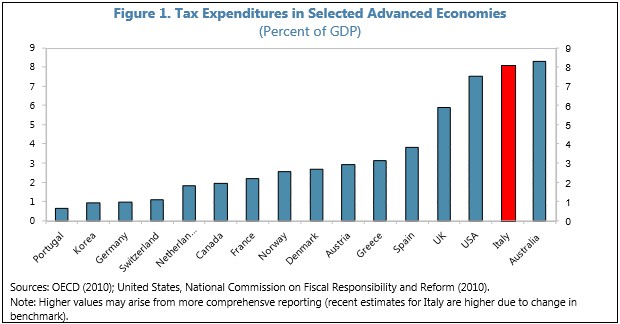
According to the report, tax expenditures are:
…government revenues foregone as a result of differential, or preferential, treatment of specific sectors, activities, regions, or agents. They can take many forms, including allowances (deductions from the base), exemptions (exclusions from the base), rate relief (lower rates), credits (reductions in liability) and tax deferrals (postponing payments).
The IMF also believes that tax expenditures should be reformed since they:
…can have major consequences for the fairness, complexity, efficiency, and effectiveness of not only the tax system itself but, since they often serve purposes that might be (or are also) pursued through public spending, of the wider fiscal system.
Labor’s shadow assistant treasurer, Andrew Leigh, has today come out stating that reform that aims to reduce spending by tackling loopholes remains the best way to improve Australia’s system, including by reforming superannuation concessions, negative gearing and the CGT discount. From The Canberra Times:
“…public finance reformers should look not only at spending levels and tax rates, but also at tax expenditures”…
“Such an approach… raises revenue more efficiently than increasing tax rates,” Mr Leigh says. “In economic jargon, closing loopholes has a lower deadweight loss than raising rates”…
That’s why Labor had a policy to rein in superannuation tax concessions, and restrict negative gearing and capital gains tax concessions.
He said when it comes to reducing personal income deductions, it is really a conversation about negative gearing. “Rental deductions account for more than half of all personal deductions,” Mr Leigh says. “So anyone who tells you they’re serious about cutting tax breaks, but won’t touch negative gearing isn’t serious about broad-based tax reform”…
“Put another way, our tax system would be billions of dollars better off if we simply took landlords out of the tax system altogether.”
We know that Prime Minister Malcolm Turnbull actually agrees with Labor on the need to wind-back tax concessions.
In his 2005 tax policy paper, Turnbull described negative gearing and the CGT discount as a “sheltering tax haven” that is “skewing national investment away from wealth-creating pursuits, towards housing”, and has caused a “property bubble”. Turnbull also acknowledged that “Australia’s rules on negative gearing are very generous compared to many other countries” and that “the normal deductibility principles do not apply to negatively geared real estate such that the taxpayer is not obliged to demonstrate that the negatively geared property will generate positive cash flow at some point in the distant future”.
Moreover, in 2014 Turnbull acknowledged that the tax system favours richer older people over younger working Australians:
“Looking at Australia’s tax regime you would say that it is too tough on people earning income… but is incredibly concessional to older people who have made their money…
All of these areas are very hard to deal with because any change invariably… [leads them]… to become very angry. That’s why reform is very difficult…”
Too bad, then, that Malcolm Turnbull has ruled-out meaningful reforms to negative gearing, the capital gains tax discount and superannuation concessions, thus leaving Australia’s world-beating tax shelters intact and Labor in the clear policy and national interest lead.
