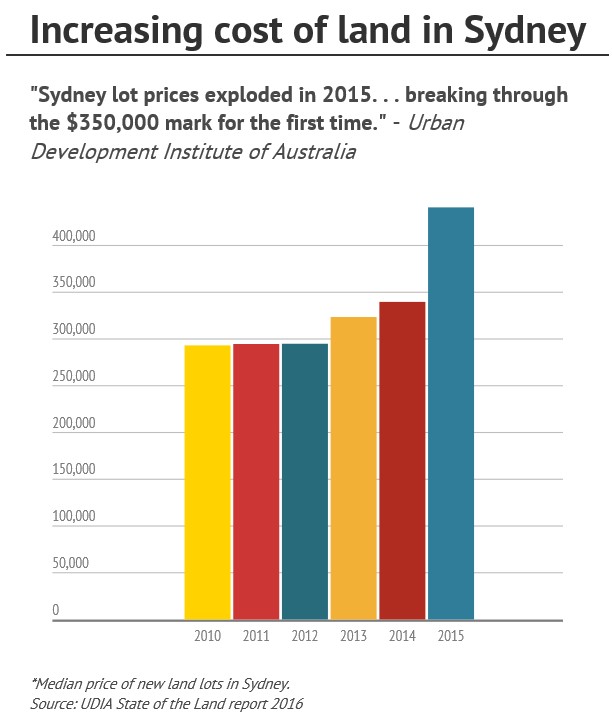
The 2016 Urban Development Institute of Australia’s (UDIA) State of the Land report has produced some depressing news for Sydney first-time buyers, with the cost of detached land jumping by $100,000 over the past year despite shrinking in size. From Domain:
In 2014, it cost $339,750 to buy a block of land in the suburbs, but buyers of the same block will now find themselves set back $440,725 for a median priced new lot…
That works out to be a hefty $975 per square metre, almost double the cost in 2010 and a third more than 2014…
Not only is land becoming more expensive, it’s shrinking too – in 2010 the median size block was 524 square metres and cost $293,250. Over the past five years prices have jumped 50.3 per cent and the the typical block size has shrunk to 454 square metres.
With the city’s population expected to surge 80,000 people a year until 2031, block sizes are going to get even smaller, the report warns…
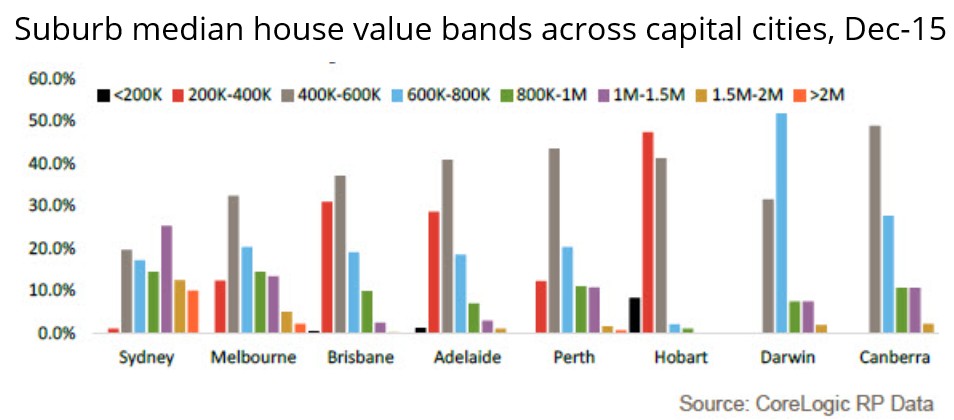
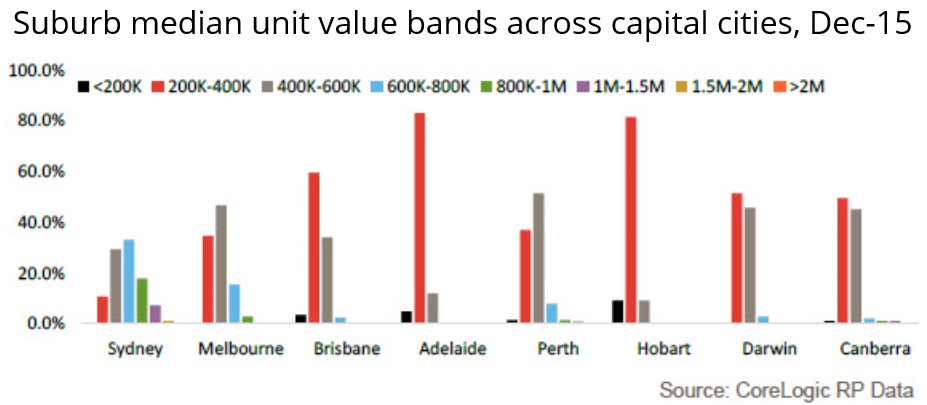
The UDIA’s report is backed-up by Core Logic-RP Data, which last week released data showing a dearth of affordable housing options in Sydney:
Advertisement
For houses, 25.3% of Sydney suburbs have a median value of between $1 million and $1.5 million making it the largest single value band for the city… In Sydney, 47.8% of suburbs have a median house value of more than $1 million…
It is a similar story for capital city unit markets with 33.1% of Sydney suburbs having a median unit value of between $600,000 and $800,000 making it the largest band for the city… 8.8% of Sydney suburbs have a median unit value of more than $1 million…
The data shows that particularly in our larger capital cities there is a critical undersupply of affordable housing options (even in the unit market). As a result an increasing number of residents are being locked out of home ownership…
Meanwhile, the Australian Population Research Institute has pinned the blame for Sydney’s (and Melbourne’s) housing affordability woes on the combination of negative gearing, the capital gains tax discount, rampant immigration, and shortsighted planning by the state government:
For its part, the Coalition Government has its head in the sand. The abolition of negative gearing incentives for established dwellings has to be part of the solution. When removed, this will take some of the heat out of the housing market. The Government’s strategies to promote housing are part of the problem rather than the solution. This includes its migration policies. To add ever more households searching for family friendly housing in a context where there is already a serious shortage may be good for the housing rich but it is a disaster for the housing poor.
Advertisement
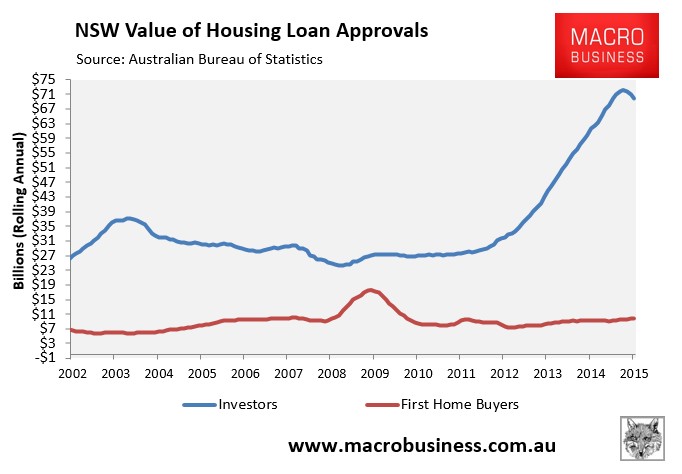
Whatever the cause, the situation facing Sydney first home buyers is dire, crowded-out by investors:
Leith van Onselen is Chief Economist at the MB Fund and MB Super. He is also a co-founder of MacroBusiness.
Leith has previously worked at the Australian Treasury, Victorian Treasury and Goldman Sachs.