
Prime Minister Malcolm Turnbott’s contradictory positions on negative gearing are now generating a powerful counter-movement within Coalition ranks.
Last week, Turnbott attacked Labor’s negative gearing and CGT policy because they would not raise enough Budget revenue – despite the independent Parliamentary Budget Office (PBO) estimating that the policies could save the Budget some $32 billion over 10 years once they come into force, albeit back-ended:
“As far as Labor’s announcement is concerned, I will make a couple of observations: one is that it raises relatively little money in the near term, over the next four years, and they acknowledge that. So it doesn’t address the big deficit…”
With no policy of his own to raise Budget revenue, Turnbott then changed track and argued that Labor’s proposed changes to negative gearing and the capital gains tax discount would somehow simultaneously “crash housing prices” without improving housing affordability:
Mr Turnbull told a joint meeting of Liberal and Nationals MPs on Tuesday that Labor’s policy would do nothing for housing affordability, which was mainly due to a lack of supply and delays in development approvals.
More than one-third of new loans were made to housing investors and it “beggars belief” that taking those buyers out of the market would not impact on housing values.
“To crash housing prices would be very damaging to the economy,” he said.
“(The ALP’s policy) would represent a very significant shock to the largest single-asset class in Australia.”
Then on Monday, Turnbott told parliament that Labor is engaging in “politics of envy” by attacking the rich:
“Let’s be frank. What they have done is set out to go for a ‘soak the rich’, ‘politics of envy’ policy.”
Only to then do an about-face yesterday, telling parliament that Labor’s policy is “inequitable” and would harm middle-income families while leaving the rich untouched:
“Labor’s policy is so inequitable…the only buyers that would be left who could claim a net rental loss are those who are so wealthy that they have investment income which can offset the losses. This is a negative gearing policy for the very rich…
“Under the shadow minister’s [Chris Bowen’s] policy, somebody on a wage of a quarter of a million dollars, who had net rental losses of $50,000, but also had $50,000 worth of, for example, dividends, unfranked share dividends, could offset that net rental loss against his or her share income against their investment income. They’d be able to do that.
But a middle income family, Mr Speaker, with a net rental loss of only $10,000 would not be able to deduct those losses against an income of $90,000 in salary and wages.
So that’s Labor.”
So, Turnbott is now trying to argue that Labor’s negative gearing policy would primarily benefit the rich, which makes absolutely no sense.
Here is Labor’s policy:
Labor will limit negative gearing to new housing from 1 July 2017. All investments made before this date will not be affected by this change and will be fully grandfathered. This will mean that taxpayers will continue to be able to deduct net rental losses against their wage income, providing the losses come from newly constructed housing. From 1 July 2017 losses from new investments in shares and existing properties can still be used to offset investment income tax liabilities. These losses can also continue to be carried forward to offset the final capital gain on the investment.
And below are breakdowns showing that the “rich” benefit the most from negative gearing under current arrangements – i.e. they are already claiming large investment losses against their unrelated wage/salary income.
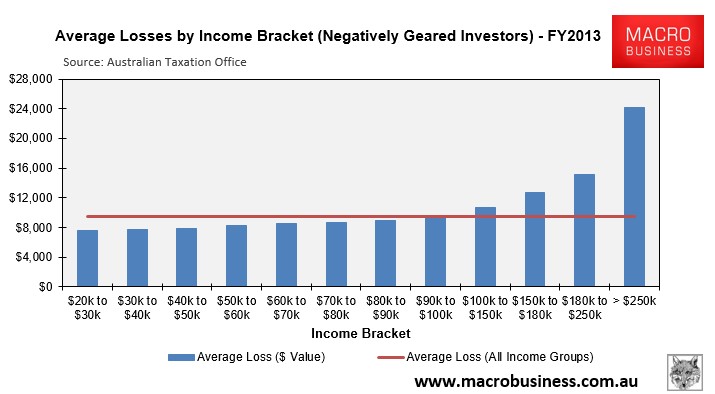
First, the ATO Taxation Statistics – which are highly flawed because they look at taxable income (i.e. what is left after deductions like negative gearing) – show that high income earners claim by far the biggest deductions:
Next, more accurate modelling from the National Centre for Social and Economic Modelling (NATSEM) showed that one third (34.1%) of the benefits of negative gearing were captured by the top 10% of income earners, whereas 15.7% of negative gearing benefits goes to the next 10% of income earners (see next chart).
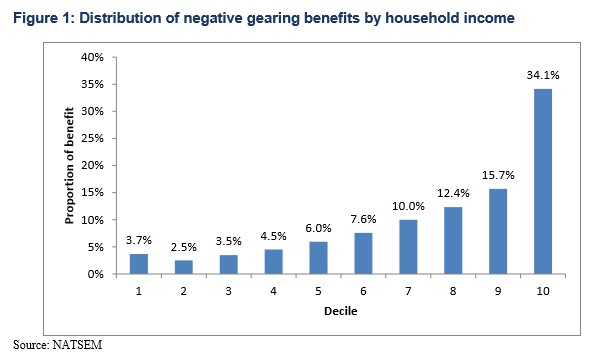
So that’s the top 20% of income earners receiving around half of the negative gearing benefits, according to NATSEM.
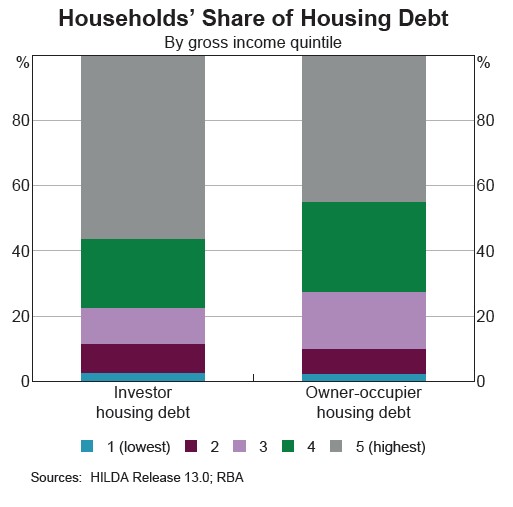
Third, according to the RBA, based on data from the Household, Income and Labour Dynamics in Australia (HILDA) Survey, households in the top two income quintiles hold nearly 80% of all investor housing debt (see next chart).
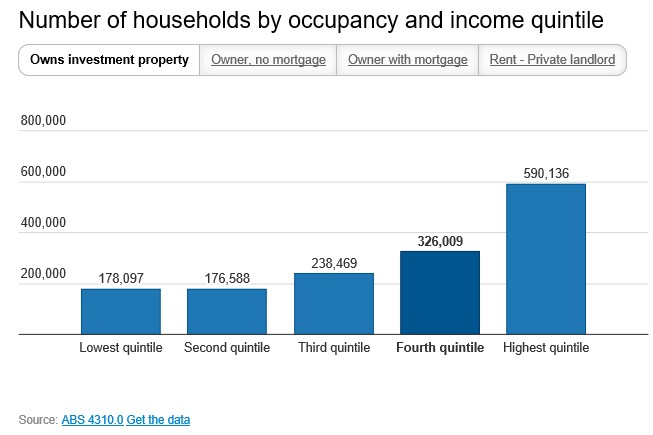
And according to the ABS’ most recent housing occupancy and cost data, the richest 20% of households accounted for 39% of all housing investors (chart via Greg Jericho):
Based on the above facts it is clear as day that it is overwhelmingly the “rich” that invest in property and derive the biggest benefits from negative gearing. It stands to reason, therefore, that it is rich that would be affected the most by Labor’s quarantining of rental losses on established homes from 1 July 2017. There is nothing “inequitable” about it.
For Malcolm Turnbott to argue otherwise is either confused or dishonest.
It’s impossible to tell which but Domainfax is reporting today that a powerful revolt is building on the Coalition backbench against any negative gearing reform at all:
A group of backbench Liberals who helped kill a GST rise has now committed itself to seeing off any changes to negative gearing, warning that limits on the amount claimable would inevitably be “retrospective” and therefore “worse than Labor’s”.
Their determination comes as Prime Minister Malcolm Turnbull pointedly kept open the option of placing a cap on negative gearing losses by repeatedly declining to rule out changes that would see existing investors affected.
Tax proposals to be put to Prime Minister Malcolm Turnbull have been modelled by a private consultancy.
The MPs – all economic dries – have honed a series of alternative tax proposals to put to the Prime Minister directly, which includes the adoption of part of Labor’s proposed tobacco excise rise.
The group is having its ideas modelled by a private consultancy and believes it can identify as much as $15 billion in credible savings to fund income tax cuts and a “modest” business tax cut.
The $15 billion figure is a similar amount of money that would have been available to spend after a GST rise to 15 per cent, which would raise about $35 billion, and the payment of compensation to low-income earners.
This is truly a new low in Australian policy-making. We now have a splinter group of politicians employing the rent-seeker tricks of the private sector in pursuit of their own interests against their party’s developing public policy. The Australian argues Turnbott is persisting:
Malcolm Turnbull is pushing ahead with the idea of capping the use of negative gearing by the wealthiest investors in a bid to craft a “fair” tax reform that avoids the economic shock he claims Labor’s reform will deliver.
Risking a revolt from government MPs who want negative gearing kept in its current form, the Prime Minister has recognised the case to tighten the rules as part of a significant tax reform package and is refusing to rule out the changes.
However, he has left room to drop the proposals if they do not need to be part of the wider reforms in the May budget.
Mr Turnbull has asked advisers to prepare a detailed economic analysis of Labor’s negative gearing proposal, making it clear he will escalate the government attack on changes that he believes will “smash” house prices by driving investors out of the market.
The Coalition has forgotten how to govern.
