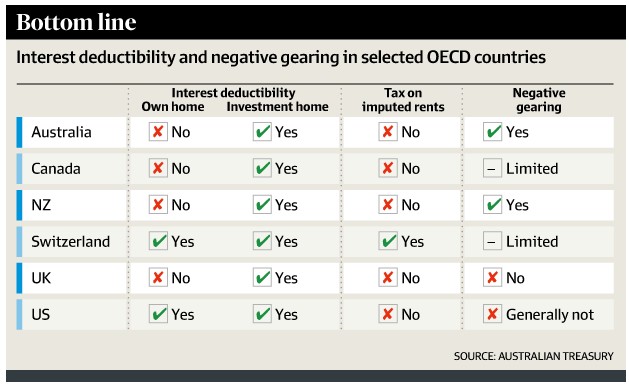
The Australian Treasury has made the rare admission that Australia’s system of negative gearing, which allows investors in both shares and property to deduct their expenses not just against their asset’s revenue but also unrelated wage/salary earnings, is “relatively generous” compared to other developed nations. From The AFR:
Treasury points out that Britain limits interest claims to 20 per cent and the United States limits expenses to the amount of interest income generated.
“While Canada and the US may seem to allow negative gearing, various limits reduce its effectiveness as a tax-minimisation tool,” Treasury says.
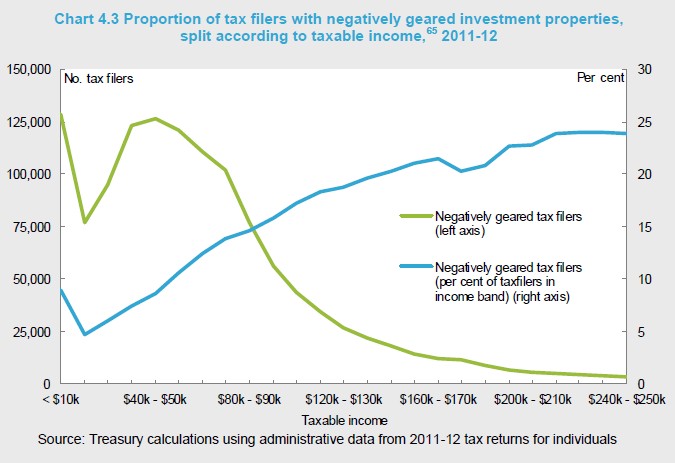
Two-thirds of landlords were negatively geared in 2013, claiming $41.7 billion of rental expenses and net rental losses of some $12 billion.
Good stuff. In the Australian Treasury’s Tax White Paper discussion paper, released last year, it also noted the following about negative gearing and its partner-in-crime, the capital gains tax (CGT) discount:
Advertisement
Negative gearing does not, in itself, cause a tax distortion, but it does allow more people to enter the market than those who might have had the equity alone to do so. Purchasers can make bigger investments in property by borrowing, in addition to using their own savings. This behaviour is encouraged by the CGT discount, as larger investments can result in greater capital gains and therefore benefit more from the CGT discount.
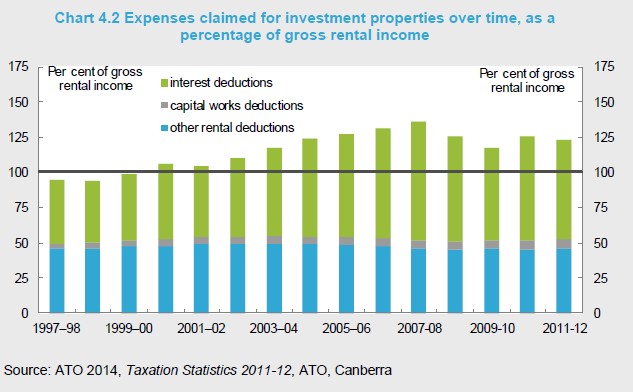
…investment properties constitute a substantial proportion of the total value of negatively geared assets. Chart 4.2 shows that deductions claimed for investment properties as a proportion of gross rental income have increased over the last 15 years and are now greater than gross rental income.
The potential tax advantage comes on the income side from the taxation of the capital gain earned from the asset. If the individual realises a capital gain when selling the property, only 50 per cent of this income is included in their taxable return.
Let’s hope this latest salvo means that the Government and Treasury are seriously considering reforming Australia’s property tax system – either by limiting negative gearing or unwinding the CGT discount (or both) – so that it does not unnecessarily inflate home values whilst robbing the Budget of much needed tax revenue.
Leith van Onselen is Chief Economist at the MB Fund and MB Super. He is also a co-founder of MacroBusiness.
Leith has previously worked at the Australian Treasury, Victorian Treasury and Goldman Sachs.