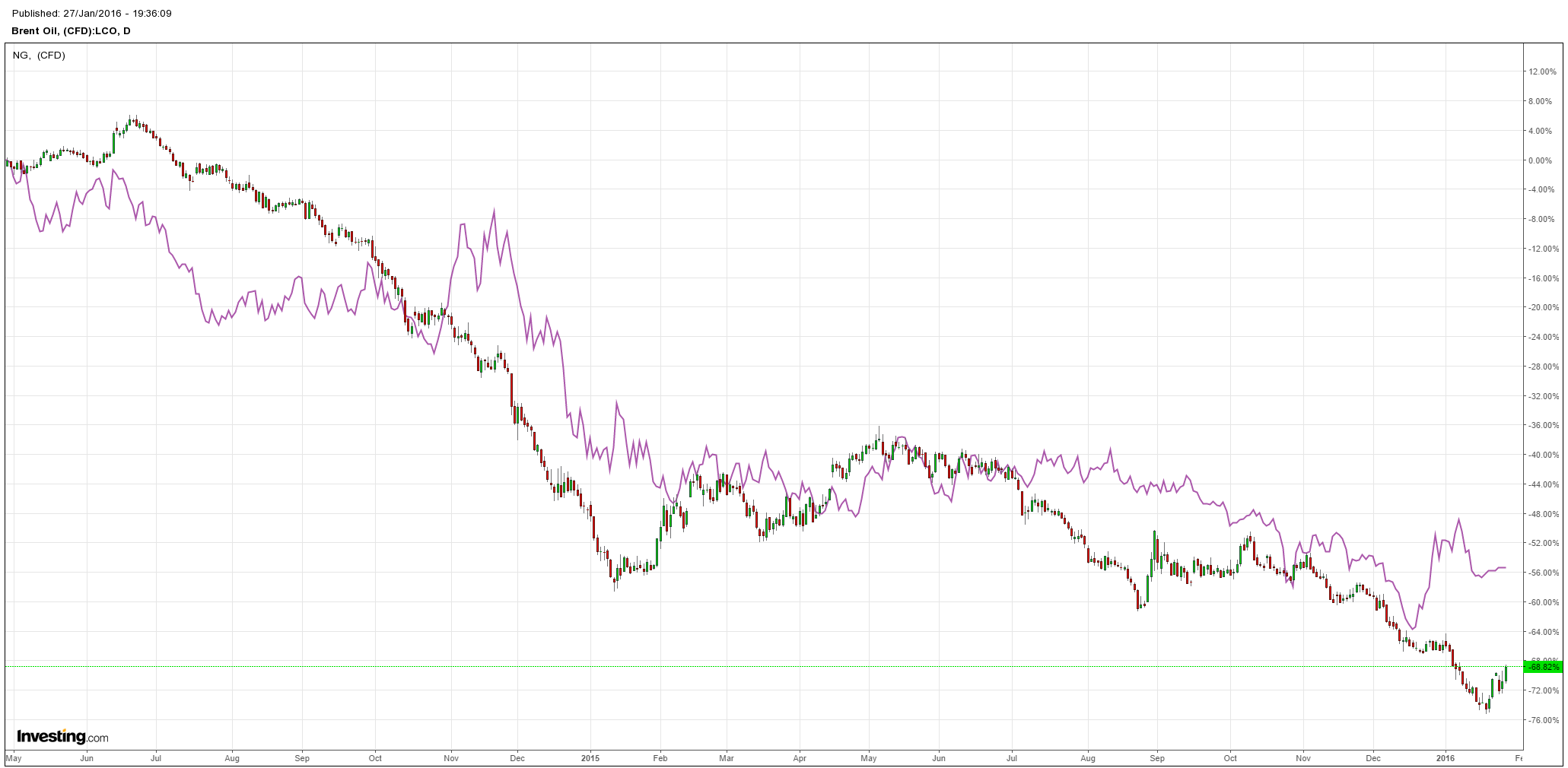
The Brent oil price jumped to $33.95 on the news that Russia, or some folks in Russia, want to chat with the Saudis about output cuts, from Reuters:
Russian officials have decided they should talk to Saudi Arabia and other OPEC countries about output cuts to bolster oil prices, the head of Russia’s pipeline monopoly said on Wednesday, remarks that spurred a sharp rise in prices.
Oil futures surged 5 percent after the comments by Nikolai Tokarev, head of oil pipeline monopoly Transneft, which gave the first hint of possible cooperation between the top non-OPEC oil producer and the cartel to try to reverse a record glut.
Brent crude rose $1.61 to $33.40 a barrel, a 5 percent gain, by 12:20 p.m. EST (1720 GMT), after a session low of $30.83. It was also boosted by U.S. demand following a blizzard.
But there was still a long journey from starting discussions to actual cuts by Russian oil producers, with many of them saying reducing output was technically very difficult and could lead to Russia losing market share to its competitors.
Tokarev said a meeting of oil executives and government officials in Moscow on Tuesday had reached the conclusion that talks with OPEC were needed to shore up the oil price.
“At the meeting there was discussion in particular about the oil price and what steps we should take collectively to change the situation for the better, including negotiations within the framework of OPEC as a whole, and bilaterally,” RIA news agency quoted Tokarev as saying.
“The main initiative is being shown by, of course, our Saudi partners. They are the main negotiators. That means that they are the ones we need to discuss this with first of all,” he was quoted as saying.
There were other stories denying the original. I remain skeptical. US shale is on the ropes so why let it off now? Also from Reuters:
Three major U.S. shale oil companies have slashed their 2016 capital spending plans more than expected in a bid to survive $30 a barrel oil prices, with one of them saying prices would need to rise more than 20 percent just to turn a profit.
The cuts on Monday from Hess Corp, Continental Resources and Noble Energy ranged from 40 percent to 66 percent. This marks the second straight year of pullbacks by a trio of companies normally seen as among the most resilient shale oil producers.
The cuts were steeper than expected. Analysts at Bernstein Energy had forecast an average 2016 spending cut for the sector of 38 percent
The reductions show budgets may shrink more this year than they did last year, when spending fell between 20 percent and 50 percent. Output at some companies may fall for the first time ever.
Advertisement
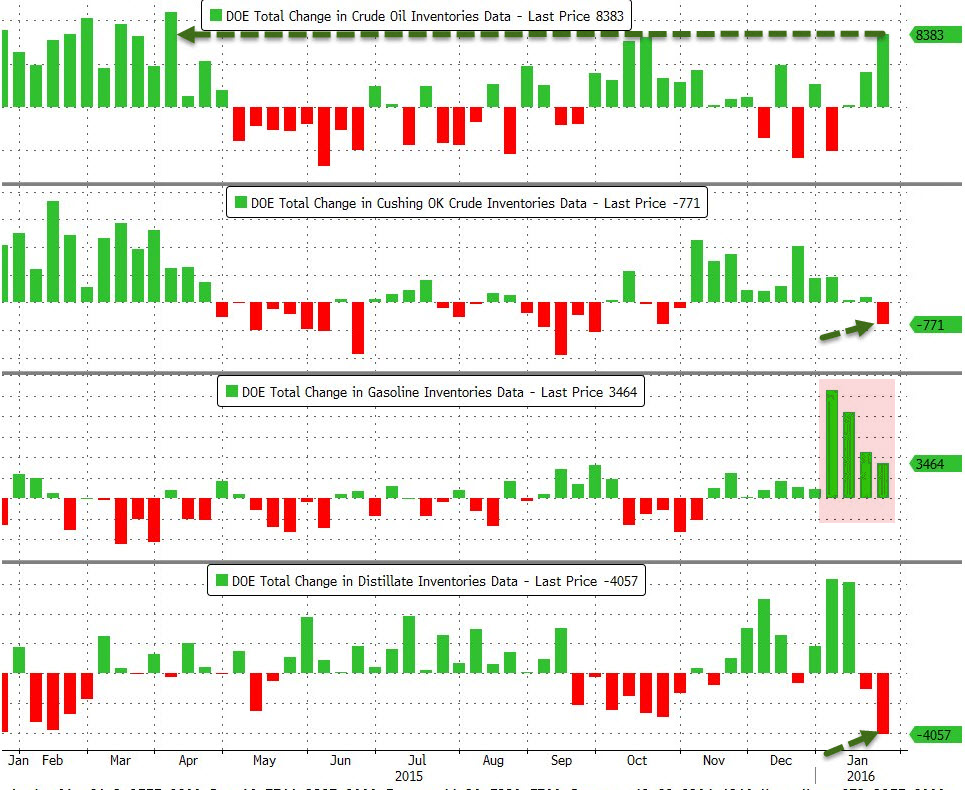
In other price sensitive news, the US DOE weekly inventory report exploded higher by 8.8 million barrels:
Stocks are now at their highest in a very long time:
Advertisement
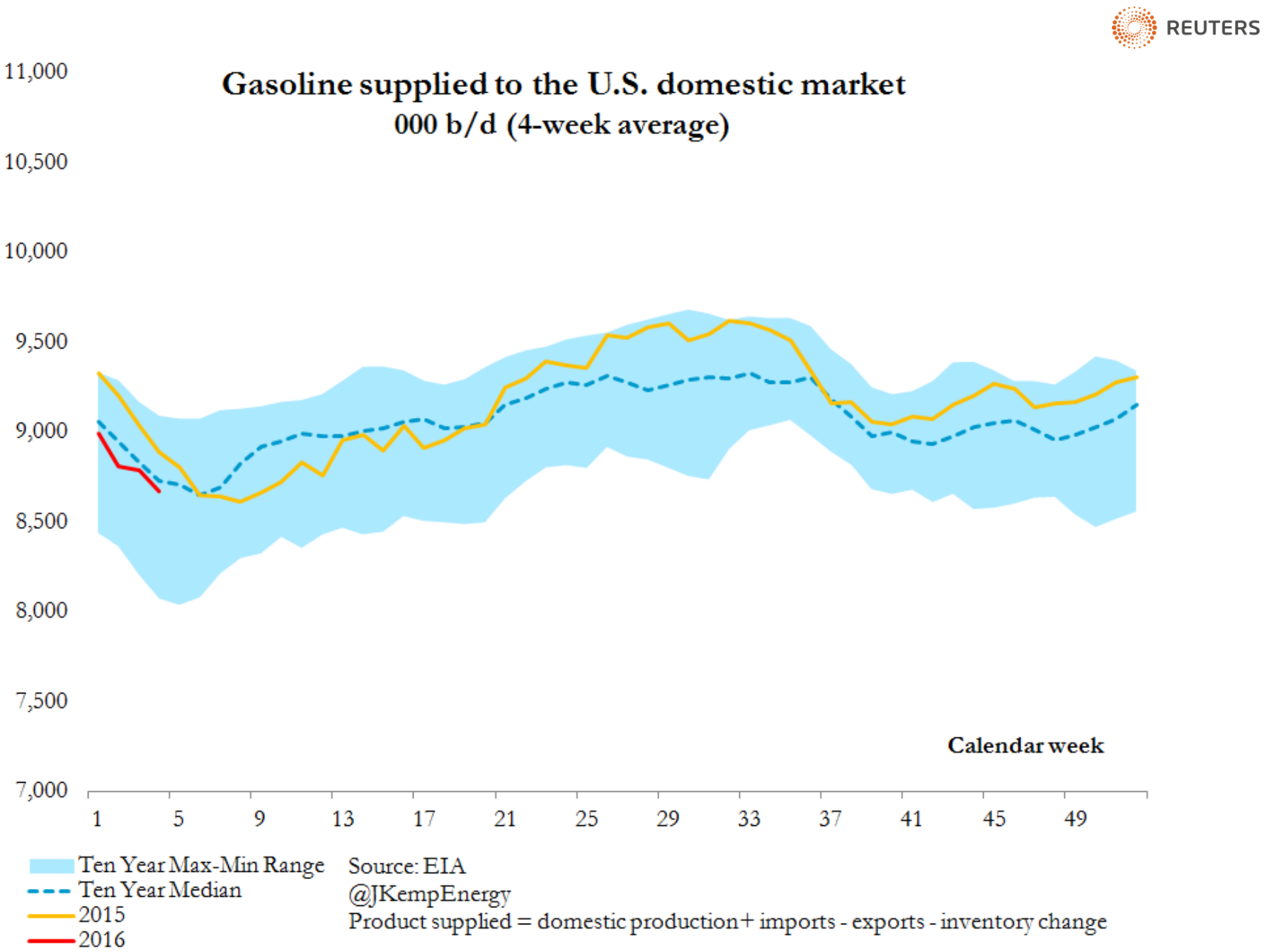
Indeed much of the report was bearish with gasoline demand down year on year, from John Kemp:
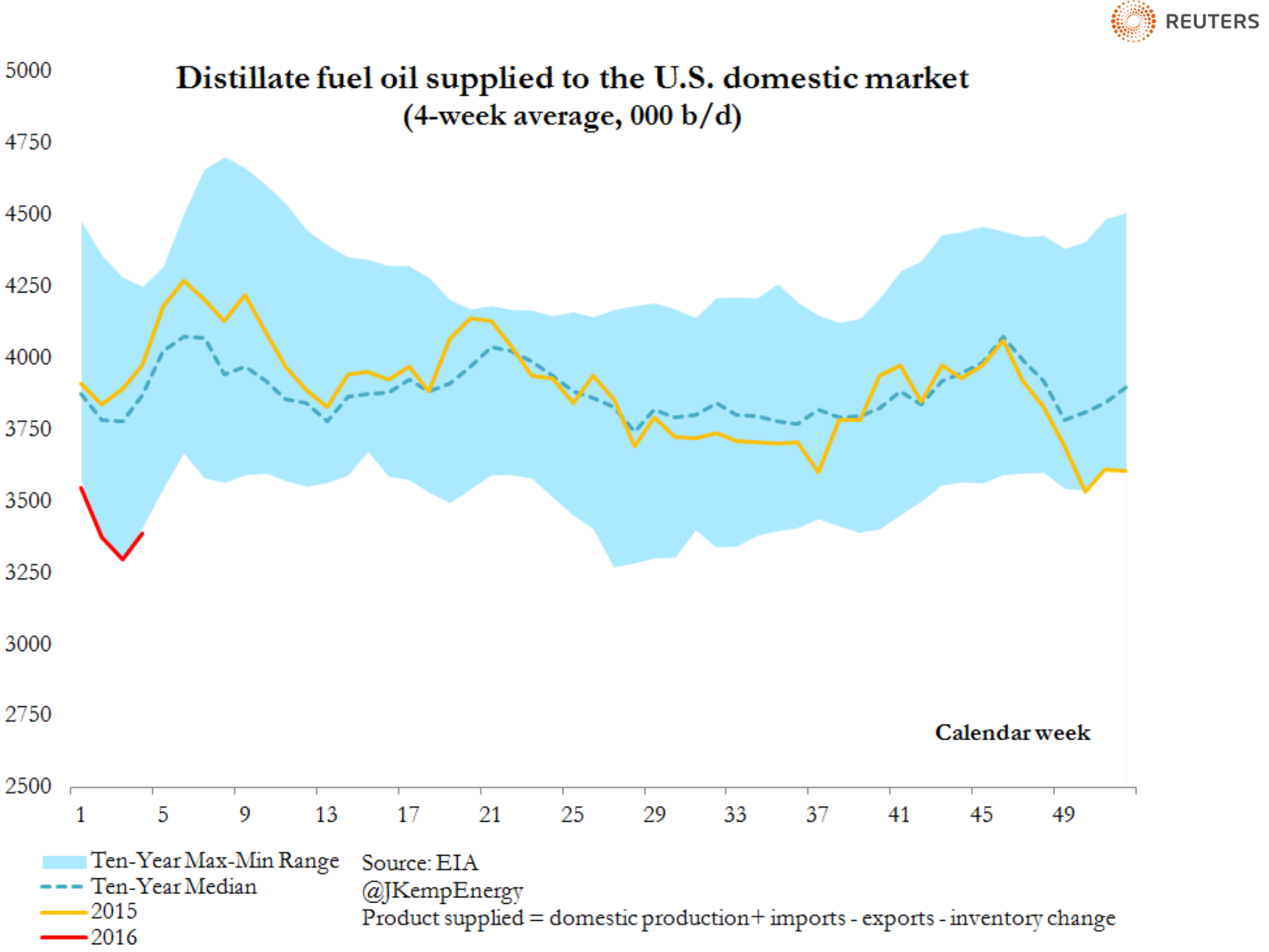
Diesel was even worse:
Advertisement
I remain of the view that we are in a bear market rally and short squeeze for oil not a bottom.
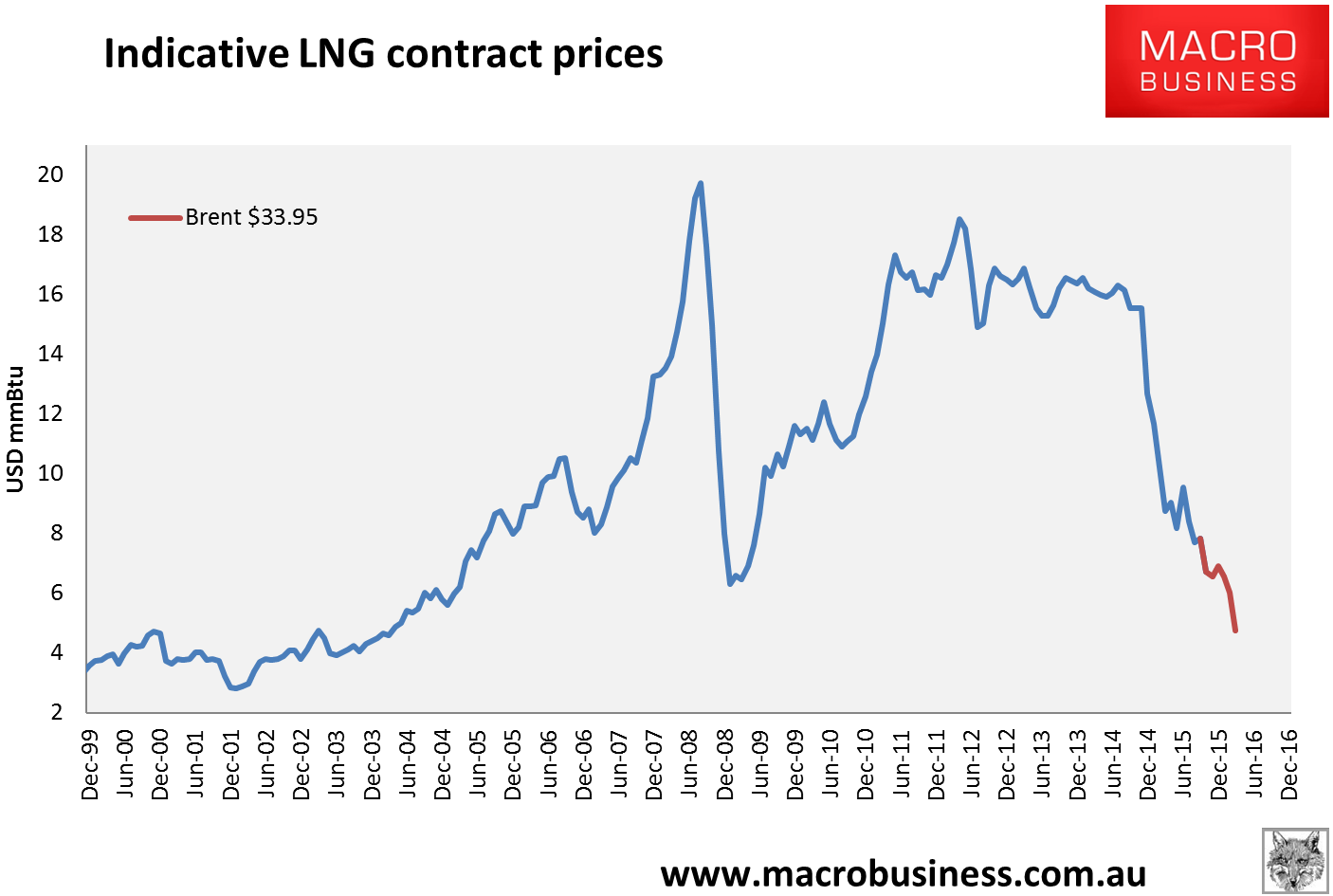
Turning to LNG, the indicative contract price rose to $4.67mmBtu:
Advertisement
In news, Iran looms as a gas as well as oil threat, from the WSJ:
Iran is pushing to find new ways to extract and export its vast natural-gas reserves, including developing facilities to liquefy the commodity and ship it to Europe in two years, now that Western sanctions have lifted, according to a top Iranian official.
Iran holds the world’s largest reserves of natural gas, but has long lacked the export infrastructure of competitors such Russia and Qatar. They have networks of international pipelines as well as liquefied-natural-gas facilities that enable them to export gas by ship.
Tehran is exploring several options to help the country “join the international LNG club,” said Alireza Kameli, managing director of National Iranian Gas Export Co., in an interview.
One project would involve restarting work on the country’s most advanced LNG project, Iran LNG, which was 40% complete when tightened Western sanctions forced work to be abandoned in 2012. It could take another three to four years to complete the project, Mr. Kameli said.
Another option would be building a pipeline beneath the Persian Gulf to Oman, which has LNG facilities that Iran could potentially use. Mr. Kameli said Oman has agreed to build the pipeline within two years. Omani officials didn’t respond to requests for comment.
Mr. Kameli said his company is also in talks with European companies, including Oslo- and Nasdaq-listed Golar LNG Ltd., to build floating LNG facilities—offshore vessels on which the gas would be liquefied. Such a project would take “less than two years,” he said. Golar declined to comment.
Those time frames look rhetorical but by 2020 is more realistic, which is supposedly about when the looming LNG glut will begin to be worked off freeing up projects like WPL’s Browse. I don’t buy that view given the subdued outlook for demand growth in Asia but with Iran’s monstrous and cheap reserves arriving on market about then you can forgedaboudit!
David Llewellyn-Smith is Chief Strategist at the MB Fund and MB Super. David is the founding publisher and editor of MacroBusiness and was the founding publisher and global economy editor of The Diplomat, the Asia Pacific's leading geo-politics and economics portal.
He is also a former gold trader and economic commentator at The Sydney Morning Herald, The Age, the ABC and Business Spectator. He is the co-author of The Great Crash of 2008 with Ross Garnaut and was the editor of the second Garnaut Climate Change Review.

and government officials in Moscow on Tuesday had reached the conclusion that talks with OPEC were needed to shore up the oil price.
Iran is pushing to find new ways to extract and export its vast natural-gas reserves, including developing facilities to liquefy the commodity and ship it to Europe in two years, now that Western sanctions have lifted, according to a top Iranian official.
