On the back of today’s housing finance figures, showing no stop in the ability of Australian household to gorge themselves on debt, comes this from Philip Soos, published at the Guardian:
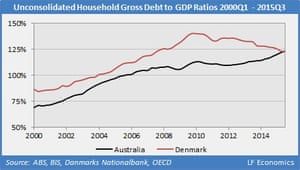
Research by the Federal Reserve has shown the consolidated household debt to GDP ratio increased the most for Australia between 1960 and 2010 out of a select group of OECD nations. Australia’s household sector has accumulated massive unconsolidated debt compared with other countries. As of the third quarter of 2015, it now has the world’s most indebted household sector relative to GDP, according to LF Economics’ analysis of national statistics.
Denmark long held this unholy accomplishment, but has been slowly deleveraging over the last several years as its housing bubble peaked and burst during the GFC. The latest debt-financed boom in Sydney and Melbourne has resulted in Australia now overtaking Denmark, a comparison of official figures from Australia and Denmark has shown.
Photograph: LF Economics
Australia has around $2 trillion in unconsolidated household debt relative to $1.6 trillion in GDP. Australia’s ratio is 123.08%, while Denmark’s fell slightly to 122.99% in the third quarter of 2015, a marginal difference of 9 basis points. Although Denmark holds the the record in terms of peak debt of 140.14% in the last quarter of 2009, as Australia continues to leverage and Denmark deleverages the current gap between the two will widen. Apart from Switzerland (which alongside Denmark has a negative interest rate), no other country is close in terms of having such extreme household sector debts.
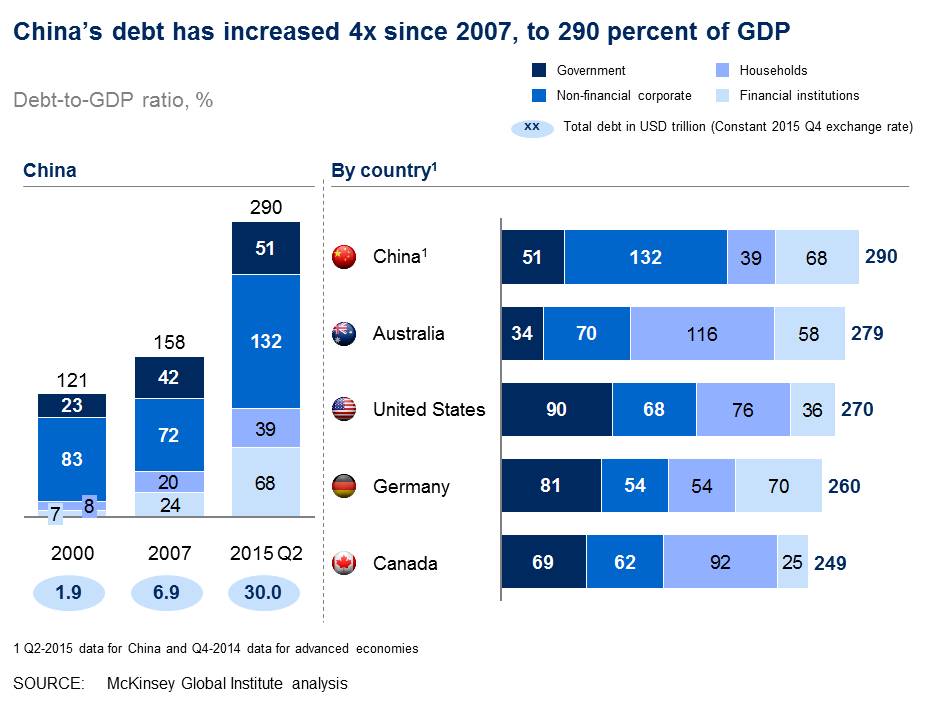
The discussion about Chinese debt levels has overshadowed this gold medal result as I showed here, where Australia only won the silver medal in overall debt:
Advertisement
Soos (who just recently joined Twitter – follow him here) sums up why this surge in household debt, almost completely ignored by local authorities, is at or near the top as the East Coat bubble boils (emphasis added):
Only a couple of housing market metrics is needed to identify a bubble, and are now considered commonplace: nominal price to inflation, price to income and price to rent. On all three, Australia is both historically and internationally at or near the top.
Since the advent of the GFC, it has become commonly accepted that the global real estate booms originated from rapidly expanding bank credit or private mortgage debt. It is not merely the growth of mortgage debt (the first derivative) but the acceleration (the second derivative), also known as the change in the rate of growth.
The future for investors and new homeowners is not good. Subdued capital price growth in the secondary capital cities, rental price growth at record lows, significant dwelling construction and a falling population growth rate leading to further oversupply all spell danger. The problems are compounded by the Reserve bank having little room for interest rate cuts, by weak macroprudential controls, minimal savings, low household income growth and anaemic GDP growth.
Captured by neoliberal ideology and the FIRE sector, government has no interest in stopping this immensely profitable yet dangerous gravy train, having enriched the already wealthy beyond avarice through privatisation of unearned economic rents rather than productive activity.
Exactly. Houses are a utility for shelter, but Australia has taken the gold, nay the platinum metal in commoditising this utility while lazily meandering into the Asian 21st century without a pot to piss in.