
According to Fairfax, Friday’s COAG meeting finished with a joint communiqué warning of “emerging budgetary pressures across all levels of government, particularly in the health sector”.
The Federal Budget, in particular, is looking dire, with three different analyses over the past fortnight estimating that the deficit will be between $33 billion and $39 billion worse than originally forecast over the next four years, thanks mainly to the collapse in commodity prices and lower than expected income growth.
Meanwhile, economist Ross Garnaut has called upon the Turnbull Government to be honest with voters about the worsening state of Australia’s public finances, in a bid to reset voter expectations and facilitate remedial action:
“Two prime ministers and treasurers were damaged greatly by the Treasury’s and their own failure to come to grips with a deteriorating budget outlook after the resources boom passed its peak”…
“It is important for Australia that Prime Minister Turnbull and Treasurer Morrison avoid a similar fate.”
Seeing blood in the water, Treasurer Scott Morrison has flagged that $5 billion of Budget cuts over four years will be announced in the mid-year economic update, in a bid to offset recent spending initiatives, but has curiously ruled-out increasing the overall tax burden. Also from Fairfax:
“The budget rules state that any new spending must be fully offset,” [Morrison] said…
“There have been a series of measures since the budget that require the offset rule to be applied such as the commitment to accept 12,000 refugee and humanitarian entrants, the reversal of the bank deposits tax as well as additional funding for Roads to Recovery”.
…[Morrison] has made it a priority to reduce the ratio of government spending to GDP from its current peak at 26.2 per cent. In May, the ratio was 25.9 per cent…
“The government will continue to restore the budget by controlling expenditure and supporting policies that grow the economy. The budget will not be restored by increasing the overall tax burden on Australians.”
The reasons for the deterioration in Budget finances are well know to regular MB readers, since we have been discussing these for nearly three years.
The main cause is the falling terms-of-trade, brought about by declining commodity prices (iron ore especially), which is weighing on national income growth and depressing collections of company taxes, personal taxes, GST, as well as state mining royalties (see below charts).
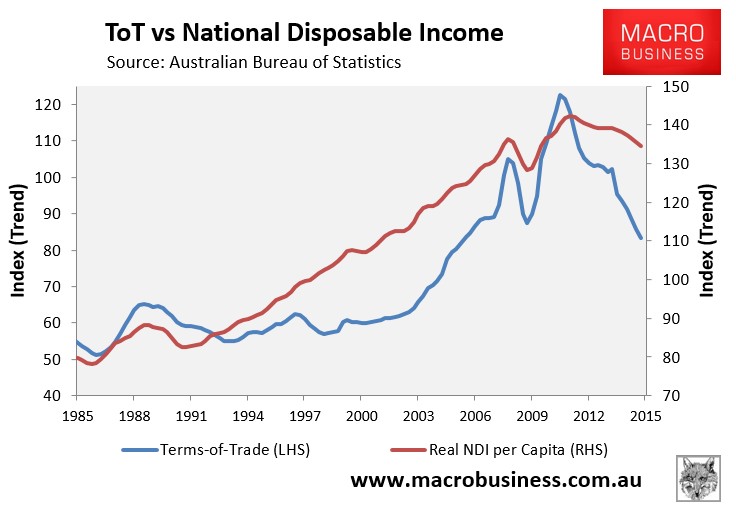
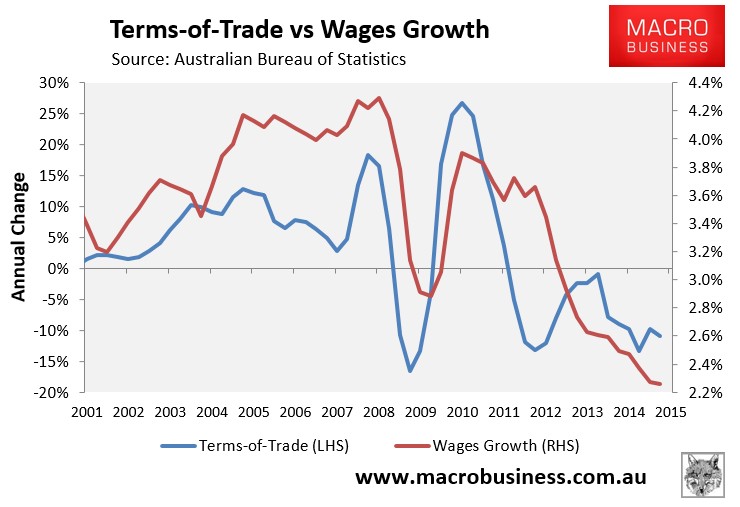
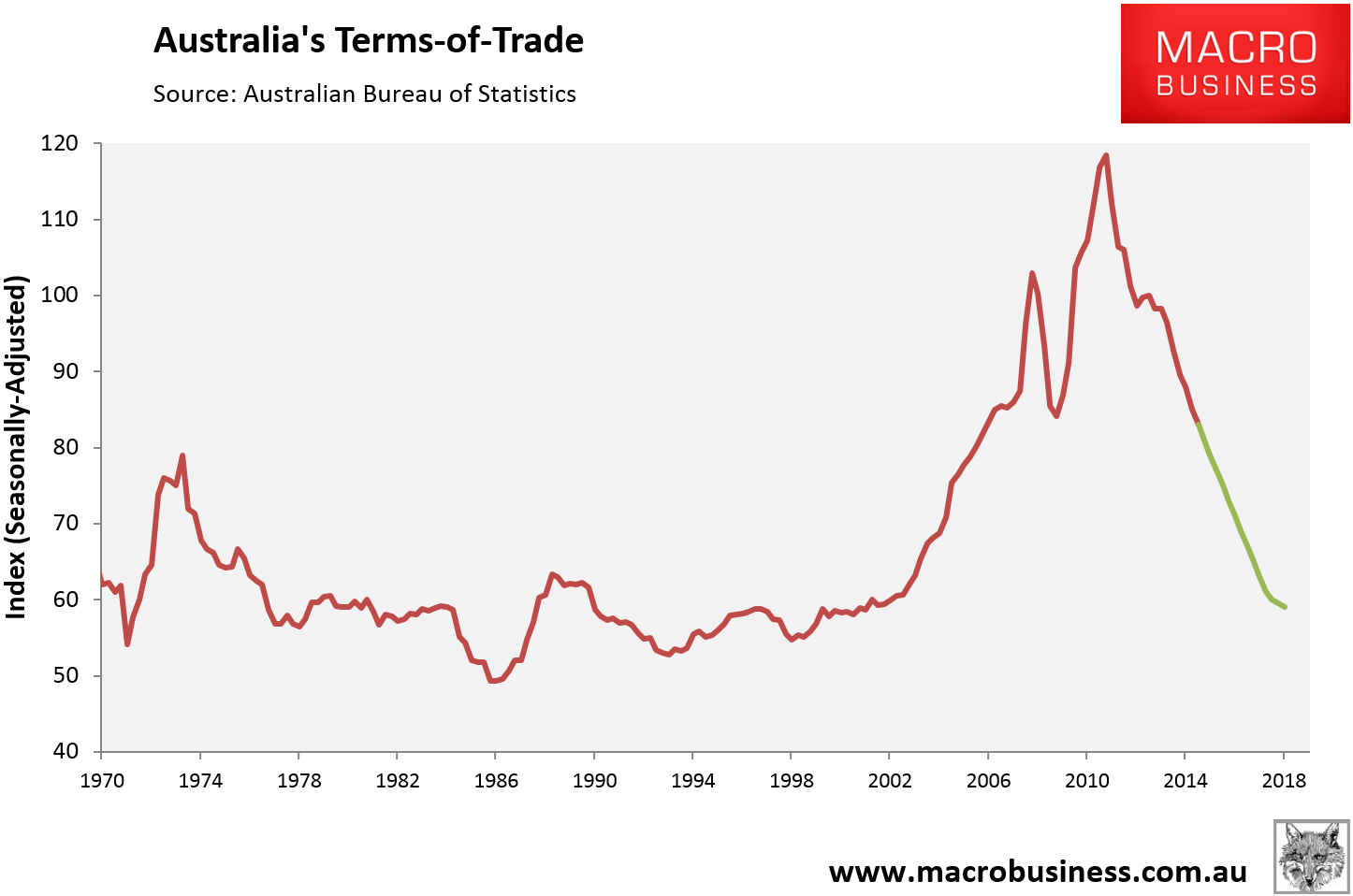
With the terms-of-trade having much further to fall before it retraces to historical norms (see next chart), there is unfortunately no end in sight. The Budget will remain under pressure for years to come.
Overlaying the revenue pressures from falling commodity prices and the terms-of-trade is the fact that Australia’s population is ageing, which means that the dependency ratio – i.e. the ratio of the non-working population, both children (< 20 years old) and the elderly (> 65 years old), to the working aged population – is projected to rise over coming decades as the baby boomers retire:
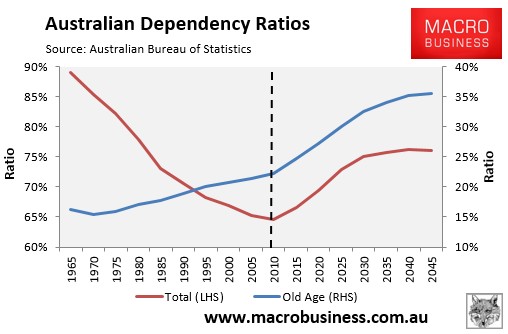
And with them, the number of workers per dependent will fall:
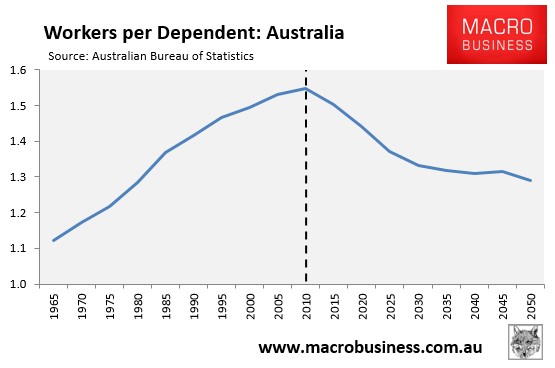
With the ageing of the population, the Government will have a much smaller pool of workers to collect taxes from, making it much more difficult to raise the required amount of tax revenue. The higher proportion of retirees and older aged Australians will also increase the amount of health and aged-care expenditure, significantly increasing overall Budget outlays.
The fundamental flaw with Treasurer Morrison’s view of the Budget is that he sees the deficit as primarily an expenditure problem, rather than both a revenue and expenditure problem. But given the above data, Australia clearly needs to take action on both the revenue and expenses sides.
Given the deteriorating circumstances, it is entirely appropriate for the government to seek to cut expenditure, so that spending is targeted towards those in genuine need. The key is to ensure that the burden of adjustment is shared across the economy, rather than being concentrated on those with less political representation (e.g. the poor and vulnerable).
The entitlement system set-up during the Howard and early Rudd years was never sustainable once the temporary revenue from the once-in-a-century mining boom ended, and in light of Australia’s ageing demographics. Whether we like it or not, Australia needs to tighten its belt, along with finding new revenue streams, either through abolishing egregious tax lurks, as well as increasing (broadening) some taxes.
Below is a short list of reforms that would help to balance the Budget in a equitable way, as well as improve efficiency:
- Unwinding the many tax concessions that are broadly inequitable, cost the Budget significant sums in revenue foregone, and reduce the progressiveness of the tax system, including: negative gearing, the capital gains tax discount on investments held for more than one year, along with FBT concessions on cars ‘purchased’ under a novated lease for private use.
- Taxing superannuation contributions/earnings at a progressive but concessional rate, as advocated by Deloitte, MB and the Henry Tax Review.
- Taxing superannuation earnings in the retirement phase, thus extending the 15% tax rate to fund earnings in that stage (perhaps with an offset for people earning below the tax-free threshold).
- Reducing superannuation contributions limits.
- Placing a lifetime cap on superannuation nest eggs.
- Tightening means testing of the Aged Pension by including one’s principal place of residence in the assets test, supported by an expansion to the Pension Loans Scheme, so that asset-rich retirees can continue to receive income support via a government-run reverse mortgage.
- Eliminating inefficient taxes like stamp duties, while raising efficient taxes on land and resource rents, as well as raising/broadening the GST (with compensation for the vulnerable).
- Extending the 2% Medicare Levy to incomes sheltered from tax by the above tax concessions (e.g. the CGT discount).
- Cracking down on discretionary trusts and private companies, which allow relatively well-off individuals to avoid tax by diverting and ‘sheltering’ their income or income producing assets.
- Abolishing the private health insurance rebate (which, less face it, is inflationary and hasn’t reduced pressure on public hospitals).
- Similar treatment for different types of savings.
As shown above, there are lots of reforms that Morrison could pursue that would help to balance the Budget whilst also improving equity and efficiency. And it should not occur in a revenue-neutral way – if it does, the Budget will remain heavily in deficit.
The most important priority is to reform the tax system to ensure that the tax base is broadened and built around more efficient and equitable sources, along with clamping down on poorly targeted leakages in the tax and welfare system.
Fundamental reform in these areas would not just improve the long-term sustainability of the Budget, but also improve the economy’s efficiency and the progressiveness of the tax and transfer system.
