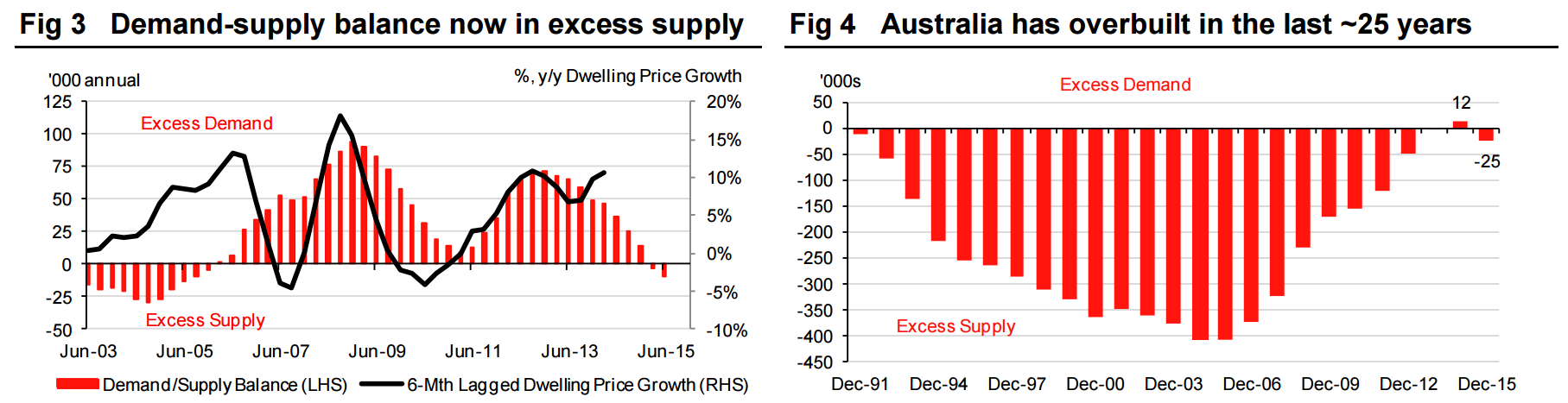
The outlook for the Australian housing market remains sluggish over the next few years…We maintain our view that price deflation is expected in 2016 and highlight that a typical contraction cycle lasts ~8 months in Australia. The key takeaways for the residential market in Australia from our analysis are:
Population growth expected to continue to slow.
Supply at record highs… running ahead of underlying demand.
Housing affordability is deteriorating in Sydney and Melbourne.
Risk to interest rates still to the downside, which would be a positive if passed on. Our Economics team expect a further 50bps of interest rate cuts in 2016 (May and August 2016).
Sales activity indicators indicate further price moderation from here. We observe that when auction clearance rates decline below a certain threshold, price declines typically follow.
Regulatory overhang remains. Regulatory bodies will continue to focus on slowing investor lending growth and also improving housing affordability.
Macquarie is forecasting 7% price falls in the year ahead. And while that is fair enough in an equilibrium scenario, my issue with it is that it will run smack into the nasty convergence of employment negatives that MB has highlighted many times for the year ahead. Job losses from:
mid next year in residential construction;
later next year from the shuttering car industry, and
all next year from the mining capex cliff.
We can add that if prices do fall at the rate expected by Macquarie then much of the recent frothy gains in the labour market, via retail and finance, will also also swiftly reverse. This raises the prospect that we see something of a feedback loop form between house price falls and the labour market. Rate cuts are assured but given we expect all of the above to also transpire within a deteriorating external context as the Mining GFC ramps up the last furlong of monetary easing may have less of an effect upon housing than hoped.
Advertisement
Thus a 7% fall might find itself on its way to something a little deeper and darker.
David Llewellyn-Smith is Chief Strategist at the MB Fund and MB Super. David is the founding publisher and editor of MacroBusiness and was the founding publisher and global economy editor of The Diplomat, the Asia Pacific's leading geo-politics and economics portal.
He is also a former gold trader and economic commentator at The Sydney Morning Herald, The Age, the ABC and Business Spectator. He is the co-author of The Great Crash of 2008 with Ross Garnaut and was the editor of the second Garnaut Climate Change Review.