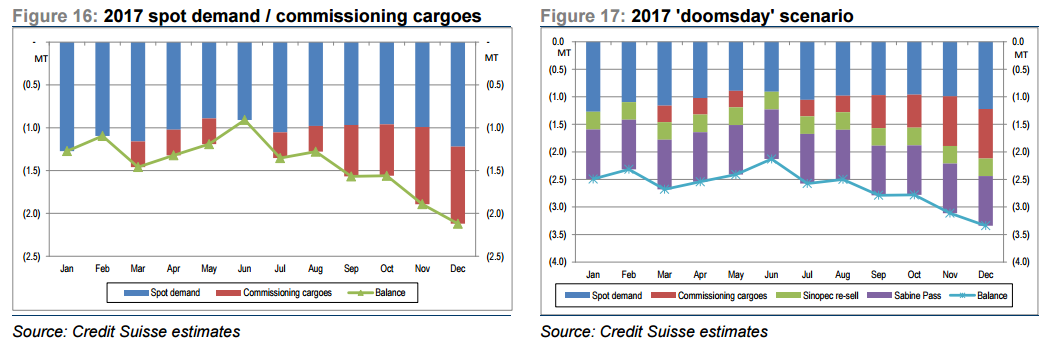
Credit Suisse today puts some numbers on a drum that I’ve been beating for a few years now: the degree to which the LNG spot market is going to undermine the term contract system:
Scenario I: 2016 monthly spot situation—no Downward Quantity Tolerance (DQT). Combining seasonalised spot demand in 2016 with our commissioning cargo forecast moves the monthly spot requirement in Asia from circa 1.5MT to 1MT net of commissioning. Importantly this assumes that no buyers call for DQT. DQT is usually 10% of the Annual Contract Quantity (ACQ), can only be requested at the ADP planning period (November to January each year) and is for ‘operational reasons’, i.e., the buyer can’t simply DQT to buy cheaper spot avails.
Scenario II: Assume buyers DQT 5% of 2016 contract quantities. Why 5%? Because not all buyers will be able to argue that their DQT request is for operational reasons.
Scenario III: Assume 5% DQT and Sinopec re-selling 50% of its APLNG off-take. Conoco confirmed last week that APLNG has relaxed destination restrictions for Sinopec’s offtake from that project (it’s not clear if that also applies for the other off-taker – Kansai Electric, but we wouldn’t be surprised that it was). In scenario III, we assume Sinopec sells 50% of its commercial off-take through 2016. The effect further weakens the market and suggests that spot cargoes would have to exit the basin in the Autumn to balance the market.
Scenario IV: All of the above and a soupcon of Spot from Sabine Pass. Sabine Pass trains 1 and 2 are due to complete in March and June 2016, respectively. For the total development 16 of the 18MTpa has been sold by Cheniere. Unlike Asian-based supply, there is no destination restriction on off-takers who are free to consume or re-sell as they see fit. If we assume the Panama Canal is completed in 2Q 2016 and that just 10% of the first two trains production targets the Asian spot market in 2016, the basin excess increases dramatically (to 1.5-2MT per month in 2H 2016).
I am sorry to say it but CS’s “doomsday scenario” is actually better than the outcome that I foresee. It’s forecasts for North Asian demand growth are better than mine and I do not expect the spot glut to diminish much beyond 2017. In fact, it could get even worse as contract reselling becomes a plague.
Thus I see a shockingly swift breakdown in the LNG contract system (much like what happened to iron ore in 2009 under pressure) and the very real danger that Australian producers will be forced to cut volumes before this is over.
David Llewellyn-Smith is Chief Strategist at the MB Fund and MB Super. David is the founding publisher and editor of MacroBusiness and was the founding publisher and global economy editor of The Diplomat, the Asia Pacific's leading geo-politics and economics portal.
He is also a former gold trader and economic commentator at The Sydney Morning Herald, The Age, the ABC and Business Spectator. He is the co-author of The Great Crash of 2008 with Ross Garnaut and was the editor of the second Garnaut Climate Change Review.