
Aussie living standards falling more than any recession
To add some perspective on why MB believes the Australian economy is so fragile, and why living standards are falling, I have once again taken the time to deflate three measures of the domestic economy, as provided in the March quarter national accounts (released yesterday), by the ABS’ population data, in order to ascertain the underlying strength of the economy in per capita trend terms.
The three measures chosen are:
- National Disposable Income (NDI), which is “considered a good measure of progress for living standards because it is an indicator of Australians’ capacity to purchase goods and services for consumption” (see ABS explanation here).
- Gross national expenditure (GNE), which is “the total expenditure within a given period by Australian residents on final goods and services (i.e. excluding goods and services used up during the period in the process of production). It is equivalent to gross domestic product plus imports of goods and services less exports of goods and services”.
- Domestic final demand (DFD), which is the sum of “government final consumption expenditure, household final consumption expenditure, private gross fixed capital formation and the gross fixed capital formation of public corporations and general government”.
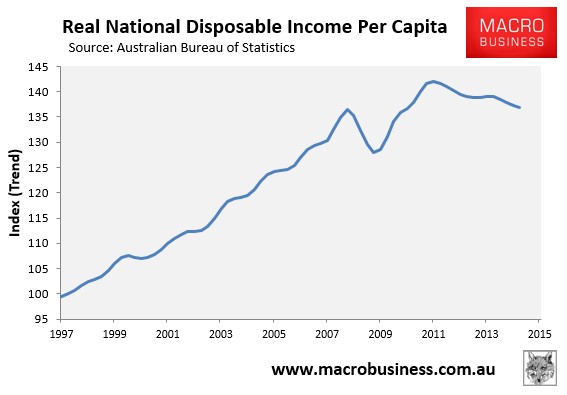
First, let’s consider per capita NDI. As shown below, this measure fell by 0.3% in the March quarter in trend terms, and has fallen by 3.6% since December 2011, suggesting falling living standards:
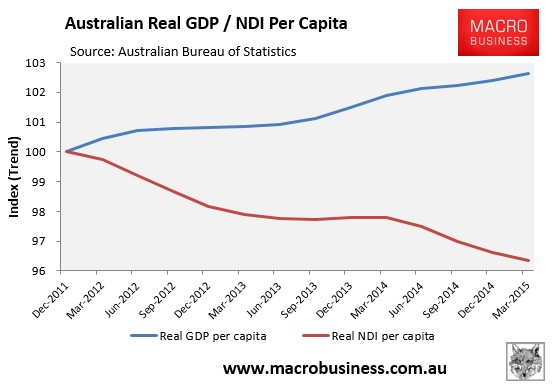
The divergence between per capita NDI and GDP is particularly revealing:
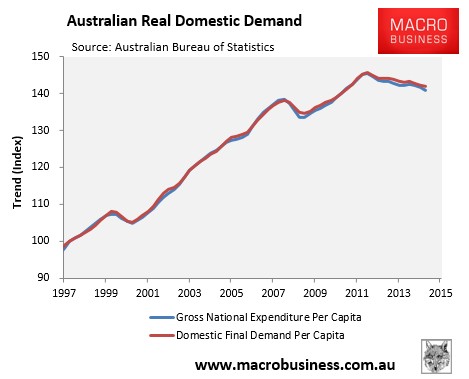
Similar trends are evident with GNE and DFD, which have also been falling since late-2012:
The big expansion in commodity export volumes that is supporting headline GDP hides the fact that the domestic economy remains weak, propped-up by elevated immigration. And because export prices are falling, national income and demand are going backwards, and the domestic economy is essentially experiencing a recession in per capita terms. We are selling more, but receiving less income in return.
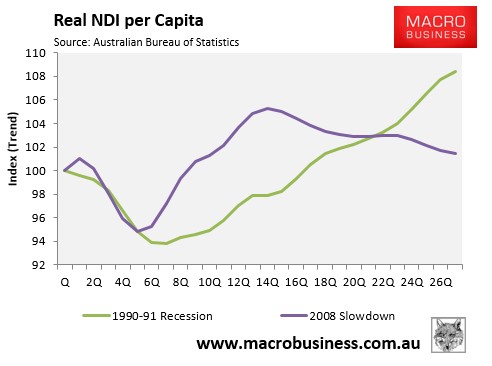
An examination of the national accounts data also shows that real per capita NDI since the onset of the GFC has grown far more slowly than at the same time after the early-1990s recession – 1.4% total growth since June 2008 versus 8.4% growth at the same point after the early-1990s recession – with obvious diverging trends (see next chart).
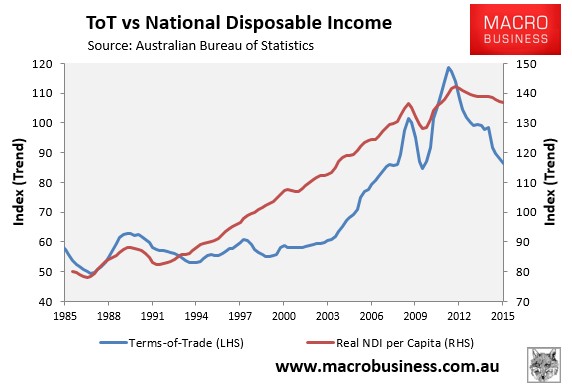
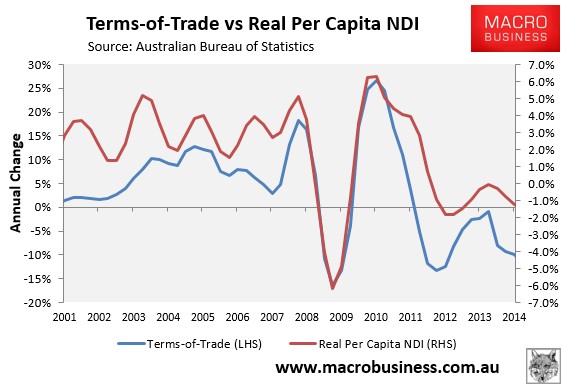
Of course, the reason for the recent decline in real per capita income is the sharp rise and then fall in the terms-of-trade, which after rising by 39% in the two years to September 2011 has since fallen by 26% (see below charts).
Even Australia’s GDP growth has been poor despite the record mining investment followed by surging export volumes. Once we subtract population growth, our performance since the GFC has been worse than the 1970s, 1980s and 1990s recessions:
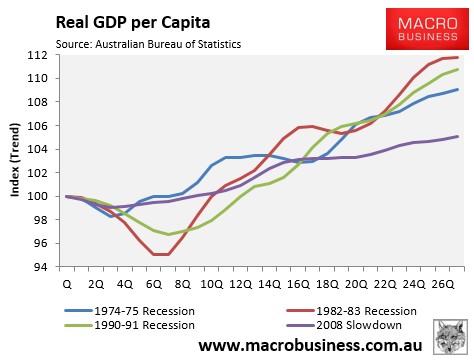
27 quarters after the onset of the GFC (June 2008), GDP per capita has only risen by 5.0%. The trends also are likely to widen the gaps further as the once-in-a-century mining investment boom unwinds over coming years, offset only partly by rising export volumes.
That, combined with falling per capita income, is why it feels like a recession already.
unconventionaleconomist@hotmail.com
