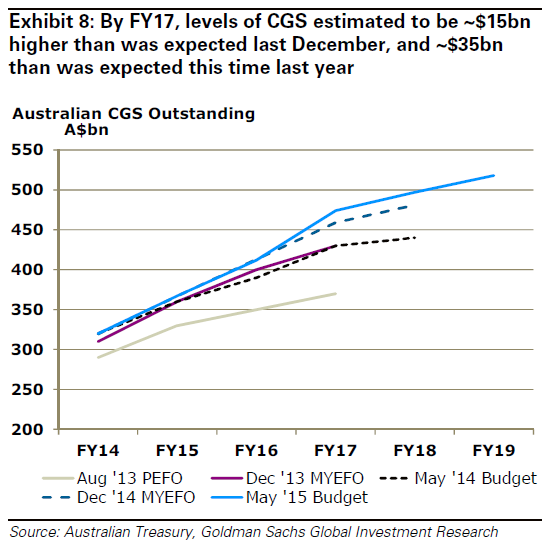
On S&P’s ratings framework, it is not just the level of net debt that matters – but also the forecast trajectory of gross debt and its credibility. At a high level, we note that the average increase in CGS outstanding (a reasonable proxy for gross commonwealth debt) over the 4 years to FY17 remains more consistent with a rating of 3 on S&P’s fiscal performance metric (than it does a rating of 2). Against the backdrop of Australia’s weak external position, this looks consistent with a rating slightly lower than AAA (stable).
o To date, S&P has adopted a very benign view of the Australian political economy, which we believe risks being overly optimistic. We note, for example, that S&P’s most recent detailed assessment of Australia highlighted “strong bipartisan and community support for prudent management of public finances” and also the expectation that “most of the eight micro-party or independent senators are likely to broadly support the Coalition’s agenda”. Clearly, with tens of billions of dollars worth of policy stalled in the senate for more than a year, this favourable opinion is being tested. On balance, there is a real risk that many key cost savings currently factored into the FY15 Budget numbers will not be delivered – resulting in further significant fiscal slippage and damage to the credibility of the promised consolidation on which the AAA rating is currently founded.
o We remain relatively less optimistic than Treasury on the outlook for iron ore prices. Specifically, compared with Treasury’s technical assumption that the iron ore price will remain at $US48 a tonne, our Commodity team’s forecast is for prices to be ~10% lower in 2016 ($US44) and ~20% lower in each of 2017 and 2018 ($US40). Using Treasury’s own sensitivities, this relative weakness in commodity prices might be expected to strip a further $US15bn from revenues over the forward estimates.
o Australia’s sovereign rating is also a function of the public finances of the states and territories. These budget updates are still mostly to come and we expect them to amplify the fiscal challenge – and not least because the Commonwealth used the FY14 Budget to significantly reduce education/health funding to the states in the period beyond the forward estimates. Fallout from this decision is likely to be increasingly evident in the states’ public finances over time.
o We remain very wary of the favourable cost of borrowing assumption used by Treasury in the FY15 Budget, given that relative to MYEFO the net public debt interest expense is forecast to be $1.2bn lower than over the four years to FY18 – notwithstanding the total amount of net debt and CGS outstanding being meaningfully higher over this period than was forecast at MYEFO. Specifically, given the rise in global bond yields since last December’s MYEFO, we question whether the new assumed weighted average cost of borrowing (2.5%; cf. 2.9% at MYEFO) might be too low. To the degree that this assumption converges to current global rates in future budget updates, the risk rises that Australia will come closer to breaching a key ratings threshold with respect to the cost of its debt.
David Llewellyn-Smith is Chief Strategist at the MB Fund and MB Super. David is the founding publisher and editor of MacroBusiness and was the founding publisher and global economy editor of The Diplomat, the Asia Pacific's leading geo-politics and economics portal.
He is also a former gold trader and economic commentator at The Sydney Morning Herald, The Age, the ABC and Business Spectator. He is the co-author of The Great Crash of 2008 with Ross Garnaut and was the editor of the second Garnaut Climate Change Review.