Event
This week the RBNZ announced additional macro prudential policy controls, targeted specifically at the Auckland housing market. The move is an interesting one given its targeted nature and as the median house price for Sydney moves ever closer to $1m, it is possible APRA may consider a targeted approach as well.
Impact
Additional lending restrictions on Auckland investor housing – announced in the NZ Financial Stability Review released this week were some key macro prudential policy changes to come into effect from 1 October 2015. The most interesting change was that investors in the Auckland area will be required to have a minimum 30% deposit for property purchases. The existing 10% high LVR speed limit for Auckland owner-occupier purchases was retained, whilst the 10% high LVR cap for lending outside of Auckland was eased to 15%.
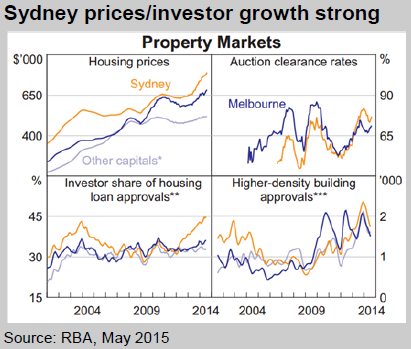
APRA could look to do the same in Sydney – whilst APRA has typically taken a more hands-off approach compared to their trans-Tasman counterpart, the stubbornness of the Sydney housing market (c30% price growth over the past two years) could force them to become more active and prescriptive with their policy tools. Such a move would likely be welcomed by the RBA that is being hamstrung by an equally stubborn Aussie dollar.
CBA and WBC the most exposed to Sydney – using the APRA points of presence data we can see each banks’ Sydney exposure based on the number of branches. Whilst this is not an exact measure of mortgage exposure and does not factor in the broker channel, we think it paints an interesting picture should APRA narrow their sights in on the Sydney property market. CBA has the highest proportion of their branches in Sydney with 18%, followed closely by WBC with 17%, ANZ with 15% and finally NAB with 12%.
Outlook
Continued house price strength in Sydney has been a real concern for the RBA given their desire to bring the Aussie dollar down through monetary policy. As they continue to work with other regulators a more targeted approach to macro prudential policy is a possibility. In this scenario the retail banks would likely be the most affected given their higher exposure to the Sydney property market.
I’d applaud such a move but I don’t think so. Capping Sydney prices is the same as busting them and APRA doesn’t have the cojones. That, in turn, would kill Melbourne property and recession would be upon us. This horse bolted two years ago.
What APRA is really about now is preparing the banks for the coming bust so that it’s not completely catastrophic.
David Llewellyn-Smith is Chief Strategist at the MB Fund and MB Super. David is the founding publisher and editor of MacroBusiness and was the founding publisher and global economy editor of The Diplomat, the Asia Pacific's leading geo-politics and economics portal.
He is also a former gold trader and economic commentator at The Sydney Morning Herald, The Age, the ABC and Business Spectator. He is the co-author of The Great Crash of 2008 with Ross Garnaut and was the editor of the second Garnaut Climate Change Review.