
As noted briefly by Houses & Holes, the Australian Bureau of Statistics (ABS) has released the Consumer Price Index (CPI) data for the March quarter 0f 2015, which registered a modest quarterly headline inflation, with underlying inflation rising slightly ahead of expectations (although well contained in annual terms).
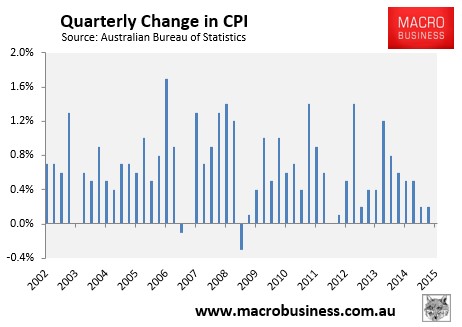
According to the ABS, headline CPI rose by a modest 0.2% in the March quarter, the same as the December quarter’s 0.2% rise (see next chart).
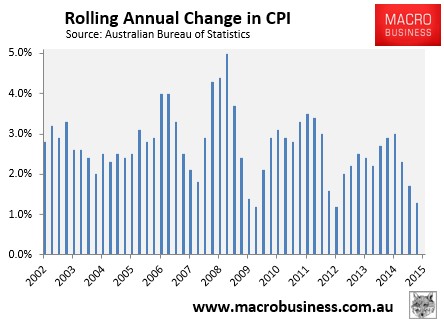
On an annual basis, headline CPI growth fell to 1.3% from 1.7% in the December quarter, which is well below the Reserve Bank of Australia’s (RBA) target of 2% to 3% growth over the medium term (see next chart).
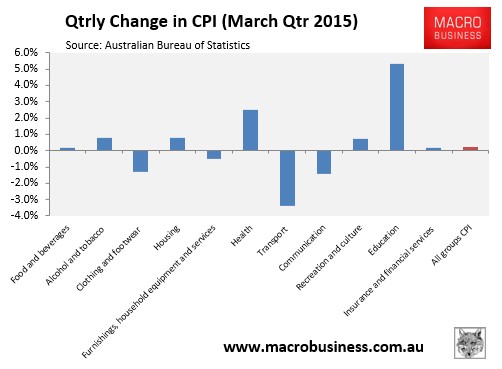
Looking at the major components, you can see that the quarter’s inflation was driven by rising Education and Health prices, partly offset by big falls in Transport (oil price-related) prices:
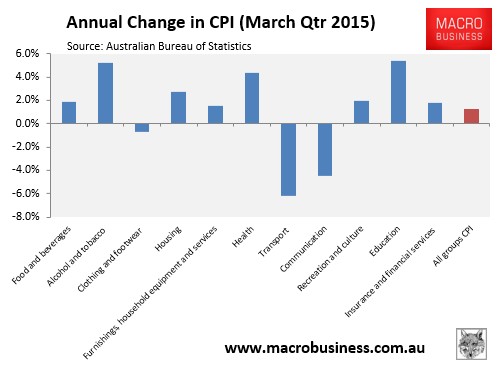
Over the year, prices rose in eight out of 11 key components, but were strongest in Alcohol & Tobacco, Education and Health, with Transport prices again the major offset on account of the falling oil price (see next chart).
The ABS includes an ‘analytical series’, which provides alternative measures of underlying inflation in the economy. These measures – namely the trimmed mean and weighted median – aim not to measure the size of inflation (which is captured by the headline figure), but the breadth of price inflation across the basket of consumer goods and services.
The purpose of these measures is to exclude unusually large price movements (in both directions) of just a few of the subgroups, which may have quite an impact on the headline CPI. By excluding these outliers, you can get a feel for how widespread across the consumer basket inflation really is (see here for further details).
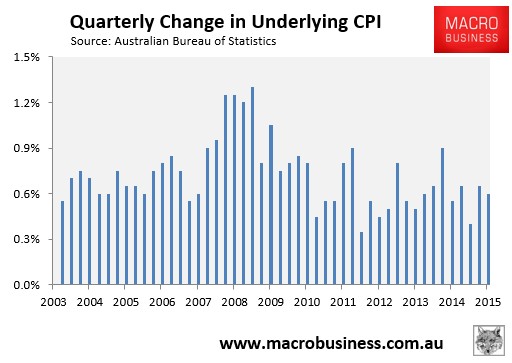
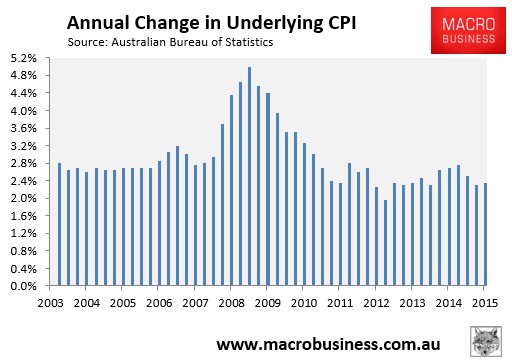
According to the ABS, the trimmed mean and weighted median measures were higher than the headline result, rising by 0.6% respectively over the March quarter but rising to 2.3% (trimmed mean) and 2.4% (weighted median) over the year – still well within the RBA’s inflation target.
The below charts, which average-out these measures, shows the underlying inflation on a quarterly and annual basis:
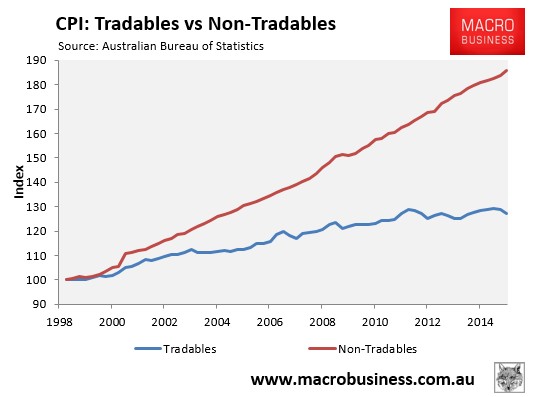
Finally, the below charts show CPI broken-out by tradables (mostly imports) and non-tradables (mostly services). As you can see, tradable inflation (circa 40% of the CPI basket) has been held down over the past decade or so by the rising Australian dollar and cheaper goods from China:
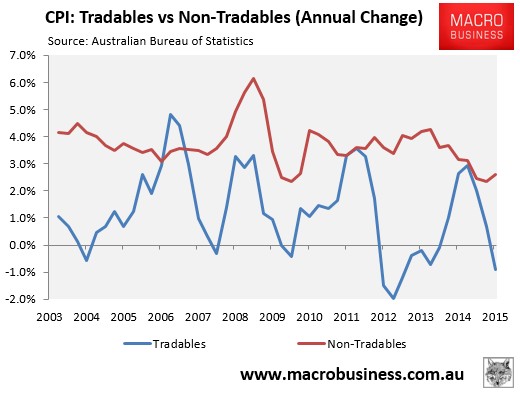
The sharply falling oil (petrol) price has also meant that tradable inflation has fallen sharply in recent times, despite the devaluation of the Australian dollar, just as non-tradable inflation has begun to rise:
In summary, inflationary pressures across the Australian economy remain well in-check, despite this quarter’s modest lift in annual underlying inflation.
The chronically weak domestic economy – characterised by relatively elevated unemployment, weak wages growth, and excess capacity – should also keep inflationary pressures in check, even in the event that the falling Australian dollar eventually causes an uplift in tradable inflation.
