
The RBA released an interesting document in its Bulletin yesterday looking at the impacts of the LNG boom on the economy:
The decline in LNG investment and ramp-up in LNG production and exports is expected to affect Australian economic output (real GDP) and national income in a number of ways. LNG investment contributed an estimated ¼ percentage point on average to Australian annual GDP growth between 2008 and 2013, once the high share of imported inputs used to construct these projects is taken into consideration. The peak in LNG investment was in late 2013, and the continued falls in LNG-related investment will subtract from GDP growth in the next few years as the construction of large-scale projects is gradually completed. As the projects begin to ramp up production, the Bank currently estimates that LNG exports will contribute around ¾ percentage point to GDP growth in 2016/17. The timing of the boost will depend on whether these projects are completed on schedule and how quickly production is ramped up. As production of LNG gradually stabilises at a higher level, the boost to GDP growth will dissipate although GDP will remain at a higher level.
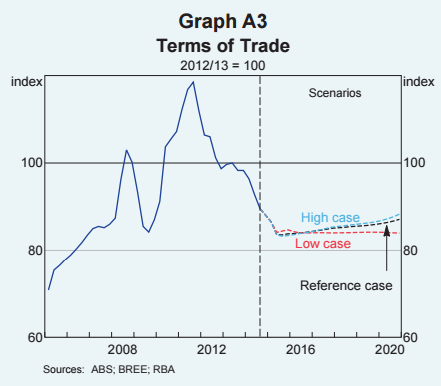
LNG is expected to become Australia’s second largest commodity export in value terms after iron ore by 2018. This means that LNG will have an increasingly important bearing on Australia’s terms of trade over the next few years. As Australia’s LNG export prices are tied to oil prices, fluctuations in the global price of oil will have an important effect on the terms of trade (see ‘Box A: Oil Price Scenarios and LNG Export Prices’). While changes in the terms of trade do not directly affect real GDP, they will affect the purchasing power of domestic income. This effect is commonly measured by comparing the change in real GDP with the change in real gross domestic income (real GDI), which deflates nominal exports by import prices rather than export prices (RBA 2015). However, in the event that LNG prices boost the terms of trade (e.g. if oil prices were to increase over the next few years), the real GDI measure will overstate the increase in purchasing power of national income as some of the benefit from the rise in terms of trade will accrue to foreign investors (e.g. through dividend payments to non-resident owners of LNG companies operating in Australia), and as a greater share of gross income will be used to offset depreciation of the LNG capital stock as it increases in size. Real net national disposable income (real NNDI) attempts to adjust real GDI for these effects. While it is difficult to gauge the share of foreign ownership of the LNG industry, it is estimated to be substantial. This suggests that a sizeable portion of profits will flow to foreign investors.
With this in mind, the rise in LNG export receipts is expected to affect the domestic economy in a number of different ways. Household incomes are boosted for those employed in either the LNG investment or production phase. However, liaison and company reports suggest that the production phase of LNG is highly capital intensive and will not require as much labour as the investment phase. Household incomes will also be supported via the domestic share of the profits of LNG companies. To the extent that the increase in government revenues (discussed below) are passed on to households via transfer payments or changes to taxes, this will also support household incomes. The effect of changes to domestic gas prices resulting from increased LNG production for export markets will offset some of these factors on real household incomes.
Government revenues are also expected to rise as LNG production increases. Federal government revenue will increase via corporate tax income and the petroleum resource rent tax, while some state and territory governments will receive higher royalties. The magnitude of the increase to revenues will depend on the prevailing oil price and royalties arrangements between state and territory governments and LNG producers, and the extent to which tax payments will be reduced by deductions (which are assumed to be fairly large in at least the first few years of production).
Conclusion
By 2018, Australia is expected to become the world’s largest exporter of LNG. The bulk of these exports have been purchased by Asian importers under long-term contracts, and the price of these is linked to the oil price. There are a number of factors that are likely to influence the Asia-Pacific LNG market over the next decade, including the emergence of the United States as a key supplier of LNG and the gradual change in the scale and composition of energy demand in Asia. Australian production of LNG is expected to ramp up substantially over the next few years, providing a significant contribution to domestic output. The effect on Australian living standards will be less noticeable than this given the low employment intensity of LNG production, the high level of foreign ownership of the LNG industry and, in the near term, the use of deductions on taxation payments.
Hmmm, well, a few problems here. The major issue is that this is partial analysis. Where is the assessment of the impacts of LNG exports on the east coast gas market and economy? Victoria University modeling has shown that the higher the LNG price gets, the worse the income impacts upon east coast economies as the gas price shock hits manufacturing and households. If we add the west and north coast projects the net impact may be a marginal positive but only if gas reservation keeps the price down and that does not look altogether likely.
The second issue is the terms of trade forecast. If the RBA thinks the correction is going to stop there then its got a nasty shock coming.
The third issue is that while the RBA is technically correct in describing LNG as adding to “domestic output”, it is in reality a massive subtraction from domestic economic activity as employment collapses 90% from construction to production. It will add to GDP of course but to get domestic activity that creates jobs the output will need to be transformed into something else, and we all know what that will be.
The available GDP boost will be leveraged up offshore by our banks and dumped into house prices with some wealth effects that fuel a few years of activity for the services sector. But, we tend to use these things up in advance so that second step is happening right now as interest rates fall.
In short, LNG has already saved us, but the lifeline is being used up awfully fast.
