Record passive cash reserves held by Australian corporates are leading to underperformance and destroying shareholder value, Deloitte said today.
According to a new research paper – The Australian Cash Paradox – Australian companies need to use their cash holdings to re-focus on growth and M&A.
Deloitte Mergers and Divestments lead partner Robert Arvai said: “The emergence of this ‘cash paradox’ among ASX 200 companies is a real challenge.
“Companies holding the majority of the cash war chest in corporate Australia are actually growth laggards. And lazy capital is delivering lazy growth.”
The research shows that among ASX 200 non-financial services companies:
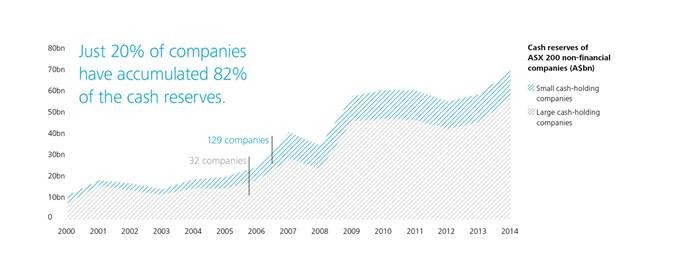
· Just 32 are holding more than 80% of Australia’s corporate cash reserves, currently $57 billion (at the end of FY14), up from $19 billion in 2006
· Only $13 billion is held by small cash holding companies (80 % of companies and 20% of total cash reserves).
“Not surprisingly, the GFC had a profound impact on corporate ‘cash hoarding’ tendencies, particularly among larger companies,” Arvai said.
“The cash reserves of our large cash holders jumped from $24 billion in 2008 to $46 billion in 2009. In contrast, the small cash holders held a balance of $11 billion in 2008 – and this remained fairly constant throughout the crisis years, and currently stands at $13 billion.”
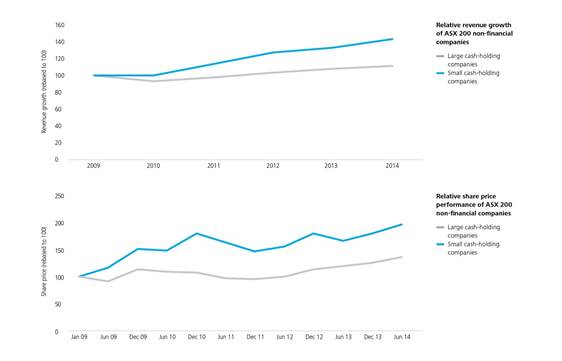
Report co-author and Deloitte Mergers and Divestments director Lee Dryden said: “Importantly, the cash-rich corporates have been underperforming by a factor of three since the GFC, compared to companies with relatively small cash-holdings, measured either by quarterly revenue growth or share price performance.”
Small cash-holding companies have experienced higher revenue growth since 2009 – a five-year compound annual growth rate (CAGR) of 6.5% compared to large cash-holders that experienced a CAGR of 1.9% over the same period. More striking is the relative share price performance of the two groups. A clear divergence of performance exists from 2009, with small cash-holders producing better returns.
“Remarkably, the gap widened even more after the GFC, suggesting that in the long run, financial markets are rewarding companies that take a bullish attitude towards growth,” Dryden
Growth opportunities for Australian corporates were identified in the third report in Deloitte’s Building the Lucky Country series. Positioning for Prosperity? Catching the next wave identified a ‘Fantastic Five’ sectors (agribusiness, tourism, gas, wealth management and international education) that offer the next waves of above market growth over the long term, while another 25 sectoral hotspots, including aged care, medical research, retirement living and financing the ‘Fantastic Five’, were also identified. Outside Australia, market opportunities in a number of Asian economies, and particularly China, India and Indonesia, are also plentiful.
“Of course companies will continue to grapple with ‘yield v growth’ strategy dilemmas. But the challenge for CEO and CFO agendas remains to optimise capital between investment, financing and dividend decisions,” Arvai said.
“As Reserve Bank of Australia Governor Glenn Stevens recently said: “At some stage, the equity analysts, shareholders, fund managers, commentators and so on will want to be asking not ‘where’s your cost cutting or capital return plan?’ … but ‘where’s your growth plan?’”.”
“So, it’s time to address the cash paradox in corporate Australia and for cash-rich companies to re-evaluate their ‘yield v growth’ strategies.
“Looking ahead, winners will likely be those that understand the cash paradox, take a long term outlook, and are decisive and steadfast in their pursuit of growth.”
I don’t see any shareholders clamoring for growth plans. I see them clamoring for dividends in the a world of low returns. Moreover, what are these cash-hoarding corporates supposed to do with the cash if they don’t trade in Deloitte’s five growth sectors? The cash is reflective of weak demand for their products and services.
This is more “confidence” twaddle. Fix the nation’s competitiveness and more investment will come, and not before.
David Llewellyn-Smith is Chief Strategist at the MB Fund and MB Super. David is the founding publisher and editor of MacroBusiness and was the founding publisher and global economy editor of The Diplomat, the Asia Pacific's leading geo-politics and economics portal.
He is also a former gold trader and economic commentator at The Sydney Morning Herald, The Age, the ABC and Business Spectator. He is the co-author of The Great Crash of 2008 with Ross Garnaut and was the editor of the second Garnaut Climate Change Review.