
Lot’s of talk today of possible mergers and corporate action in the iron ore sector. The best of it comes from Alberto Calderon via the AFR:
Correct though I think regulators will be far less sanguine than than Alberto reckons owing to the vertical integration of the GlenRio model. The chances of China passing it are close to nil in my view. Glencore also spoke with Cliffs:
Spurned by Rio Tinto, Glencore chief executive Ivan Glasenberg continued to look at other potential iron ore targets with a call to US miner Cliffs Natural Resources, according to people familiar with the matter.
Glencore talked to Cliffs about its Australian iron ore assets around a month ago, these people said. While that conversation was described as very preliminary, the call underscores that Mr Glasenberg isn’t placing all his iron ore ambitions on another attempt at Rio Tinto.
That would have been a short conversation. Cliffs Australian mines are expensive and are going to shut. Others are arguing that Glencore’s real target is Fortescue, from Moneyweb:
Probably John Tumazos hit the 150mt nail on the head.
The question to Tumazos, owner of Very Independent Research, was: What, as a Fortescue Metals follower, did he make of Glencore, now rebuffed by Rio Tinto, taking over the upstart iron ore miner instead?
Fortescue is: already number four in the iron ore world; a nimbler iron-only titan among much larger and more complicated diversifieds; a miner with lowish-cost iron ore assets in Australia, that is, near-to-China; and new; a company built and controlled by kangaroo billionaire Andrew Forrest (AKA Twiggy).
…Fortescue could bolt on to Glencore in ways none of the diversifieds could. It is a simple, but very large, iron ore mining company in one of mining’s most valuable sectors where Glencore is incredibly weak.
…Fortescue is doing well. It’s advertising basic operating costs on Australian operations at under $35/tonne this year and $31-$32/tonne next year. It’s not as good as Rio Tinto, which is near $20/tonne and set to go a lower, or BHP under $25/tonne, and also set to go lower, but it is pretty good. Glencore would see that too.
So if Glencore got Fortescue it would become a force to be reckoned with in iron ore mining, and meantime, it would have fewer headaches with regulators than if it was tieing up with another diversified.
…And their would be, to speculate further, the possibility of others entering the fray if Glencore made a predatory move. Tumazos rhymed off a few possible white nights: “Gina Rinehart’s Hancock Prospecting, a Chinese or Japanese entity, other local Australians or other overseas companies could surface,” he said.
By the way, there’s an analyst trip to Fortescue’s operations coming up at the end of October. Tumazos plans to go.
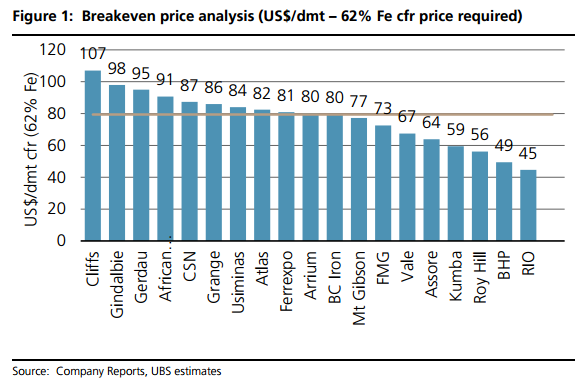
Good for him. Maybe he’ll find a brain there as well. FMG is not a good buy for anyone. The prices quoted on costs are for wet metric tonnes. FMG has to dry its iron ore which is one major reason why its all-in break even jumps $25-30 above that of RIO. FMG is shaping as the marginal cost producer in the new normal iron ore market which is the last place anyone wants to be. In that position, any cost savings from a merger with Roy Hill or Glencore or anyone else will simply be recycled as cheaper iron ore to China.
The only reason to buy FMG is to either keep pressure on iron ore prices (China) or to boost prices by shutting its production (one of the majors). This is now a race down the cost curve in iron ore and that’s the end of it.
On that front, it appears Vale has just cut $5 per tonne from its costs:
A giant iron-ore freighter owned by Vale SA was allowed to dock at a Chinese port last week, Reuters data showed, the first since the Brazilian miner signed deals with two of China’s largest shipping groups in what was seen as a thawing of relations.
Chinese ship owners have opposed access for Vale’s mega-ships of 400,000 deadweight tons, known as the Valemax, saying they could worsen a shipping glut and steal market share. In 2012, the Ministry of Transport banned the ships from China’s ports, citing safety concerns.
But last month, Vale signed deals with state-backed firms China COSCO and China Merchants Energy Shipping in a move that marked a breakthrough in the lengthy standoff and prompted analysts to forecast that Valemax ships would soon be docking in the world’s top iron ore consumer.
That adds to its healthy lead over FMG on costs:
It’s simple economics that you buy low margin businesses in the up-cycle and high margin businesses on the down. Glencore’s target is RIO or some other high margin business. It knows the volume strategy is going to kill their share prices.
