

Barrons reckons you should buy RIO:
Mining giant Rio Tinto is a rough diamond due for a bit of a polish. The Anglo-Australian firm said last week that it had rejected a tentative takeover approach from commodities-trading powerhouse Glencore, but Rio’s shares can benefit from its focus on becoming a leaner, more efficient and cash-producing business.
Even if a combination with Glencore (ticker: GLEN.UK) doesn’t ultimately emerge, Rio’s stock (RIO.UK) can climb 20% in the next 12 months. Mergers and acquisitions interest, however tenuous, is just another reason to own it.
…THERE’S NO DENYING that Rio Tinto is cheap. Glencore’s chief executive, Ivan Glasenberg, spied an opportunity to pick up a bargain and plug a hole in his company’s portfolio. Glencore has no experience in iron ore, which will account for as much as 70% of Rio Tinto’s projected earnings next year.
…This year, Rio Tinto is projected to earn £3.18 per share, or net income of $9.14 billion on sales of $48.57 billion. In 2015, EPS is forecast at £3.23. The stock offers a generous dividend yield of 4.1%.
Analysts are generally bullish on Rio Tinto. A consensus price target of £37.44 suggests upside of about 20%. Whether or not Glencore takes another run at it, Rio Tinto still looks like a gem.
RIO is cheap, NOT. A lousy dividend yield of 4% on a trailing P/E of 15 does not mitigate against the threat of falling iron ore prices (which will make up more like 90% of next year’s earnings). Consensus pre-tax profit estimates for 2015 are $15 billion, which will be achievable only if iron ore averages $90 plus:
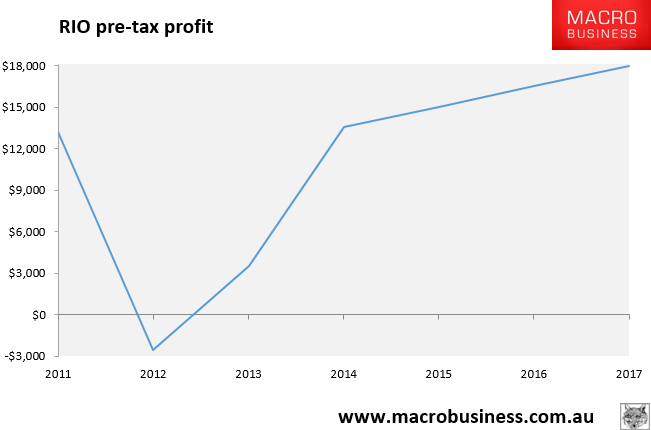
If the iron ore price averages in the $75-80, which is reasonable, earnings will fall by 25-30%. The only thing RIO has to recommend it is Glencore and that’s not going to happen without more share price pain.
