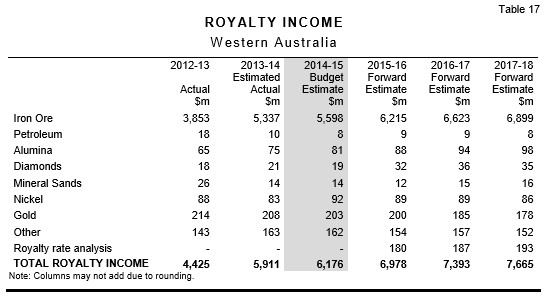
MB has recently been tracking the impacts of iron ore on West Australian Budget. Iron ore royalties are projected to grow to 23% of total revenue:
But the government has been far too aggressive in its price and revenue assumptions:
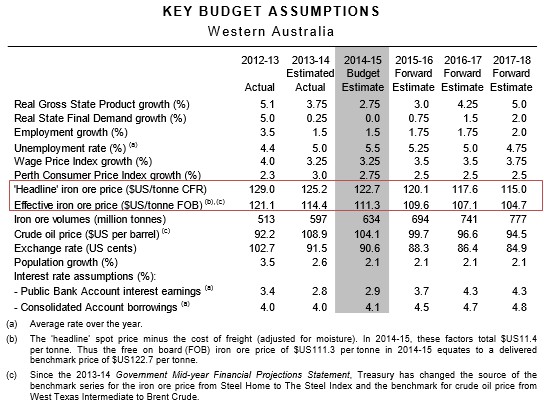
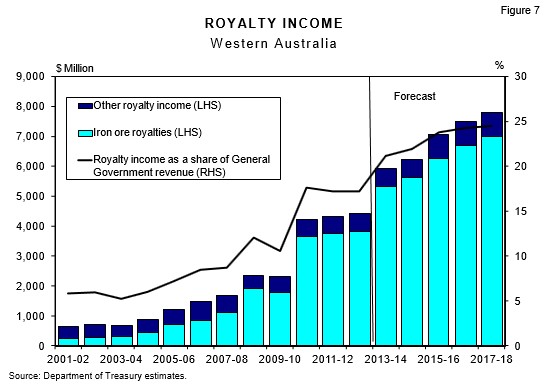
$90 is the new normal so royalties are going to miss big, by between 20 and 30%. The ABC is reporting that the government is still determined to deliver its slim $175 million surplus:
West Australian Premier Colin Barnett has flagged further spending cuts to deliver a promised budget surplus if the iron ore price does not recover.
The price of iron ore has slid below the benchmark level of $US90 a tonne for the first time since September 2012 as demand from China drops.
It is now down 34 per cent for the year.
Treasury has forecast an average price for the coming financial year of $US111.
Mr Barnett said while he expected the iron ore price to rebound somewhat, the government was committed to delivering a surplus regardless.
“We have budgeted for a surplus and if it’s necessary to make further cuts in expenditure to achieve that, we will do it,” he said.
The cuts will need to be in the order of billions not millions. Given WA is also facing the capex cliff and employment shock, as well as a likely stall in real estate, one wonders about the wisdom of applying austerity on top. State final demand is already falling sharply:
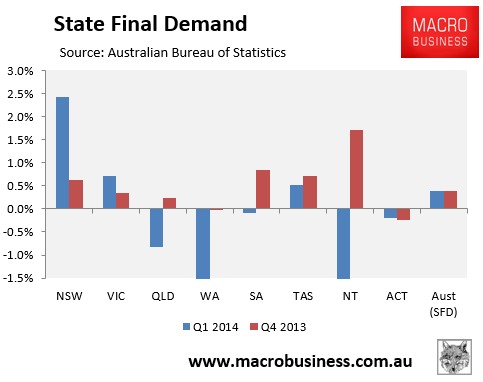
This matters because state final demand is a much closer representation of real economic activity on the ground. As we’ve explained many times, during the next phase of the mining boom net exports will improve headline growth for the nation but falling investment as major projects are completed will weigh on real activity, especially jobs.
Both QLD and WA are charging backwards at the moment on the combined coal and iron ore busts, which are going to get much worse before they get better. Still to come are the massive LNG project completions, three each of which are in WA and QLD. NAB estimates that the associated capex cliff will take out 100k jobs over the next two years and most of these are going to be in QLD and WA.
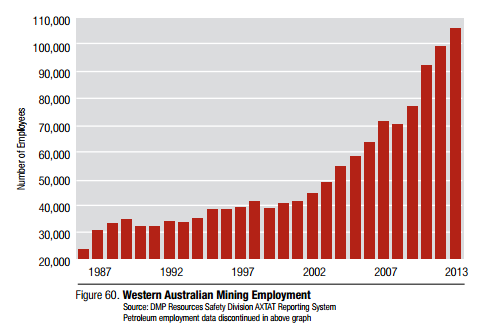
It’s not hard to imagine how. WA for instance has added 30k jobs in mining alone in the past few years:
The WA government needs to be preparing for a rainy day not flexing its fiscal manhood and risking an austerity feedback loop.