

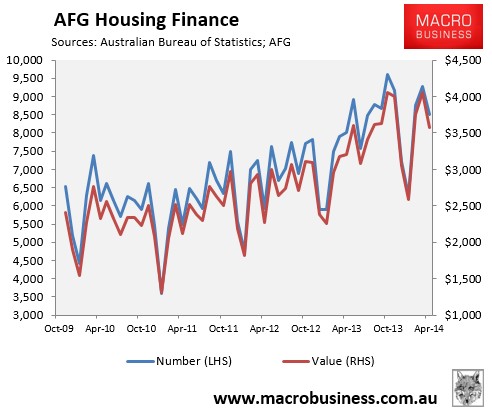
Australian Finance Group (AFG) has released its housing finance data for the month of April, which registered a seasonal 8.1% decline in mortgage applications over the month, but more importantly (since the series isn’t seasonally-adjusted) a 6.4% increase in the number of applications over the year. It was also the Group’s strongest April on record, with 8,517 mortgage applications (valued at $3,574 million) processed over the month (see next chart).
AFG also reported a decline in first home buyer (FHB) mortgage share in April, to 10.1% from 10.7% in March, driven by ongoing paralysis in New South Wales (3% share) and Queensland (5% share).
By contrast, investors continue to drive new mortgage demand, although their share did also fall marginally from 39.6% in March to 39.0% (see next chart).
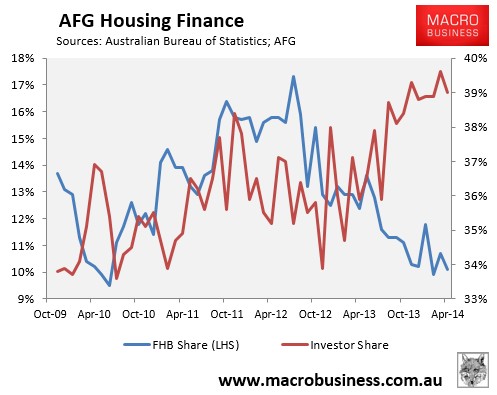
According to AFG, New South Wales continues to be the mecca for investor activity, accounting for a whopping 47% of mortgages in April. However, the proportion of investors in QLD surged last month to comprise 38% of all new home loans processed in the state, up from 32% in March, and in the process overtaking Victoria (37%), South Australia (33%) and Western Australia (32%).
As noted previously, some caution should be exercised in interpreting AFG’s figures and extrapolating its results to the overall mortgage market, as measured by the Australian Bureau of Statistics (ABS).
AFG’s data measures mortgage applications, whereas the ABS measures actual mortgage commitments. According to AFG’s General Manager of Sales & Operations, Mark Hewitt, just over three quarters of applications on average become mortgage commitments, although this figure can obviously fluctuate month-to-month. AFG’s market share has also been rising in recent years.
Therefore, while AFG is a useful guide as to the strength of mortgage demand, its results do not necessarily translate to the overall mortgage market as captured later by the ABS.
To illustrate, consider the below chart showing how the growth of AFG mortgage applications has diverged significantly from ABS mortgage commitments since November 2009:
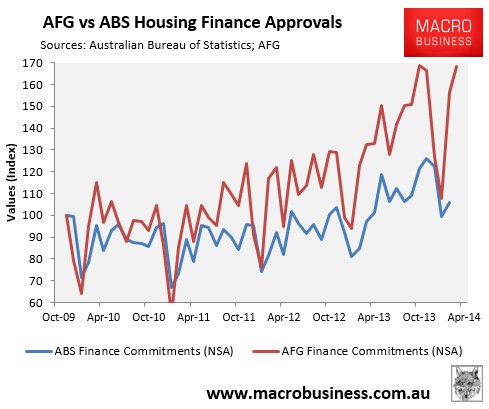
Nevertheless, the AFG data does support the notion that investors are continuing to drive Australia’s housing market.
unconventionaleconomist@hotmail.com
