
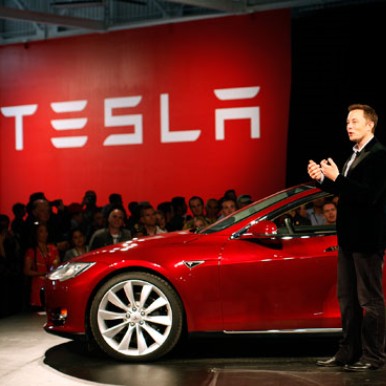
Todd Woody has produced an interesting (but very long) review in Quartz of the current state of play in the next generation car market, where he argues that we should not assume that Tesla (and electric vehicles) will win the race to replace petrol-powered cars:
Forget the Tesla Model S… After decades of development—and no small amount of skepticism—major automakers are set to start selling hydrogen fuel-cell cars in small numbers in the US…
The state of California, meanwhile, is putting up $20 million a year to finance the construction of 100 fueling stations…
Powered by a fuel whose supply is practically inexhaustible – every nation can be the Saudi Arabia of hydrogen – fuel-cell cars convert pressurized hydrogen gas into electricity that powers the vehicle. The hydrogen cars now coming onto the market have triple the range of most battery electric cars and can be refueled in minutes rather than recharged in hours. And hydrogen technology can be scaled up to fuel buses, long-haul trucks and other big vehicles that most current battery packs are too puny to power. “We don’t see any reason customers wouldn’t adopt this technology in exchange for a gasoline vehicle as there’s no trade-offs,” Craig Scott, Toyota’s US national manager of advanced technology vehicles, told Quartz…
No automaker will reveal the production cost of its hydrogen cars, but analysts peg it at between $50,000 and $100,000. Gil Castillo, senior group manager of advanced vehicles for Hyundai in California, says costs have dropped 70% since the Korean company began working on fuel cells in the late 1990s. “I wouldn’t say that they’re at a price where they would equal a regular mid-sized sedan but they’re possibly up there with higher-end electric vehicles,” he told Quartz…
The hard truth, though, is that Tesla may well end up being the biggest rival to hydrogen cars.
In February, Tesla revealed plans to build the world’s largest lithium-ion battery plant—a “gigafactory”—to drive down costs, so its next car, set to debut in 2017, can be cheap enough for the mass market. According to Tesla’s estimates, the gigafactory would allow the company to make 500,000 cars a year. (This year Tesla expects to build only 35,000.)…
While developments in this area are certainly interesting, it is worth pointing out that both electric and fuel-cell cars still rely on conventional sources of energy to generate their sources of power. Accordingly, neither is “emissions free”, as is often claimed.
In the case of fuel cell powered cars, hydrogen still needs to be extracted from other compounds, such as water or methane, which requires consumption of fossil fuels (e.g. coal, nuclear or gas), unless the energy can be sourced from renewables. Ditto electric cars, which require power from the grid.
unconventionaleconomist@hotmail.com
