

The AFR’s James Eyers has written a good article today urging David Murray’s financial system inquiry to recommend ending tax disincentives of deposits which, due to the dearth of deposit funding available, has led banks to borrow too much from offshore, worsening financial stability in the process:
With income from interest receiving the least favourable tax treatment of all asset classes, the Australian Bankers’ Association and Westpac Banking Corp, in a separate submission, will call for the removal of tax disincentives on deposits. Currently, depositors pay the marginal tax rate on interest earned on deposits, while investments in superannuation, property and equity receive tax concessions. But the banks say this could be propagating the dangers to stability as it makes them more reliant on offshore funding markets, which can seize up in times of global market stress…
The funding gap between domestic deposits and the level of bank lending is about $600 billion…[And] this gap may increase as credit growth improves…
Should Murray agree that tax policy should be adjusted to bolster the funding of Australia’s banks, businesses and projects, a challenge will be putting his recommendations persuasively enough to force the government – and the Australian Taxation Office – to support action.
Ending the tax disadvantage on deposits is a worthwhile initiative.
The most glaring anomaly in Australia’s tax system is the way that different forms of saving are treated. Someone that invests $25,000 into a term deposit is taxed at their full marginal rate, whereas if that same person buys a negatively geared property, they receive full tax breaks on their rental losses, and then pay a reduced rate of capital gains tax when the property is eventually sold.
Such anomalies have created over-investment in housing, which has chocked-off productive areas of the economy. The dearth of savings is also one of the reasons why Australia’s banks have such a high reliance on offshore borrowings, which has also driven-up Australia’s net foreign debt (see next chart).
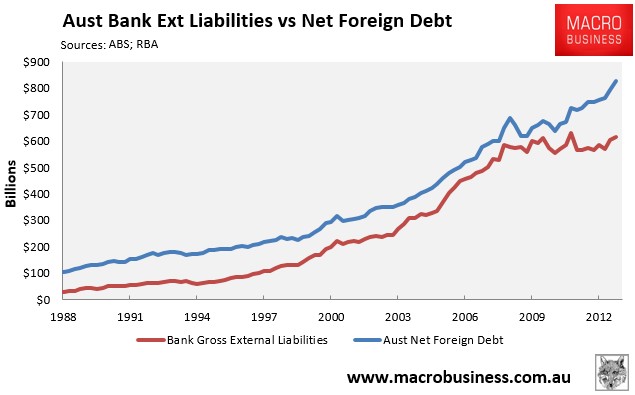
There are also potential financial stability risks in such an approach, since the banks’ ability to refinance their borrowings rests with the willingness of foreign investors to continue to lend them money. When times are rosy, perceived risks are low, and credit is freely available, the banks are able to refinance their foreign borrowings easily and cheaply. But in times of heightened risk-aversion – such as when Lehman Brothers collapsed during the GFC – foreign investors are less inclined to continue extending credit, leaving Australia’s banks, house prices, and broader economy exposed to a sudden liquidity shock.
Indeed, the banks’ reliance on offshore funding has also shifted risks onto Australian taxpayers in the form of: (1) the wholesale funding guarantee implemented in the wake of the GFC; and (2) unprecedented liquidity support from the RBA via the repo market and the committed liquidity facility, neither of which was properly priced. Credit rating agencies have also given Australia’s big four banks a two notch ratings uplift because they believe the Government would support these institutions in a crisis.
The Henry Tax Review recognised some of these issues and recommended to lower taxes on deposits while reducing tax breaks on negatively geared investments by 60%. David Murray and the Government would be wise to revisit Henry’s recommendations.
unconventionaleconomist@hotmail.com
