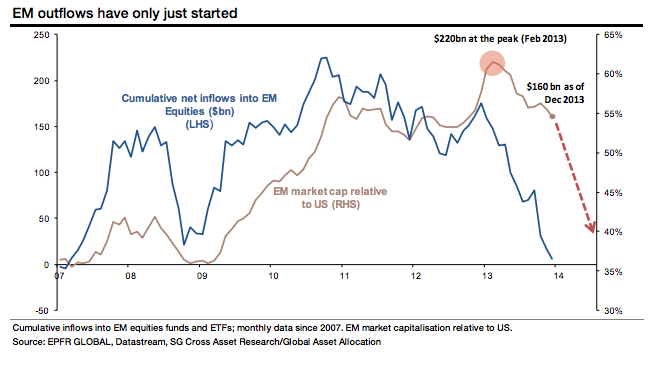
Society Generale via FTAlphaville has a fantastic chart which in a stroke shows the EM crisis has far yet to run:
Since cumulative inflows into EM equity funds reached a peak of $220bn in February last year, $60bn of funds have fled elsewhere. Given the exceptionally strong link between EM equity performance and flows, we think it plausible that funds are currently withdrawing double that from EM equity (see chart below). EM bond funds face a similar fate. For reasons discussed in our latest Multi Asset Snapshot (EM assets still at risk – don’t catch the falling knife), we see no early end to EM asset de-rating. Furthermore, the Fed remains assertive on execution of tapering despite recent turmoil within the EM world, which spells more turbulence ahead.
A close look at Global EM funds indicates that all EM markets are suffering outflows Mutual fund and ETF investors in EMs both favour global EM funds. Regional or country specialisation is less common (less than 47% of global EM assets). The implication is that all EM markets face outflows currently, with little discrimination between the countries that are most exposed and those which are more defensive. We think Balance of Payment issues may emerge as an important factor going forward.
To balance the ledger, also from FTAlphaville comes a bullish take from BNP Paribas:
Advertisement
Obviously, one could argue that more needs to be done but we can’t say we have not seen a policy response. Rate hikes in EM are now either being delivered (and sometimes aggressively so) or priced in as the rates markets have sold off. This could lead to a significant and decisive correction in current account balances, particularly as global commodity prices remain subdued…
While this still feels like catching a falling knife, we can’t help but wonder what else investors would expect from the CBRT, SARB, RBI or even BCB after rates have gone up so much (and, chances are, some of them will rise still further). Particularly in Turkey, the market reaction to a much more decisive move than had been expected appears strange. After all, not only did the central bank return to orthodoxy and hiked rates significantly, it also accepted that its long-held view about how to run monetary policy had to be adjusted.
This is really a semantic game. For me, when EM market central banks are jacking rates at ludicrous speed owing to capital flight then it’s a crisis as growth is going to be crushed. For others that’s just normal going, seemingly.
At the end of the day, there are two basic facts in play:
Advertisement
the capital flight from EMs is reversing the sell-off in the US bond market where yields are now threatening to break to new lows. That will keep US housing bubbling along and the consumer in better shape than I feared a few weeks ago, helping taper to continue until the US is hit either by enough deflation, a big enough equities sell-off, sufficient damage to its export sector, or all three;
second, assuming China continues its rebalancing program, all of these dynamics are going to worsen considerably. Many EMs are very commodity exports focused – South Africa, Brazil, Russia, India, Indonesia etc – and slowing export demand growth will prevent the swift rebalancing in their external accounts that markets will want to see via currency devaluations.
To understand the full effect of these two facts on EMs, we must add the impact of global capital flows which dramatically exaggerate underlying macro economic themes.
Advertisement
The dominant post-GFC capital markets narrative was one of huge demand for commodities as China stimulated fixed asset investment to correct its US export dependence. This combined with a monetary effect from a chronically weak US dollar to drive commodity prices to super cycle highs.
That’s yesterday’s news. The new paradigm is one in which China must slow its building boom to prevent debt-saturation from too many uneconomic fixed asset projects and the US dollar firms as its economy grinds out of crisis, reversing the monetary inflation of commodities as well.
Hot money chased the former narrative largely through piling into emerging markets. This gave them abundant capital, unnaturally low interest rates, domestic booms and Dutch disease as currencies rose. As that same capital now pulls out with accelerating speed, all of those imbalances will correct, hitting growth and pushing out more capital. The virtuous cycle is moving into full reverse.
Advertisement
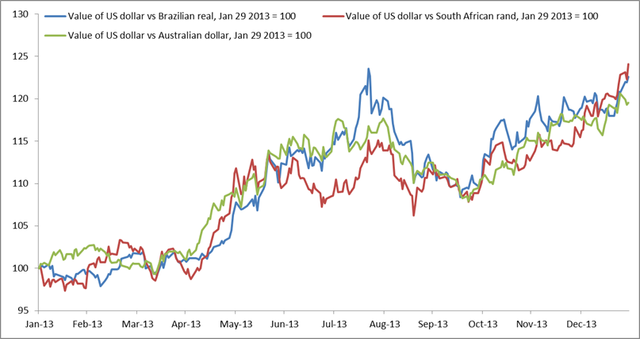
For Australia, the news is good and bad. We are not an emerging market even though our currency is tracking them closely. From Bloomie:
Unless the Chinese slowing gets out of hand I do not see capital flight driving up our interest rates. There has been no widening in the US/Australia 10 year bond spread in recent days, as there has been in EMs, even if our banks are CDS price sensitive.
Advertisement
But the currency is going to keep falling, with the risks shifting to the downside of my 2014 80 cents forecast. But commodity prices (especially iron ore) will fall even faster, so we can look forward to a renewed terms of trade shock with some income mitigation from a falling dollar.
As usually happens at these turning points, consensus is far behind. The Australian dollar rot has set in.
David Llewellyn-Smith is Chief Strategist at the MB Fund and MB Super. David is the founding publisher and editor of MacroBusiness and was the founding publisher and global economy editor of The Diplomat, the Asia Pacific's leading geo-politics and economics portal.
He is also a former gold trader and economic commentator at The Sydney Morning Herald, The Age, the ABC and Business Spectator. He is the co-author of The Great Crash of 2008 with Ross Garnaut and was the editor of the second Garnaut Climate Change Review.