From FTAlphaville comes a new study by BofAML building upon the recent work of the BIS in examining how emerging markets are still vulnerable to a carry trade reversal under the Fed’s taper:
The first one was driven by European banks, financing East Asian capex – that ended in 1997. The second one was global banks and equity-FDI supporting mainly capex in the BRICs. That ended in 2008. This time, it is increasingly non-equity flows: commercial banks and, more importantly, the bond market – undercounted in the BoP and external debt statistics that conventional analysis looks at.
…Even in countries with an external balance, if enough corporates and/or banks play a large enough carry trade, issuing foreign currency debt to invest at home or abroad, this exposes their home government – it is the size of the gross external debt that matters and exposes these carry-trade players to rollover risk…
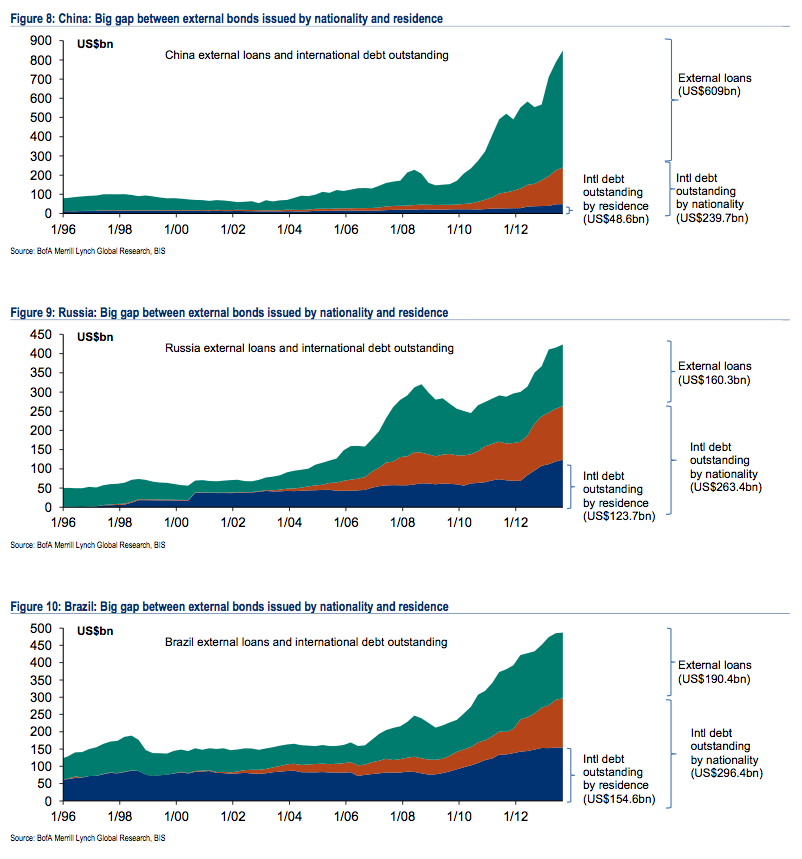
Most standard analysis on the balance of payments recognizes external debt as issued by residence, not by the nationality of the issuer. That is, if an Indian firm borrows USD debt from a foreign bank branch in Mumbai, that is counted in the BoP, but if it raises a USD bond in London, it is not. Given the proliferation of EM banks and corporates borrowing in offshore bond and inter-bank markets, and using BIS data, we rectify for this. It makes a huge difference. For externally-issued bonds, USD1042bn has been raised by the nationality of the EM borrower since 2009, USD724bn by residence of the borrower – a gap of USD318bn, or 44%. This undercount is USD165bn in China, USD100bn in Brazil, and USD62bn in Russia. There is evidence that this bond borrowing overseas by EM non-financial corporates is part of a carry trade, with these corporates acting like financial intermediaries. EM banks have also been busy issuing bonds overseas, a part of this carry trade.
…So, to summarize: the Fed’s QE policy reduced USD interest rates across the curve. This compelled EM borrowers – banks, non-bank financials, and corporates – to engage in a large carry trade, borrowing in foreign currencies at low rates, and re-investing domestically at higher local rates. Of course, they could simply have used the borrowed forex proceeds offshore to make real investments overseas, or to hedge forex receivables. Our experience tells us to be suspect of this innocent use of funds: we believe EM entities execute carry trade opportunities with a ferocity that only becomes clear when the carry reverses.The rise in EM debt issuance correlates well with the rise in EM international reserves, the EM monetary base, and in EM M2 from 3Q2008 to 2013.
Not only does the Fed’s balance sheet matter as a source of funds, but we believe so does the attractiveness of the recipient of the carry trade – and the trust in its collateral.
…If the EM carry trade diminishes as a consequence of a changed Fed policy and/or less attractive risk-adjusted returns in EMs as collateral quality is questioned, the sources of EM forex reserve accumulation will need to change. Perhaps to bigger current account surpluses, more equity FDI and portfolio investment through privatization and more open equity markets. If that does not happen, expanding the EM monetary base might require EM central banks increasing net lending to the financial system and/or monetizing fiscal deficits (this last part has not worked so well in EMs). Potential asset deflation is a risk, as the carry trades diminish/unwind. Property prices are at risk – the collateral value for EM financial systems. This is not a dire projection – it simply seeks to isolate the US QE as a key driver of EM monetary policy and asset inflation, and highlights the magnitudes involved, and the transmission mechanism. Investors should not imbue stock-price movements and property price inflation in EMs with too much EM flavor – this is mainly a US QE-driven story, in our view.
Does the EM-wide story we have told hold for the three EM regions – Asia, EMEA and Latin America? We think so.
And thus, there is no taper without crisis. No that anyone cares at this point but how do you fix it without killing the global economy in the next cycle? Tobin taxes on hot money flows.
David Llewellyn-Smith is Chief Strategist at the MB Fund and MB Super. David is the founding publisher and editor of MacroBusiness and was the founding publisher and global economy editor of The Diplomat, the Asia Pacific's leading geo-politics and economics portal.
He is also a former gold trader and economic commentator at The Sydney Morning Herald, The Age, the ABC and Business Spectator. He is the co-author of The Great Crash of 2008 with Ross Garnaut and was the editor of the second Garnaut Climate Change Review.