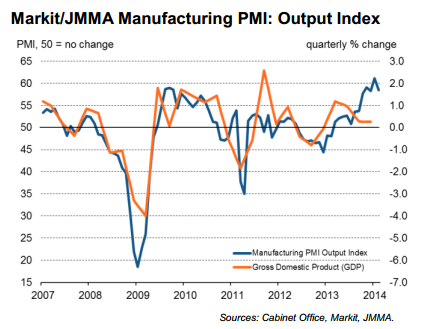
Japan released a raft of data this morning and Abenomics can keep the inflation candle burning a little longer with industrial production rising 4 per cent from the previous month, well above consensus at 2.8 per. Consumer prices excluding fresh food were 1.3 per cent over the year.
February saw business conditions at Japanese manufacturers improve sharply, though the pace of expansion eased from January’s near eight-year high. Both output and new orders increased for the twelfth consecutive month, whilst employment rose at the sharpest pace since February 2007. Inflationary pressures were evident in both input prices and manufacturers’ charges, with the PMI data signalling the fastest increase in output prices since October 2008.
The headline seasonally adjusted Markit/JMMA Purchasing Managers’ Index™ (PMI™) – a composite indicator designed to provide a single-figure snapshot of the performance of the manufacturing economy – posted at 55.5 in February, down marginally from January’s near eight-year high of 56.6. This was the twelfth consecutive month of growth, with the latest reading signalling a sharp improvement of operating conditions in the Japanese manufacturing sector.
The same report indicated potent input cost inflation. Who said currency warfare didn’t work?
David Llewellyn-Smith is Chief Strategist at the MB Fund and MB Super. David is the founding publisher and editor of MacroBusiness and was the founding publisher and global economy editor of The Diplomat, the Asia Pacific's leading geo-politics and economics portal.
He is also a former gold trader and economic commentator at The Sydney Morning Herald, The Age, the ABC and Business Spectator. He is the co-author of The Great Crash of 2008 with Ross Garnaut and was the editor of the second Garnaut Climate Change Review.