

By Martin North, cross-posted from the Digital Finance Analytics Blog.
We continue our series on shadow banking, having outlined previously the size of the market. Today we look at the core financial flows which are at the heart of the system, and look at the repurchasing (repo) market, which is central to the existence of shadow banking. That said, we should again state that shadow banking covers a whole portfolio of entities and activities, not all of which function in the same way.
Here is a summary of the way the shadow baking system works, from the perspective of the cash flows involved.
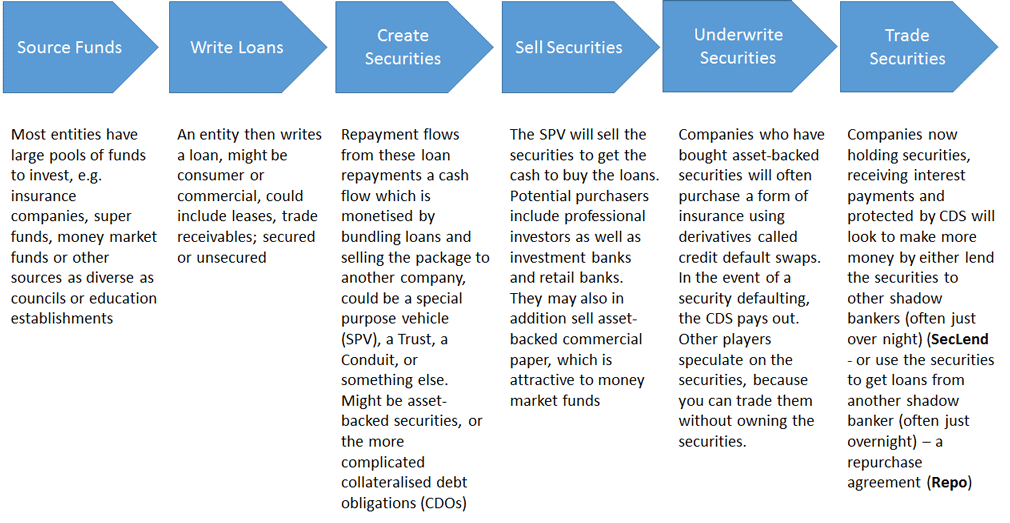 There is a lot to take in here, but it starts with companies who need to make investments use the cash to make loans. These loans are packed up, or securitised, into new financial instruments. They may be enhanced by features like tiered pricing and will often receive a credit rating from an agency, for which they pay. These new instruments, which may be bonds, or something else, are then purchased by banks, and other investors, and they may well protect their investments using derivatives – credit default swaps. These securities are then traded, an investor pays cash to get the security, and this investor can then re-use the same security to get their own repo loan. Actually, the same security can be passed on several times, creating a daisy-chain of interconnected transactions. This is called rehypothecation. Whilst repos are often overnight transactions, they may be renewed each day, but in the chain of transactions, if any one entity failed, the lender simply disappears – overnight!
In a way therefore, the core of shadow banking is the repo market. Before the GFC, the repo market was seen as best place for large players to both lend and borrow. As a result it was not unusual for the US market to see repos to the value of $6 trillion a day being transacted. Players would often get repo loans to pay for securities, CDOs, CDS or commercial paper. In addition, many central banks also operate in the repo market, using it as a mechanism to execute its money market transactions. Securities which are government backed generally are regarded as more secure, so lower risk. Today the range of securities which can be used in the repo sector has been reduced, but bankers in the sector are looking for the next class of security. So in summary,
The main take-outs are that shadow banking is intertwined with normal banking and the financial markets. The daisy-chaining of transactions makes it complicated, and the risks across the system are not easy to pin down.
Next time we will look at the Australian situation.
