The ABC published an interesting article yesterday citing new analysis from the 2011 Census showing that 71% of Australians drive to work, up 0.8% from the 2006 Census:
Of all adult Australians in full-time work or study, more than seven in 10 (71 per cent) primarily use a passenger vehicle to commute, and nearly nine in 10 adults (88 per cent) use a car to get to places other than work.
The study found an 0.8 per cent increase in the number of car commuters compared with five years ago, amounting to 655,939 people daily..
The only three commuting methods to have declined in share are walking (down by 3 per cent), going as a car passenger (down by 0.6 per cent) and going by motorcycle or scooter (down by 0.1 per cent).
One in five train commuters also uses a car for part of their journey, while one in 10 bus passengers did the same.
More than half of Australians (50 per cent) said the reason they did not use public transport was that no service existed or, where it did, the times did not suit their needs…
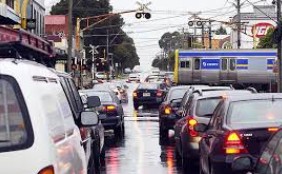
A disproportionate number of Melbournians drive to work – 107,792 more than do in Sydney, even though Sydney has 400,000 more people, the research found.
Advertisement
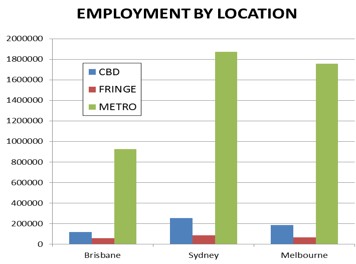
I am not at all surprised by this finding. Early last year, Ross Elliott published research showing that the overwhelming majority of employment in Australia – over 85% – is located in the suburbs of Australia’s major cities. Moreover, the share of jobs in the inner city have fallen in many of Australia’s cities, which might help to explain some of the increase in car commuting:
…despite their profile, our CBDs account for a very small proportion of jobs in the economy. Census data for employment has its limitations but even with these limitations in mind, the evidence is emphatic: employment in our cities is overwhelmingly located in suburban locations…
…what will also come as a surprise is that in the past decade, suburban jobs have been growing as fast or faster than in the inner city, meaning that CBDs are only holding their share, or losing their share, to suburban employment. This has come about despite what has arguably been a decade or two of intensive debate and policy investment into our inner city locations.
In a separate post, Elliott showed that that the small minority of workers (circa 15%) that work in the CBD predominantly use taxpayer-subsidised public transport to commute to work, whereas the overwhelming majority of workers employed in the suburbs are more heavily reliant on private transport:
Advertisement
The very nature of dispersed suburban employment makes public transport uneconomic, which is why only around 5% of suburban workers use it. For CBD workers though, public transport is more widely used because it’s more available and convenient: more than 50% (and more than 60% in Sydney’s case) of CBD workers make use of it.
Elliott’s findings also have adverse distributional impacts, with lower income suburban employees tending to subsidise the transportation costs of higher income inner-city workers:
…given CBD jobs earn the highest incomes and are also more likely to use public transport to get to work, we have a situation where those with the highest paying jobs are enjoying the biggest benefit of publicly subsidised (and heavily subsidised) public transport. You could argue on this evidence that those on lower suburban incomes are subsiding the train and bus fares of their higher paid CBD workforce cousins.
Advertisement
Overall, the Census data challenges the unrealistic policy targets for public transport patronage often adopted by Australia’s state governments, as well as urban consolidation policies aimed at increasing public transport’s share, which tend to have adverse distributional effects. The fact remains that the billions of dollars needed to upgrade public transit systems will only ever be able to serve a small minority of the working population whose jobs are in locations capable of being served by public transport, based on the current distribution of employment and the nature of transport networks.
Further, given the big agglomerations of employment in suburban locations, spread over larger areas than the density found in the inner city, it may instead be the case that further housing growth is needed in the middle and outer suburbs in order to provide additional housing choice for people working in these areas, and in order to reduce average commuting times.
Leith van Onselen is Chief Economist at the MB Fund and MB Super. He is also a co-founder of MacroBusiness.
Leith has previously worked at the Australian Treasury, Victorian Treasury and Goldman Sachs.