

Oxfam have released a new report, entitled Working For the Few, which highlights the extent that inequality is growing across the globe.
According to Oxfam, the world’s richest 85 people own as much wealth as the poorest 50%, with the top 1% holding 65 times the total wealth of the bottom half of the world’s population. Moreover, the richest 1% increased their share of income in 24 out of 26 countries for which Oxfam had data between 1980 and 2012, with the wealthiest 1% in the US capturing 95% of post-financial crisis growth since 2009, whereas the bottom 90% became poorer (see below charts).
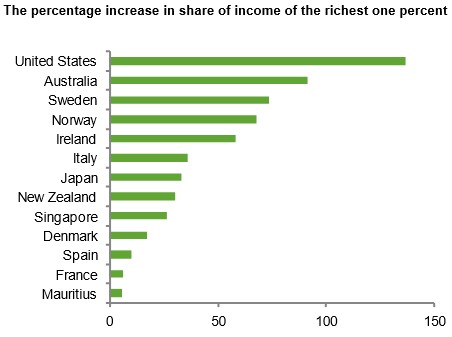
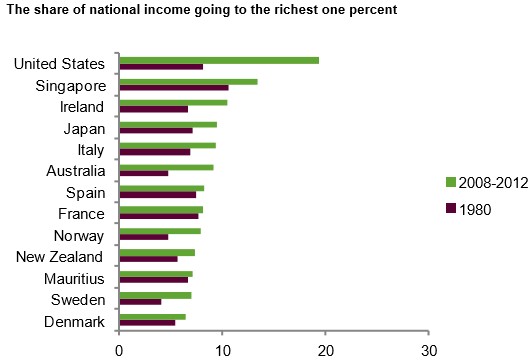
According to Oxfam, the increasing concentration of economic resources in the hands of fewer people presents a major threat to political and economic systems. People are becoming increasingly separated by economic and political power, leading to heightened social tensions and increasing the risk of societal breakdown. Laws are also increasingly favouring the rich, driven by a “power grab” by wealthy elites, who have co-opted the political process to rig the rules of the economic system in their favour:
Extreme economic inequality is damaging and worrying for many reasons: it is morally questionable; it can have negative impacts on economic growth and poverty reduction; and it can multiply social problems…
When wealth captures government policymaking, the rules bend to favor the rich, often to the detriment of everyone else. The consequences include the erosion of democratic governance, the pulling apart of social cohesion, and the vanishing of equal opportunities for all. Unless bold political solutions are instituted to curb the influence of wealth on politics, governments will work for the interests of the rich, while economic and political inequalities continue to rise…
Oxfam is concerned that, left unchecked, the effects are potentially immutable, and will lead to ‘opportunity capture’ – in which the lowest tax rates, the best education, and the best healthcare are claimed by the children of the rich. This creates dynamic and mutually reinforcing cycles of advantage that are transmitted across generations…
Without a concerted effort to tackle inequality, the cascade of privilege and of disadvantage will continue down the generations. We will soon live in a world where equality of opportunity is just a dream. In too many countries economic growth already amounts to little more than a ‘winner takes all’ windfall for the richest.
Oxfam has received support from the Internationally Monetary Fund (IMF), which has also highlighted the threat posed to the global economy by growing income inequality:
…in far too many countries the benefits of growth are being enjoyed by far too few people. This is not a recipe for stability and sustainability,” [Christine Lagarde, managing director of the IMF] told the Financial Times…
Unfortunately for Oxfam and the IMF, inequality is likely to worsen before it gets better. As noted yesterday, improvements in technology and robotics are putting at risk a large number of skilled jobs, which risks further hollowing-out the middle class and increasing returns to owners of capital at the expense of labour.
unconventionaleconomist@hotmail.com
