

By Martin North, cross-posted from the Digital Finance Analytics Blog.
Shadow Banking has become “topic de jour”. There is a need to understand what is really happening, as the snappy tag hides the complexity of the subject. So we will begin a dissection in today’s post. We will start with an international view and in following posts will drill into the Australian situation and then explore some of the implications for the banking system. This may not be an easy read, but the subject warrants careful exploration.
Traditional banking, is simple. Take deposits from people with money who want it kept safe, and lend it to people who need cash, taking a margin or turn. Regulation ensures that (in theory) banks have sufficient funds to repay deposits when needed, holding cash and other capital in liquid assets. In practice some banks were too big to fail, and had too little capital so were bailed out. Since the GFC, banks are now holding more capital to ensure they do not fall over, and work is in hand to identify systemic risks at an country and international level, buttressed by appropriate capital buffers.
Shadow banking is different because these commercial entities will lend money to people who need it, but they will so, not from deposits, but by raising funds on financial markets against various financial instruments, like bonds for example. Many of these entities are perceived as highly innovative, and will venture into deals normal banks would not consider. In the event of a problem, investors will demand the return of their funds, and the commercial entity might crash. There are no regulatory buffers. Data is often hard to find, as discussed here.
Shadow banking creates two risks. The first is regulatory arbitrage. If banks and shadow banks are operating in the same market, regulators who are trying to control finance and credit through bank regulation will find ever more funds flowing across to the unregulated shadow sectors reducing their ability to adjust and manage risks. Second, shadow banking tends to reinforce boom and bust cycles by heightening risk and masking finance structures. This creates greater system-wide risk, which in turn can feedback to the regulated sector. In addition, many of these entities are transnational and in-country regulation will not be effective, reflecting the realities of a more globalised financial system. In the event of failure, these entities may need to be bailed out, or allowed to fail. Sounds like the GFC all over again!
Shadow banks have the potential to disrupt the financial sector and the broader economy, in the event of difficulty or failure. No surprise then for Janet Yellen to say:
“We need to increase the transparency of shadow banking markets so that authorities can monitor for signs of excessive leverage and unstable maturity transformation outside regulated banks.”
So, lets look at the history. Google trends tells us that prior to the GFC, shadow banking never made a news headline, whereas now, it features often. The term is attributed to Paul McCully from PIMCO, at the 2007 meeting of the US Federal Reserve in Jackson Hole.
Post the Financial Crisis of 2007-8, at the G20 Leaders Summit of April 2009, the Financial Stability Forum (FSF) was expanded and re-established as the Financial Stability Board (FSB) with a broadened mandate to promote financial stability. Its mandate is outlined on their web site:
The FSB has been established to coordinate at the international level the work of national financial authorities and international standard setting bodies and to develop and promote the implementation of effective regulatory, supervisory and other financial sector policies. It brings together national authorities responsible for financial stability in significant international financial centres, international financial institutions, sector-specific international groupings of regulators and supervisors, and committees of central bank experts.
A list of institutions represented on the FSB can be found here .
The FSB is chaired by Mark Carney, Governor of the Bank of England. Its Secretariat is located in Basel, Switzerland, and hosted by the Bank for International Settlements.
As part of their work, the FSB has been reporting on Shadow Banking, and its latest update was published in November 2013. I am using some of their material to describe the international scene.
Their definition of the shadow banking system is helpful:
“The shadow banking system can broadly be described as the system of credit intermediation that involves entities and activities fully or partially outside the regular banking system, or non-bank credit intermediation in short”.
Some prefer “market-based financing” as opposed to shadow banking, which has taken on perhaps a pejorative tone, but along with the FSB, we will still use the term. So, shadow banking is at its broadest, covers any credit related activities which fall partly or fully out of the regular banking system – “non-bank credit intermediation” in short. These “other financial intermediaries” (OFI’s) are under the microscope. Actually, the FSB started with the catch all broad definition, but then refined their analysis, concentrating on entities which pose bank-like risks to financial stability. 25 jurisdictions were included in the 2013 report, including Australia. In Australia, non-prudentially regulated institutions include registered financial corporations (RFCs), securitisation vehicles, money market funds and other investment funds.
FSB reported the global growth trend across all finance sectors as follows. The top light blue slice represents the OFI’s.
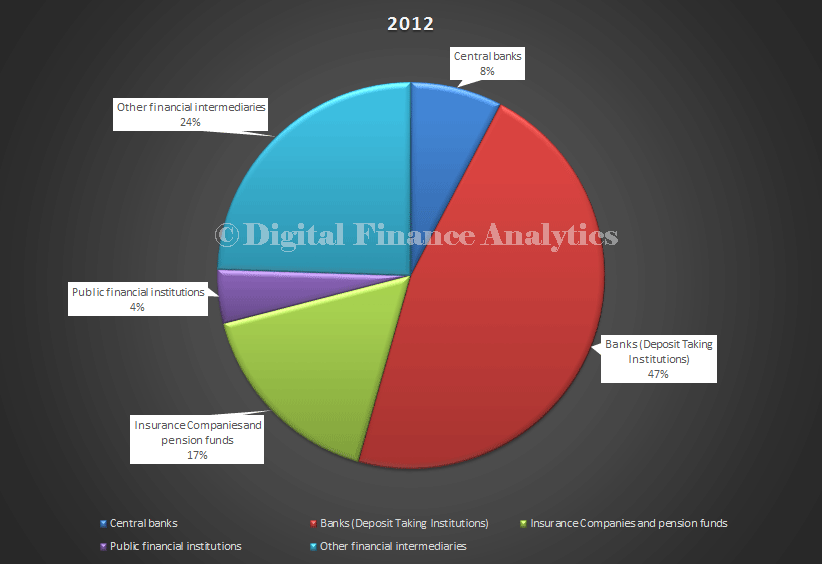
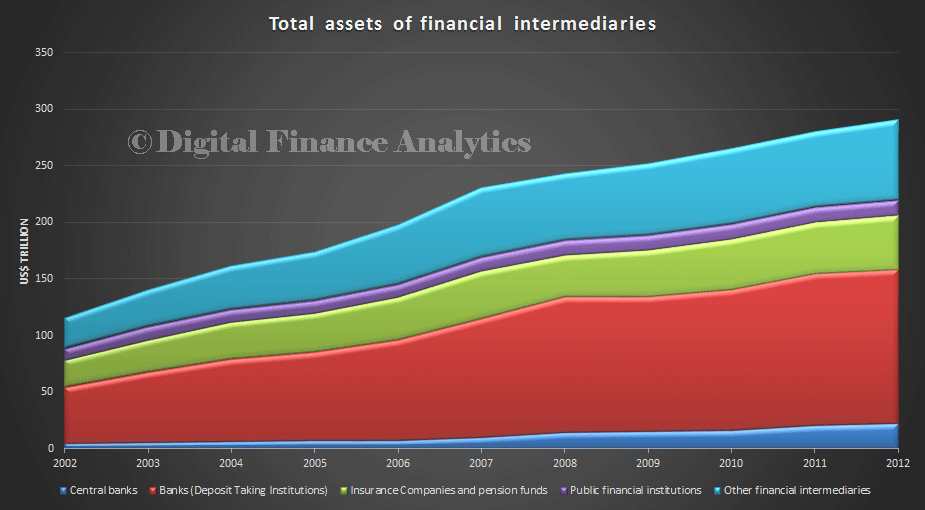 In 2012, around 24% of assets were held by OFI’s in the 25 countries included, compared with 47% in Banks and ADI’s. Despite a dip after the GFC, growth continues so total OFI assets are now in the order of US$70 trillion. (Based on data from 20 countries)
 This is a sizable sector globally, and is not under the same strict supervision as the banks, often being treated more like any other commercial company.
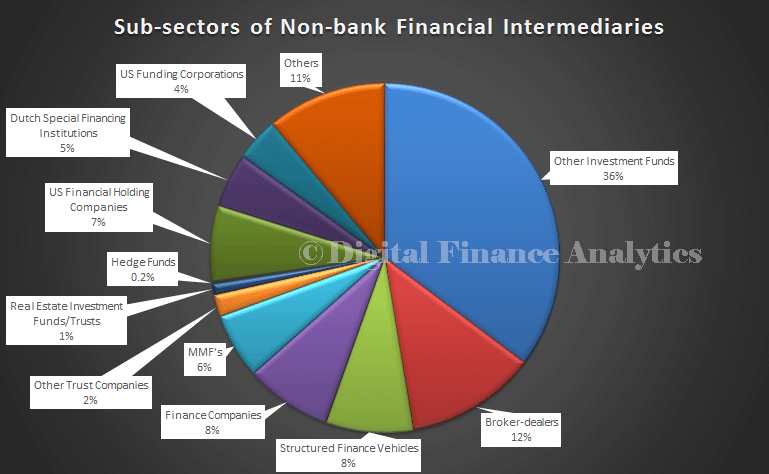
 Getting at the next level detail introduces significant complexity, because not all countries were able to provide the same granular data. Nevertheless, it is possible to split out the main types of non-bank intermediaries for the 25 countries who reported.
 And analysis of the 36% in other investment funds was also split out:
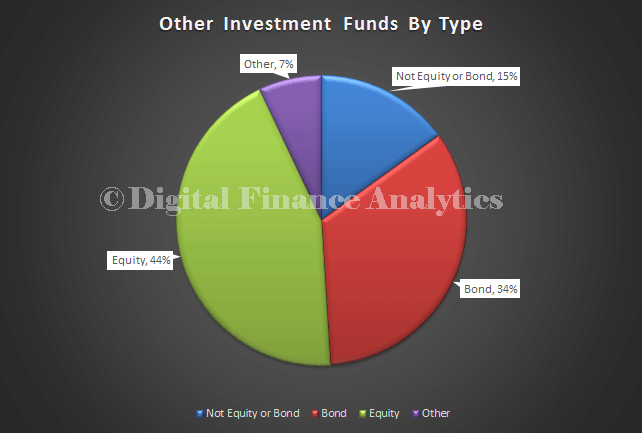 Roughly US$9 trillion of OFI assets were in equity funds, US$7 trillion in fixed income/bond funds, US$7 trillion in broker-dealers, US$5 trillion in structured finance vehicles, US$4.5 trillion in finance companies, and US$4 trillion in Money Market Funds (MMF). Hedge funds appear underweight compared with data in other surveys, because of their off-shore nature. Country specific entities made up the rest.
This analysis highlights the diverse nature of shadow banking entities, and that the mix will vary country by country.
One way to show this variety is to look at the relative situation of each country. We can express this as the relative ratio of banking and OFI assets to GDP. This view adjusts the absolute values by the relative economic size of each country.
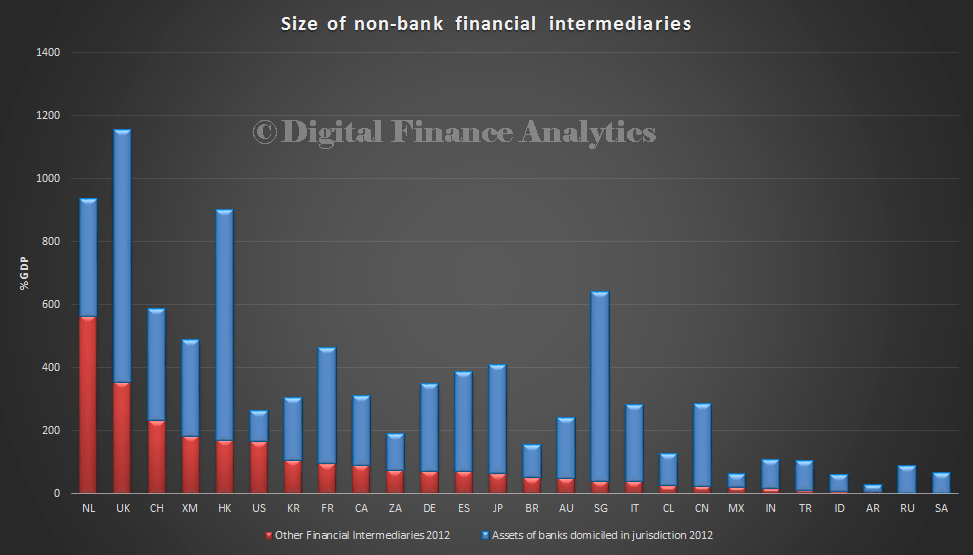 Using the 2012 data, the Netherlands has the highest ratio of OFI, then UK, Switzerland, the Euro area (XM) and US. Australia is fifteenth.
To finish this first post on shadow banking let me hint at some of the issues we will touch on later.
First, not all OFI assets are equally exposed to banking risk, so needs to be adjustment for this.
Second, the OFI’s have taken up the slack as banks, post GFC hunkered down and refused to lend. Lending to SME’s for example is one area where some OFI’s are active.
Third, some argue that a reduction in the size of shadow banking is a good thing, as it reinforces financial stability, whereas others argue the shadow banking is meeting a need which otherwise would not be met by the normal banking system, and a reduction in shadow banking would reduce economic activity and outcomes.
Finally, in Australia OFI’s are shrinking, not growing. Is this a good or bad thing?
More later….
