

These reports will be coming out all month, but already it’s clear what the big idea for 2014 is:The final return to a normal non-crisis environment and the search for growth.
This theme was stated with the most flair by Japanese investment bank Nomura, which titled its 2014 outlook the “End Of The End Of The World.” The idea there is that since 2009, investors have been able to make progress merely by beating back the doomers. Betting against a U.S. financial collapse was a great call. Betting against a Eurozone crash was a great call. Betting against a Chinese hard landing that threatened the whole world was a good call. Betting against a debt ceiling default was the right call.
But the story of 2013 is that all of these fears really did come to an end. Nobody is worried about a big Chinese hard landing or a European collapse. And 2014 might be the first year in a while without some huge fiscal scare if the GOP is smart enough not to go down the same cul de sac it entered into during the “defund Obamacare” fight.
…Morgan Stanley’s outlook for 2014 incorporate similar ideas. They lay out 5 big things that need to happen for sustained global growth, and what’s key is that each pillar is region specific and not crisis related. For example, Europe needs to make progress on a harmonized banking union. China needs to get serious about reforms and a growth model not just based on exports and credit. And the Fed needs transition out of QE to a model more based on guiding interest rates.
But overall the vibe is the same. Investors ought to look at region-specific stories, and not think about the risk of collapse.
Meanwhile, Citi’s top economist Willem Buiter goes so far as to call 2014 a potentially “revolutionary” year for the global economy, precisely because of the end of the age of crisis.
Yet what is revolutionary about 2014 is that the likelihood of severe downside tail events, which could paralyze the global economy, seems to have diminished significantly (though not disappeared). Granted, the euro-area is still work in progress, China presents meaningful question marks, Congressional gridlock in the US could still throw sand in the federal fiscal wheels and geopolitics can always surprise. But, enough progress has been made that all of these issues seem less threatening today than 12 months ago.
Recent data is supportive. Aggregated November PMIs are showing a clear uptrend in global manufacturing activity with a very nice looking head and shoulders bottom in place for the technicians:
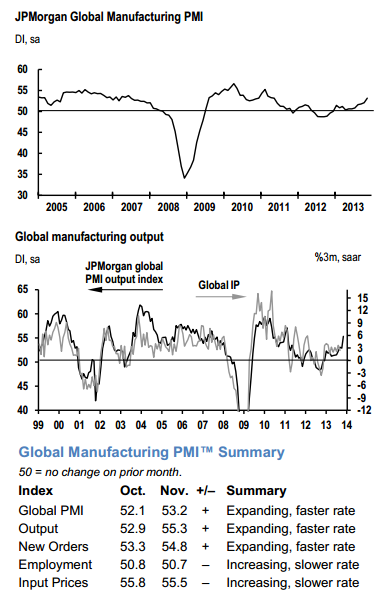
As we’ve been arguing for some months now, Europe is improving across the board as it allows public debt to grow and Germany releases wage inflation. The US is also grinding its way to recovery and North Asia is in the flush of another round of large Chinese stimulus.
I mostly agree, then, that 2014 is a better year in prospect. FTAlphaville has more on what that means for shares:
We came into 2013 saying it was going to be a year of rational exuberance, and so it has proved.
The investment focus is now shifting to 2014. We expect markets to continue to view the political games being played in Washington as noise, and central bank policy action, by definition, as a fundamental signal. A fundamental signal should always trump noise, even when the noise is grating.
With the Federal Reserve on hold for a little longer, the Bank of Japan likely to increase stimulus again next year and the European Central Bank having just cut policy rates, equity markets should be well supported again in 2014.
Equity markets are not cheap, but they are not overextended either. They are running a little ahead of themselves, which markets sometimes do.
Why isn’t this year a replay of 1999? In a word: valuation. In 1999, the forward price/earning multiple on the S&P 500 was in excess of 24 times; currently, it is about 15 times. From a historical perspective, that is roughly fair value.
…The one certainty about next year’s outlook is that investing is going to get more complicated as return expectations need to be reset lower. 2014 is going to test the macro environment to see if the rest of the world wants to play catch-up to US outperformance. Investors need to watch whether budding investor exuberance remains rational. Valuations currently argue it will.
The extraordinary post financial crisis market recovery is not over yet.
Hmmm, well, I don’t think the comparison to 1999 is valid if you add in the policy stimulus in place. The real question is are shares overvalued given interest rates are at zero? It’s not so easy to answer that given you’ve no denominator to work with. Of Two Minds provides a chart that says it all:
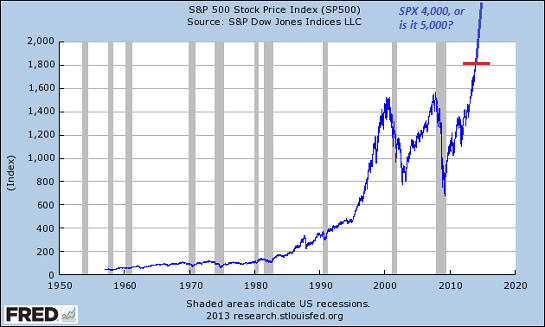
Enough said!
Still, I basically agree with the assessment of the year in prospect. Tapering will be slow and equities are likely to grind higher even as US housing slows and growth disappoints. Indeed, that’s essential for US stocks to keep climbing. Otherwise stimulus will disappear and we will have a denominator against which to measure stock market overvaluation. Europe will keep recovering slowly too.
China, on the other hand, is an open question. Plenum enthusiasm is far ahead of reality. China may have a plan for rebalancing but the basic truths about why and what that means remain the same. Either China rebalances, which will mean it slows further and is very bad for commodities, or it will support its rebalancing with more investment, which means it won’t rebalance, and it will slow dramatically in the medium term as it gets bogged down in the middle income trap. It should still chooser the former, which makes it the key potential party-pooper for next year.
And behind it all, Nouriel Roubini remains absolutely right in saying that the driver of global recovery is, once again, asset bubbles. The utterances of Jeremy Grantham about S&P upside are also worth bearing in mind.
So, it’s not the end of the end of the world so much as it is a return to the build up to the end of the world that we’ve all seen before. 2014 doesn’t look like the year that it will all unwind again but that’s not quite the same thing as the end of tail risks.
As Bill Gross said last night:
“Look for constant policy rates until at least 2016,” in the U.S., Gross said. “Front-end load portfolios. Don’t fight central banks, but be afraid. Global economies and their artificially priced markets are increasingly at risk, but the unwinding may occur gradually.”
Enjoy it but don’t believe it.
