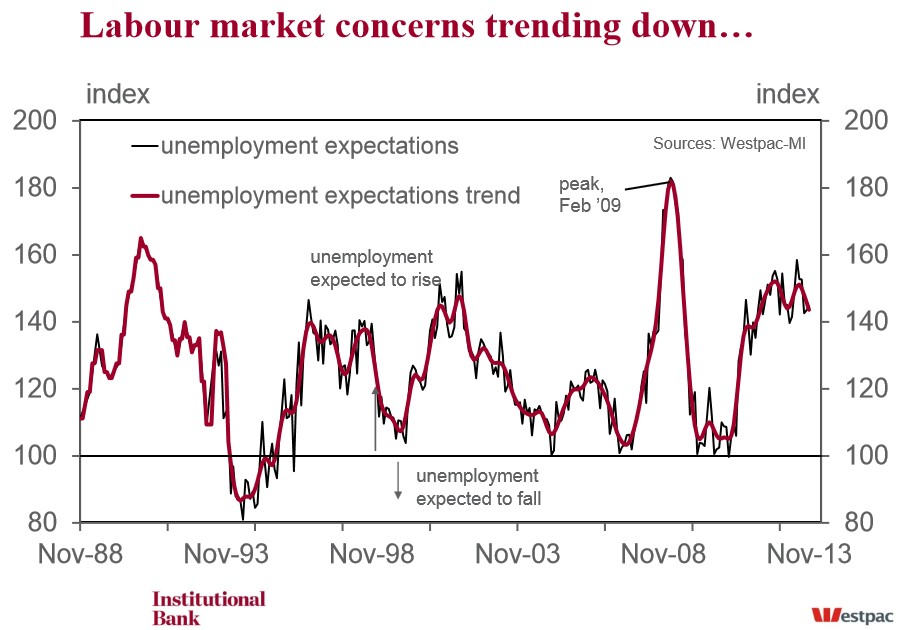
Westpac has released its unemployment expectations survey for November, which rose 0.9% over the month but looks to have peaked:
The unemployment expectations index rose 0.9% in Nov following on from +0.6% in Oct. Given a 10% fall in the preceding three months the last two months are broadly flat. Sep was the largest monthly improvement (a fall in the index suggests consumers are not expecting unemployment to rise as much as they were) since the 6.9% fall in Nov 2012.
This levelling is seen in the turnaround in the annual growth rate of the index. The pace has shifted from +5%yr in Jun, –0.7%yr in Aug –6%yr in Oct then a modest +1.8%yr print in Nov.
The trend also highlights that the index has peaked and is looking for a new direction. The trend index, which is reported as a three month centred average, was flat in Jul, –1.6%mth Oct while it rose just 0.3%mth in Nov.
The index is off its highs suggesting households are not expecting the labour market to worsen any further that they already do.
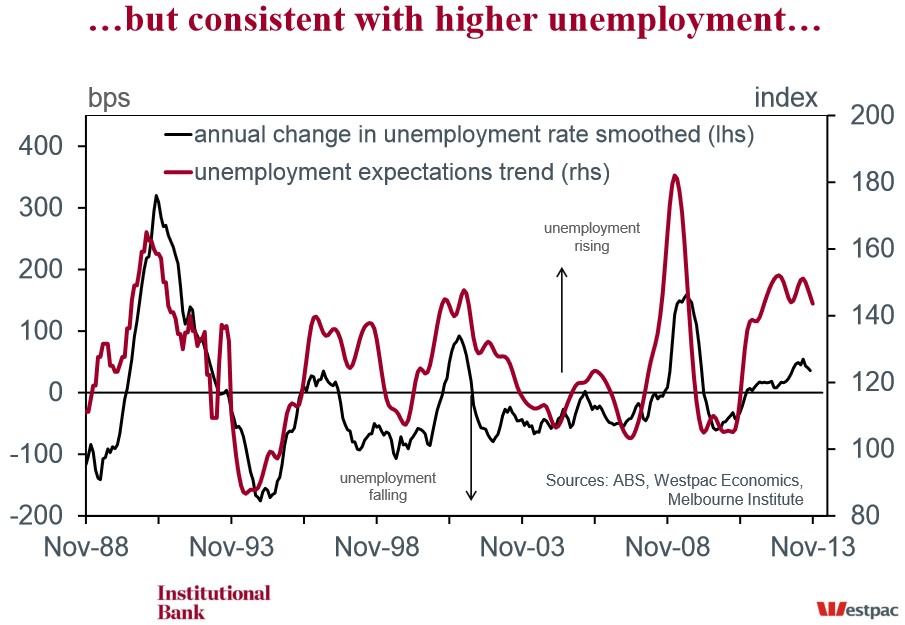
Nevertheless, the trend is still some 14% higher that it long-run average. The index is still pointing to employment growth underperforming relative to population growth. That is, the employment to population ratio is likely to hold at levels, which is below the GFC lows.
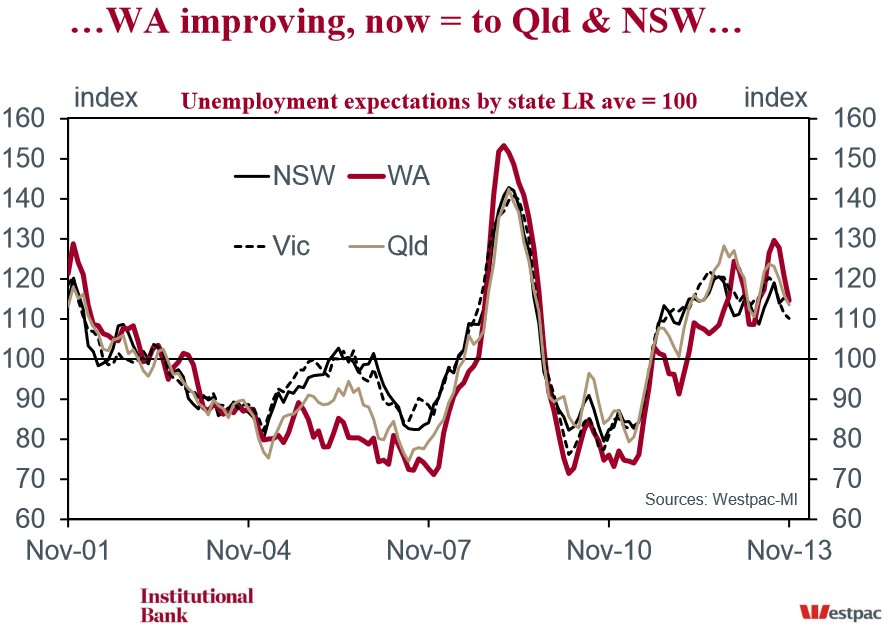
Expectations from the mining states continue to improve with expectations in WA now back on par with Qld and NSW. Surprisingly, Vic has the strongest level of unemployment expectations relative to its long run average.
In NSW, hours worked has outperformed the unemployment expectations index while full-time employment has underperformed. In that state, employers are clearly working their existing employees harder than employing new workers. Qld is not as extreme but also highlight stronger hours worked relative to full-time employment.
Leith van Onselen is Chief Economist at the MB Fund and MB Super. He is also a co-founder of MacroBusiness.
Leith has previously worked at the Australian Treasury, Victorian Treasury and Goldman Sachs.