
Late last year, I warned that the Victorian Government would pursue further austerity measures in a bid to sure-up government finances, but that such moves risk weakening the already fragile economy:
With budget revenues continuing to fall, there is now the risk that the state government will make further cuts to spending and jobs in attempt to return the budget to surplus. Such moves would further weaken the Victorian economy…
Back in May, the Government signalled that it would respond to the revenue squeeze by cutting back on expenditure and infrastructure investment in order to stop the state’s debt from increasing and prevent any downgrading of its AAA credit rating:
Victoria’s new Treasurer, Michael O’Brien, will place retention of the state’s AAA credit rating over his goal announced this week of encouraging more big transport infrastructure with injections of public capital…
“If you massively increase your borrowings you won’t have a triple-A,” Mr O’Brien said. “There’s no point saying ‘we’ve got triple-A, let’s borrow our heads off’ because if you borrow your heads off you won’t keep your triple-A. Plunging us into debt is a self-defeating way of funding infrastructure”…
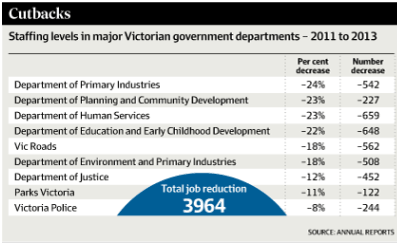
Today, the AFR reports that the Victorian Government has cut around 4,000 public service workers across departments since 2011 as it fought to preserve its AAA-rated budget. The cuts equate to average staff reduction of 15% across the surveyed departments, with the total number of employees falling from around 27,400 to 23,100, saving the Budget an estimated $250 million per year.
And there could be further cuts to come, with ratings agency, Standard and Poors, warning that the Government will need to keep the brake on spending if it is to maintain its AAA credit rating:
Standard & Poor’s credit analyst Anna Hughes said weak revenue growth meant it was vital that government kept the brakes on spending.
“It is very important,” she told The Australian Financial Review.
“In an environment of soft revenues, controlling expenses is particularly important.” Ms Hughes said.
“It is difficult for governments to do that and it really does come down to tough decisions having to be made.”
As noted last time, the Victorian Government’s predicament is symptomatic of what happens when a government becomes overly reliant on pro-cyclical taxes like stamp duties. The booming revenues enjoyed by the former government allowed it to expand the bureaucracy to unsustainable levels and embark on billions of dollars worth of wasteful projects, such as the MYKI public transport ticketing system, the Wonthaggi desalination plant, the HealthSmart project, amongst others. And after the stamp duty and GST rivers of gold stopped flowing, the current Government was left with a budgetary black hole, which it had to fill via cuts to expenditure and/or public sector jobs, or risk downgrading from the ratings agencies.
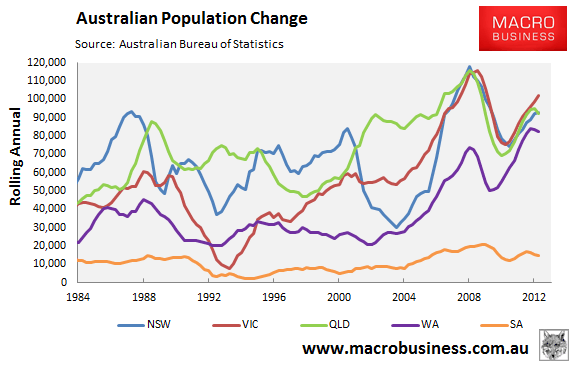
With Victoria’s population growing the fastest of any state in numbers terms (see next chart), its citizens now also face declining living standards as existing infrastructure pushes up on capacity constraints, which the Government now seems unwilling to ease via new investment.
The situation in Victoria is also being played out to varying degrees around the nation at both the state and federal levels.
unconventionaleconomist@hotmail.com
