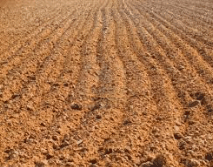
We’ve had peak oil, peak coal, peak demographics, and now it seems we have peak soil. An interesting new article in The Week explains how modern farming practices are depleting minerals from our food and making it less nutritious:
Concerns about the quality of our food tend to focus on the many evils of modern industrial farming, but 10,000 years of agriculture have created a more insidious problem. The minerals and phytonutrients historically derived from rich soil are diminishing in our produce and meat. It takes 500 years for nature to build two centimeters of living soil and only seconds for us to destroy it. While pesticides, chemical-rich fertilizers, and agro-tech exacerbate the problem, even natural gardening can leach soil of vital minerals. When the same land is constantly re-cultivated without replenishing phytonutrients it yields more disappointing and nutrient-deficient crops.
Importantly, this depletion of important nutrients is raising the risk of developing all kinds of cancers, cardiovascular disease, diabetes and dementia. At the same time, excessive agricultural activity is reducing the amount of productive land, making soil a rapidly depleting resource just like fossil fuels:
Over the past 40 years, about two billion hectares of soil — equivalent to 15 percent of the Earth’s land area (an area larger than the United States and Mexico combined) — have been degraded through human activities, and about 30 percent of the world’s cropland have become unproductive. But it takes on average a whole century just to generate a single millimetre of topsoil lost to erosion. Soil is therefore, effectively, a non-renewable but rapidly depleting resource.
The key solution, according to the article, is “re-mineralization” – a process whereby growers replace minerals lost through farming and, in the process, dramatically improve the quality of produce. However, the solution does not come cheap:
The process is relatively simple in concept. Through soil-testing, farmers can determine which minerals are deficient and regularly reintroduce them into their farmland. But the economics of it are quite challenging. At current food prices, artificially reduced by government subsides, the cost of remineralization could put many commercial farmers out of business.
Take phosphorus, for example. Vegetables and fruits grown in phosphorus-abundant soil have less starch and sugar, and feature higher concentrations of other important minerals and nutrients. Yet, the nutrient-rich produce looks the same as if it had been grown in phosphorus-deficient soil, making it difficult for consumers to rally behind the cause. Getting a critical mass of consumers is especially important because the cost of reintroducing a healthy supply of phosporus into just an acre of soil is about $10,000.
And therin lies the problem. How do you get consumers, farmers and government to rally to the cause, especially when nutrient rich foods are indistinguishable from their inferior cousins? As the article concludes: “Unfortunately, saving dirt just isn’t a very sexy issue.”