

For three years I have warned that the retirement of the large baby boomer generation – a cohort that represents around 25% of Australia’s population but holds roughly half of the nation’s housing and financial assets – would eventually pose stiff headwinds for asset values, since many boomers would look to divest their asset holdings in order to fund their retirements – a process that would place downward pressure on valuations.
Indeed, a Bank for International Settlements (BIS) Working Paper, published in 2010, agreed with this view, estimating that the ageing of the baby boomers is projected to reduce Australia’s real house price growth by around 30% in real terms over the next 40 years compared to neutral demographics (see below chart). The BIS also expects ageing to have a similar impact on the value of financial assets.
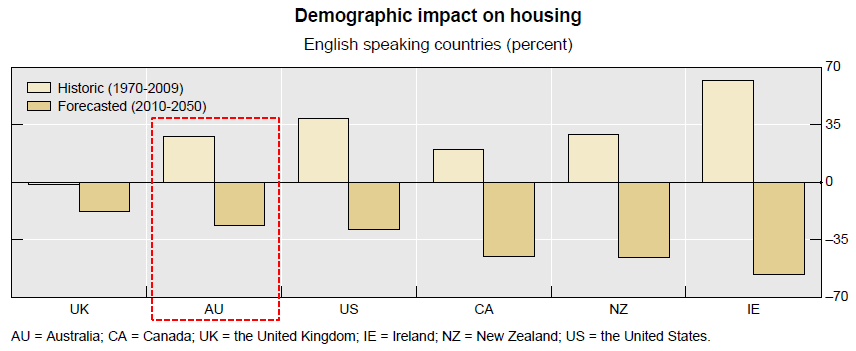
An article published in the Weekend AFR supports this notion, claiming that nearly 40% of baby boomers are planning to downsize, potentially flooding the nation with some $500 billion worth of property – equivalent to roughly 11% of the total housing stock:
…the sky-high price expectations of a generation whose wealth was swelled by surging property prices might be disappointed because of their successors’ inability to pay their asking prices…
George Boubouras, chief investment officer of Equity Trustees, a funds management group, says a 13-year housing credit binge through to 2007, which ended with the onset of the global financial crisis, enriched house-owning boomers but closed the door on many trying to get into the market…
“This mix of credit boom from the 1990s, ageing demographics of those who got into housing stock early, credit competition leading to a lending boom and higher loan-to-value ratios for the new generation make it difficult to create a natural new set of buyers,” says Boubouras about the high prices and even higher seller expectations…
The boomers’ luck at having been born at the right time to enjoy record property growth has been at the expense of their children and grandchildren, many of whom will postpone their parents’ move because they can’t afford to leave the family home…
Tony Crabb, national head of research for Savills Australia, says the way boomers selling into the market will play out will also be influenced by when and if they also begin selling their investment and holiday houses…
“Sales volumes are going to be large. You want to be the first – and not the last – one out because there are going to be more buyers at the start than the end.”
It probably wouldn’t be drawing too long a bow to suggest that the current surge in investor demand for property is being driven by younger boomers – i.e. those aged in their late 40s to mid-50s – who are significantly larger in size than their older boomer cohorts and likely scrambling to accumulate assets for their retirement.
As such, the great baby boomer sell-down will likely commence late this decade as the lion’s share of boomers have entered retirement – rather than just the tip of the iceberg, as is currently the case.
Of course, Australia is not the only nation where retiring baby boomers are likely to present headwinds for growth and asset prices – most developed nations (and particularly those in the Anglosphere) are in a similar position. Indeed, legendary fund manager, Stanley Druckenmiller, is even predicting that the retirement of the boomers will cause a financial meltdown worse than the Global Financial Crisis, as the economy chokes on mushrooming old age-related entitlement spending:
Druckenmiller, 59, said the mushrooming costs of Social Security, Medicare and Medicaid, with unfunded liabilities as high as $211 trillion, will bankrupt the nation’s youth and pose a much greater danger than the country’s $16 trillion of debt currently being debated in Congress…
Druckenmiller said unsustainable spending will eventually result in a crisis worse than the financial meltdown of 2008, when $29 trillion was erased from global equity markets.
Nobody knows exactly how the retirement of the baby boomers will play-out for asset markets. All we know is that the huge demographic tailwinds that were present for the economy and asset prices in the 30 or so years to 2010 are shifting into headwinds, and their effect will be negative on growth and asset prices from some point in the near future.
unconventionaleconomist@hotmail.com
