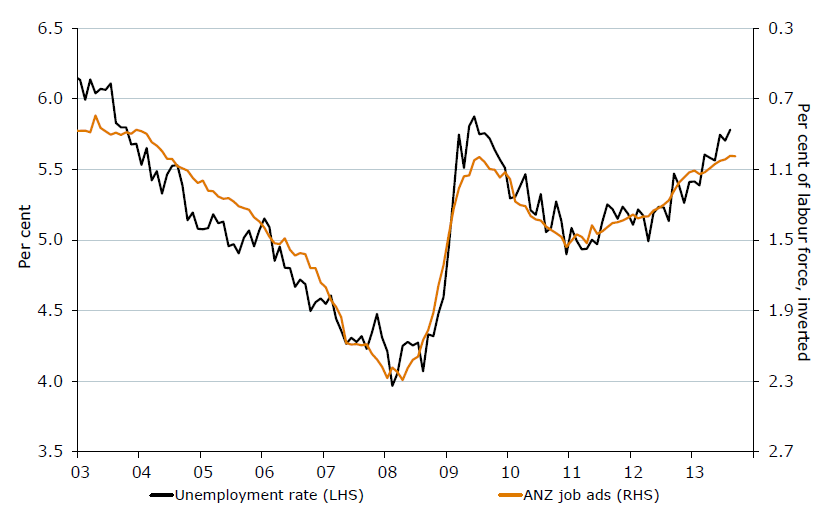
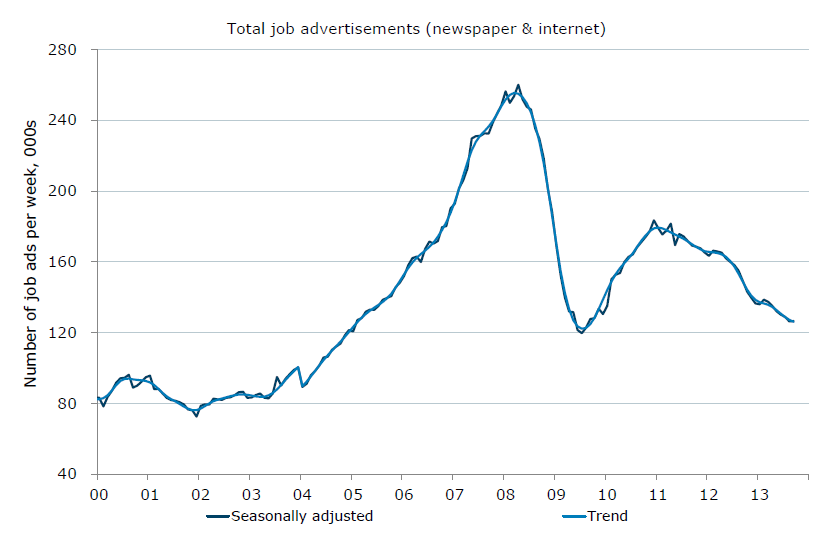
Job advertisements rose 0.2% m/m in September, effectively unchanged, but technically the first monthly increase since February. While job ads had fallen for six consecutive months, the pace of monthly decline appears to have moderated in recent months.
The level of job advertising remains quite low. In September, job ads were 15% below year-ago levels and only 6% above the lowest level reached during the Global Financial Crisis.
Newspaper job advertisements rose 1.1% m/m in September, a relatively sharper increase than internet job advertisements which rose 0.2% m/m in the month. However, because newspaper job ads make up less than 5% of overall job ads, this did not significantly impact the overall outcome for September.
In trend terms, job advertising has shown tentative signs of improvement in some states and territories. Together with trends in SEEK and DEEWR’s measures of labour demand, job ads in New South Wales, South Australia, Tasmania and the Northern Territory appear to be basing. Job ads in Western Australia, Victoria, Queensland and the ACT continue to fall.
A recent RBA Bulletin article looked at key labour market indicators and their relationship with employment growth. The RBA’s research found that the quarterly change in ANZ job ads has a stronger correlation with quarterly employment growth in the period from 2000 to Q2 2013 than other measures of labour demand.
ANZ’S AUSTRALIAN CHIEF ECONOMIST IVAN COLHOUN SAID:
Trends in job advertising appear to be stabilising. Along with a number of other leading indicators of the labour market, the rate of deterioration in ANZ job ads has moderated in recent months, with job advertising showing signs of improvement in a number of states and territories. This is consistent with ANZ’s view that much of the rise in the unemployment rate may have already occurred and that it is likely to drift only modestly higher.
The stabilisation in job advertising in September is consistent with other indicators of an improvement in consumer and business confidence in the weeks leading up to and immediately following the September Federal election. It will be important for these trends to be sustained in the months ahead.
The housing market has been one of the brighter spots in the economy this year, supported by low interest rates. While activity in the housing market has continued to improve, there are now tentative signs that activity in some other sectors is beginning to pick up. Surveyed measures of services and manufacturing businesses point to an improvement in conditions in these sectors in September. Overall business and consumer confidence have also increased recently but much of this is likely to have been due to the prospect of a change in Government at the Federal election and it is not clear whether the improvements will be sustained. There has been little evidence of a pick-up in growth in retail spending at this stage.
The path of the Australian dollar and the forecast sharp contraction in mining investment in 2014 remain the headwinds to Australia’s economic outlook. But with housing strengthening, the global economy improving and stimulatory monetary policy in place, the prospects of a successful transition from mining investment-led growth to a broader growth base have improved.
As always, ANZ will continue to monitor trends in job ads extremely closely. Three successive monthly increases in job advertising have been a reliable indicator of a forthcoming trend change for both the unemployment rate and interest rates.
On Thursday, the ABS releases the September labour market report. ANZ expects that around 15,000 new jobs were created in September, following two consecutive monthly declines. The unemployment rate is expected to have remained at 5.8%.
We appear to be entering a little cyclical bounce on housing and the election so it will be no surprise to see some leveling off in recent job ads falls. Whether we’ll get any material growth is doubtful.
David Llewellyn-Smith is Chief Strategist at the MB Fund and MB Super. David is the founding publisher and editor of MacroBusiness and was the founding publisher and global economy editor of The Diplomat, the Asia Pacific’s leading geo-politics and economics portal.
He is also a former gold trader and economic commentator at The Sydney Morning Herald, The Age, the ABC and Business Spectator. He is the co-author of The Great Crash of 2008 with Ross Garnaut and was the editor of the second Garnaut Climate Change Review.