
Syria remains very much in the news and is likely to weigh on markets in the next few weeks. However it is becoming clear that the prospect of military action is limited and any blow back will probably also be minimal.
A series of posts from the Lowy Interpreter makes the point.
Rodger Shanahan argued that a missile attack of limited scope would be President Obama’s ‘least worse option’:
For a president who has made the ending of two wars his signature foreign policy achievements, Obama has been disinclined to engage in another, even in the face of loud and partisan calls for action. A limited missile attack would fit well with President Obama’s desire to avoid decisive military engagement in Syria while not ignoring the use of chemical weapons. It would be punitive without being decisive, it wouldn’t materially assist the armed opposition, it wouldn’t require the type of force buildup or supporting attacks against air defences needed for a sustained air campaign, it would give some substance to his ‘red line’ and it would allow a response to be graduated if more CW attacks were carried out.
Rod Barton, a former UN weapons inspector in Iraq, gave us an excellent insight into the ‘who, what and why’ of the recent chemical weapon attack in the Damascus suburbs:
Some have compared the recent attack in Ghouta with Saddam Hussein’s gassing of the Kurdish town of Halabja in 1988, when hundreds of villagers died probably from the nerve gas Sarin. The purpose of that attack was, as part of a wider campaign against a difficult and stubborn opposition, to terrorise and demoralise. The comparison may be appropriate. If the Assad regime used chemicals against the rebel army and their supporters it is probably for a similar reason.
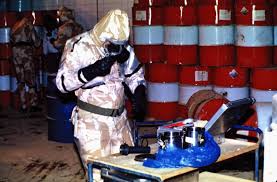
Chemicals also have an advantage in an urban environment in that under certain conditions they can be far more effective than high explosives, as bricks and mortar provide no real shelter against gas. It is with good reason that chemical weapons are classed as Weapons of Mass Destruction.
On Tuesday, Professor Tim Dunne of the Queensland looked at the role of international law in a possible intervention in Syria:
The case for military strikes must be predicated on conclusive proof that it was the Assad Government which launched the weapons that killed hundreds of civilians. Being sure of the case is the first rule of fighting a just war. It is a test the US and its allies miserably failed in the Iraq war.
Reliable evidence is a necessary but not sufficient condition for a military response. Other conditions include having a humanitarian motive for the action; retribution alone will not do. Neither will it be justifiable to target the regime’s military assets if this poses an unacceptable risk to civilians.
Even if these conditions are satisfied, the use of force will be unacceptable unless it is justifiable under international law. Again, the Iraq war casts a long shadow over current debates. Back in 2003, the US and its ‘coalition of the willing’ fought a war of regime change without UN Security Council backing and without an adequate legal justification. George W Bush believed he only need Congressional permission.
From New York Denis Fitzgerald wrote on both the limited prospects for Council agreement on Syria and the other challenges the Australian presidency will face in September:
The last time Australia presided over the Security Council was in November 1985. Then too, the Council was divided and a resolution calling for sanctions against South Africa over its occupation of Namibia was defeated by a double veto from Britain and the US, while France abstained.
After the vote, Ambassador Richard Woolcott told the Council that Australia had worked with others to produce a text that would have sent ‘a clear unambiguous signal to South Africa’ and regretted ‘that it was not possible to achieve it this time.’
Ambassador Quinlan may well find himself echoing those words with regard to Syria should a vote take place under Australia’s presidency this time around.
So, the US will not seek to get approval from the UN. Over the weekend Obama instead turned for permission to the US Congress, which he will likely get in my view, though it will take two weeks to be delivered.
When it happens, expect military action to be very limited. The scope of the action is clearly aimed at neither effecting regime change nor changing the course of the war itself. It is designed to reinforce the international norm (and law) that weapons of mass destruction is illegal among the community of nations. That is, action will be punitive in nature and you can expect it target only those Syrian capabilities that support such usage. Likely targets include a chemical weapons factory or two and perhaps associated command and control assets.
There really little Syria can do in response without worsening its position. Although in war irrational decisions are quite possible, there is little be gained for Syria in escalating the conflict. It will likely respond with a propaganda assault at worst.
For markets this will be a persistent headwind that will keep the oil price bubbling (without going much higher I suspect) and exacerbate the effects of the taper, if it happens, or hold back the rally if it doesn’t.
