JPMorgan economist Ben Jarman has a note out that takes a new perspective on the Australian growth headwinds we’ve described at MB for two years:
The Australian economy will face significant growth challenges over the next couple of years as the mining investment boom tapers off. The question is, how significant will these challenges be? Articulating this in our forecasts has been difficult, because investment is part of the expenditure breakdown of GDP, which has been running much hotter than the other GDP measures. Therefore, while we talk about mining capex having contributed up to 2%-pts to growth last year, both this number, and the expenditure aggregate that comes with it, may be overstated. If so, the underlying drag on the economy as mining activity tapers off, while large, should not be disastrous.
Additionally, our forecasts for growth this year and next assume a very large contribution from net exports (2.1%-pts in 2013 and 1.5%-pts in 2014, table), with a sharp pull-back in imports of capital goods as mining capex activity winds up,
and with a falling AUD tempering consumption imports. This might look like an unrealistic way to achieve our forecast of sub-trend, but still respectable, 2.4% growth. Much of that perception, though, is due to the lens of expenditure GDP. In making sense of what is going on underneath these numbers, we find it is helpful to instead take the production perspective.
What is going on with the GDP measures?
The official GDP measure is the average of three different perspectives: expenditure, income, and production. Conceptually the accounting ensures that these measures should all yield identical numbers. However, noise, timing effects, and measurement difficulties conspire to make them differ. In recent history the expenditure measure, which counts dollars spent on final goods and services produced domestically, has shown the most volatility in growth. Also, since the financial crisis (measured from 4Q08), this measure has shown the strongest growth, averaging 2.7%oya compared with 2.3%oya for production. In 2012, the difference was particularly stark, with the expenditure measure posting 4.6% growth, against 3.0% on production, and 3.5% on official (average) GDP. Further, the gap between the expenditure and official measures of growth in 2012 was the largest in 20 years (chart). If expenditure GDP has been overstating growth, the impact on the real economy as investment tapers off will not be as significant as suggested by the change in the %-pt contribution to expenditure GDP.
Distortions statistical, but still real
So what is driving this divergence in measures? Our sense is that it is the difficulty associated with calculating, then netting out the real value of spending on imports in recent years. Over the life of the decade-long terms of trade boom, and more so since the global financial crisis, the economy has been characterized by very high export prices, very high currency, and rising import shares in consumption and investment.
The century-high terms of trade was a national income windfall, and the high currency that came with it ensured that more real goods could be purchased, through imports, with the same A$ value of export revenue. Growth in production of real exports has not been that strong, but the terms of trade and currency effects allowed standards of living to outperform production fundamentals, with the windfall spent on imported items, which, of course, are not produced domestically.
If real imports were counted perfectly, this mix of activity would still be captured identically across the GDP measures. However, if some imports are missed (there are issues in defining the imported component of large and elaborately transformed mining equipment, for example), or if the currency- driven deflation in imported capital and consumer goods has been imperfectly captured (the statistics bureau needs to control for quality changes in calculating effective
price changes), then real spending on imports will be understated.
The expenditure measure of GDP will capture the final spending, but not deduct enough imports, which will bias the expenditure measure higher relative to what was truly produced domestically. The production measure of GDP, which measures final output by industry, does not need to explicitly count imports, so is less vulnerable to this issue.
Production more stable, and more reliable
The production measure of GDP growth has shown less volatility than the others, but that alone does not mean we
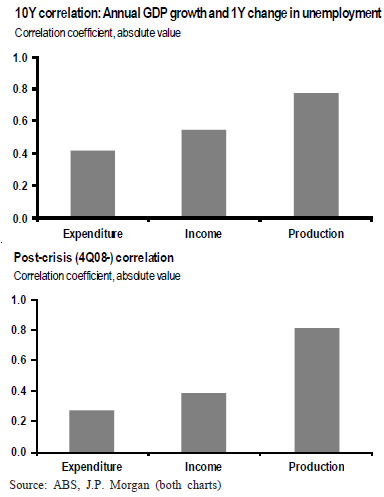
should trust it. After all, the economy may have really been enduring wild swings in activity, with the production measure just not precise enough to capture it. But there is a strong reason for us to suspect that production is capturing the real story, with the expenditure measure overstating growth in 2012: the production measure best explains labour market outcomes. We calculate the correlation of annual growth in each of the GDP measures with the one-year
change in the unemployment rate. We do this over the last 10 years, and for the period since the financial crisis. Over
both periods, the production measure has a superior correlation with labor market outcomes (charts). This
outperformance is even more pronounced since 4Q08, which is when the imports really stepped up. Over both periods,
the correlation in the production measure is a compelling -0.8 (we have taken absolute values in the charts1), but
the correlations are significantly lower in the other two, and have weakened since the global financial crisis. The production measure works well in explaining labor market outcomes since its relative stability matches the observed stability of the unemployment rate.
But production is less fun than expenditure
Just as the strength in the expenditure measure of GDP seems to stem from the unusual structure of economic activity, its convergence back to production fundamentals also has important implications. The economy is exiting a period in which real total domestic spending (i.e., before deducting imports) ran well above real domestic production, with the gap funded by the increase in purchasing power that came with a rising currency and export prices. Productivity outcomes were not particularly influential to standards of living.
As the terms of trade fall, though, increases in households’ real income will have to be driven by production fundamentals, so will be harder-won.
If the lower, production GDP starting point is the “right” one, the drag from mining is not as perilous for the economy. This explains why, in our forecasts, the economy slips to below trend, but nothing worse. The production breakdown of GDP suggests mining, including exploration and support services, added 1%-pt to growth in 2012, less than the 2%-pts for business investment on the expenditure side. Still, these outcomes likely will need to come with further productivity gains, and lower labor utilization than the economy has been used to. With the free lunch from the terms of trade boom over, we expect the labor market to remain under pressure due to weaker profit margins, and the sorry state of household and business sentiment regarding the difficult state of the economy. This keeps the bias firmly toward a lower cash rate, even with growth tracking only a little below trend.
In effect, Jarman is describing an economy that grows but feels like it’s going backwards as standards of living consolidate. Especially difficult for a population with high expectations. As the terms of trade comes off and our incomes flat line or fall, we will need to let what we produce catch up to what we spend over a long period. This is not an environment in which asset prices should be, or can, sustainably rise, though that doesn’t mean expectations won’t cause crazy booms and busts as the imbalances are worked through.
David Llewellyn-Smith is Chief Strategist at the MB Fund and MB Super. David is the founding publisher and editor of MacroBusiness and was the founding publisher and global economy editor of The Diplomat, the Asia Pacific's leading geo-politics and economics portal.
He is also a former gold trader and economic commentator at The Sydney Morning Herald, The Age, the ABC and Business Spectator. He is the co-author of The Great Crash of 2008 with Ross Garnaut and was the editor of the second Garnaut Climate Change Review.